Cats Herd You

Laugh. Learn. Love cats.

  • Home
  • Safety
  • Wellness
  • Rescue
  • Reviews
  • Life With Cats
  • About
  • Media Friendly
  • Contact
You are here: Home / Archives for Pierre

Positive Reinforcement

We all get positive reinforcement different ways. For Newton, positive reinforcement is time with the wand toy.

orange tabby cat plays with feather wand toy

For Pierre, positive reinforcement is being allowed to help make the bed.

gray tabby cat rolls on unmade bed

And for Ashton, positive reinforcement is definitely chicken.

one-eyed tabby cat and dancing solar chickenNot THAT kind of chicken!

Giving Positive Reinforcement to Your Favorite Pet Bloggers

Wouldn’t it be awesome to be able to do something a little extra for the pet bloggers you enjoy reading every day? You may not be able to give Ashton a treat, but you can do something for your favorite bloggers by nominating them for the Nose-to-Nose Awards.

The Nose-to-Nose awards are really treasured in pet social media because they are awarded by a panel of judges who look at the quality of the content nominated. No one is going to ask you to stuff the ballot box for them for these awards, because they aren’t a popularity contest. They reward quality.

Can you think of a blogger who made you laugh, made you cry, or made you think? Maybe you want to nominate them for an award.

We have already started to nominate some of the bloggers whose worked moved us this past year, and there’s still time to nominate others before nominations close April 11.

What to Do

When you think of a blogger you want to nominate, go to the BlogPaws Nose-to-Nose Award Nomination form and tell them about it!

On the form, you’ll choose what category to nominate the blog for. It might be a broad category like best cat blog or best dog blog, or it may be one of the more specific categories where they ask for the web address of the blog post of photo that you are nominating. There’s a BlogPaws blog post explaining the different categories in case the categories like Best Written Pet Blog Post and Best Pet Photo on a Blog need a little more clarification.

orange tabby cat looks closely at ipad screen

Here’s the other thing to know: It’s just like a secret ballot. No one will ever know you nominated them unless you tell them. So if you never told your favorite blogger how much you love their work, they still won’t know. So make sure you give them a high five sometime, even if you don’t tell them that you nominated them. Positive reinforcement doesn’t have to happen just through award nomination. A grateful comment, a retweet, a share, or even a thank you could brighten someone’s day any time, all year round.

A Few More Thoughts

Over the next week or so, a lot of bloggers are going to publish posts asking for nominations with links to suggested to nominate. I have already been asked when I will publish one. The answer is that this is the closest I will get.

I would be honored and touched if you nominated this blog for a Nose to Nose award. I know it takes time out of your busy day, and I appreciate your considering it. But before you do, please nominate another deserving blog first. I want to be sure that the positive reinforcement goes as far as possible.

one-eyed cat

Yes, Ashton, that includes getting some real chicken. It’s positive reinforcement from your friends!

Share Share on email
Email
Share on twitter
Twitter
Share on facebook
Facebook
Share on pinterest
Pinterest
Share on google
Google
Share on tumblr
Tumblr
Share on linkedin
Linkedin

April 6, 2016 Filed Under: Cats Tagged With: Ashton, Newton, Pierre 26 Comments

Go Fish!

Newton: This is my little friend, Freddie the Fish. My friends at Beco Pets sent him to me from Global Pet Expo.

orange tabby cat chews on beco freddie the fish catnip toy

Newton: The humans think it’s cool that he’s made of recycled plastic bottles inside and out, but I think it’s more important that he stands up to some serious abuse by a mancat like me. I have been known to rip lesser toys open in minutes, but not my pal Freddie.

orange tabby cat beco freddie the fish catnip toy

Newton: Who says I’m not allowed to have fish in my diet? I can chew on Freddie all day! He’s full of catnip, so who wouldn’t want to chew on him?

orange tabby cat chews beco freddie the fish catnip toy

Pierre: It’s my turn to play with Freddie, right?

Newton: Who said anything about taking turns?

Pierre: Did you hear that? I think I heard a human in the kitchen opening a bag of chips.

Newton: Could you fishsit Freddie for me for just a minute?

gray tabby cat and orange tabby cat face off over beco freddie the fish catnip toy

Pierre: He falls for that kitchen line every time! Come to me, little fishie friend. 

gray tabby cat gazes longingly at beco freddie the fish catnip toy

Pierre: This fish really is durable. If this was a real fish, I would have torn the tail right off by now.

gray tabby cat chews beco freddie the fish catnip toy

Pierre: I’m not as selfish as Newton. Do you want to try it, too? Here…. catch!

gray tabby cat tosses beco freddie the fish catnip toy

Share Share on email
Email
Share on twitter
Twitter
Share on facebook
Facebook
Share on pinterest
Pinterest
Share on google
Google
Share on tumblr
Tumblr
Share on linkedin
Linkedin

April 1, 2016 Filed Under: Cats Tagged With: Newton, Pierre 22 Comments

Pierre’s Very Bad Day

Those of you who follow us on social media probably heard last week that Pierre got to visit the vet last week. He wasn’t really thrilled about the whole thing.

Pierre: I’m being CATNAPPED!

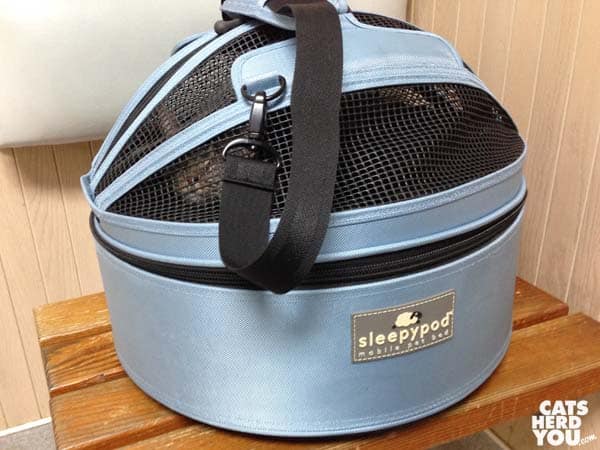
gray tabby cat in sleepypod carrier

This was an urgent visit despite Pierre’s protests. His constipation, usually controlled with the addition of some pumpkin to his diet, had gotten worse and was causing vomiting outside the litterbox when he tried to go.

Ashton was due for her wellness visit, so she accompanied him for the trip to the vet.

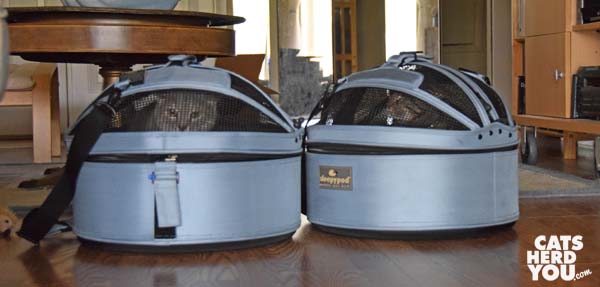
gray tabby cat and brown tabby cat in sleepypod carriers

Ashton: This is NOT funny. You’re in so much trouble for making me do this, Pierre.

one-eyed brown tabby cat in sleepypod carrier

Pierre and Ashton sang the song of their people all the way to the vet. We’re fairly sure that even with the car windows rolled up, drivers in the surrounding cars heard them at every stoplight. (If the video doesn’t display below for you, you can visit it directly to hear their song.)

At the vet, Pierre really wasn’t interested in coming out of his carrier to be examined.

Pierre: I’m fine right here, thanks. Just punch my round-trip ticket and let me go home.

gray tabby cat looking afraid at vet's office

He was diagnosed with constipation and scheduled for an enema. The vet suggested that he stay with them for a few hours since the results were usually pretty messy, and that he would be able to go home later in the day.

Ashton: Can’t you keep examining Pierre so that I don’t have to come out there?

brown tabby cat in sleepypod carrier at vet's office

Ashton had her annual exam, which was uneventful except for the vet warning that her bladder was kind of full. Worried about Pierre, we didn’t pay too much attention to that comment. As we carried her carrier back in the door, Ashton’s bladder couldn’t wait any longer. The dense humans, without a cat’s keen sense of smell, didn’t realize this until we opened the carrier and out sprang Ashton, the fur of her whole back end wet.

There are no photos of the chase over all of the furniture in the house that ensued, so you’ll have to use your imagination. It was, however, epic.

One of the awesome things we love about the Sleepypod carrier is that it’s not just super-plush for the cats, it’s also easy to clean. The innards of the carrier went right into the washer with the bed comforter and other things that suddenly needed to be washed, and they came out April fresh.

By the time cleanup was mostly done but Ashton was still hiding under the bed, the vet called to say that Pierre had gotten his enema, but he was refusing to use the litterbox at the vet. The vet suggested he would be more relaxed at home and would use his own litter box.

Pierre looked very glad to see a familiar face at the vet and went right into his carrier. We set out for home and were nearly there, only a few blocks away, when Pierre couldn’t wait for the litter box any longer. Unlike when Ashton went in the carrier, there was no mistaking what had just happened. Pierre, ever the tidy cat, tried to rearrange the incontinence pad we had added to the bottom of the carrier for just this situation, trying hard to bury the evidence. So when we got him the last few blocks home and into the house, he went into the bathroom carrier and all to assess how much mess there was.

There are no photos of this part of the story, either. In his effort to be clean, he had managed to get it all over his feet. So in addition to all of the other indignities he had suffered, Pierre had to have his paws washed before he could be allowed back into the house.

Pierre: You’re not going to publish a picture of my wet paws for people to see, are you? So humiliating!

Gray tabby cat's wet feet after they were washed

Afterward, he had a little bit to eat and then went to hide in his kitty kozy.

Pierre: I never want to go through any of that again.

gray tabby cat in kozy kitty cat sack

Neither do we, Pierre.

The good news is that Pierre feels much better now, and we have a plan to help him keep feeling that way.

Lessons Learned

This whole experience taught us that it’s important to always know how often your cat is using the litterbox. When you have three cats, it’s sometimes difficult to know who leaves what, so you have to keep an eye on them. In our house, Pierre is the only cat not eating raw, so we can usually tell which ones are his at scooping time. When we stopped being able to tell them apart, we suspected there was trouble.

PetMD lists these as additional symptoms of constipation:

  • Straining to defecate with small or no fecal volume
  • Hard, dry bowel movement
  • Infrequent or complete lack of defecation
  • Small amount of liquid stool with mucus in it – sometimes with blood present, produced after prolonged straining to defecate (known as tenesmus)
  • Occasional vomiting
  • Lack of appetite
  • Depression
  • Large intestine (colon) filled with hard, compacted fecal material
  • Swelling around the anus

If you think your cat is constipated, see your vet both so that your kitty can feel better and so that your vet can try to identify the cause of the constipation, since it could signal another underlying condition.

Share Share on email
Email
Share on twitter
Twitter
Share on facebook
Facebook
Share on pinterest
Pinterest
Share on google
Google
Share on tumblr
Tumblr
Share on linkedin
Linkedin

March 30, 2016 Filed Under: Cats Tagged With: Ashton, Pierre 33 Comments

Senior Cats Need More Protein

I don’t like to think about Pierre as a senior cat, but he is. He’s 11 now, and when he was at the vet this past week, the vet confirmed what I had suspected: he is slowly losing weight on the same diet where that had previously sustained him.

gray tabby cat is not looking at the camera

Why could this be? It’s good, high quality food, and that hasn’t changed. The thing that is changing is Pierre’s aging body.

Starting around age 10 or 12, a healthy cat’s aging body becomes less able to digest the protein in the food he eats. Pierre is eating the same food in the same amount he did, but he’s not getting as much of the protein he needs out of it.

Cats Need Protein for Energy

Animals eat food so they can convert it to energy to fuel their bodies. As obligate carnivores, cats need more protein in their diet compared to omnivores like humans. Cats don’t need carbohydrates, and their systems aren’t adapted to process carbs. They convert the digestible protein in their diet into energy to fuel their daily activities.

Not all protein is created equal. Although plant matter may contain protein, as carnivores, a cat’s system is designed to convert animal protein into energy. Even the wrong kind of animal protein isn’t digestible. For example, feathers are made of protein, but they aren’t digestible.

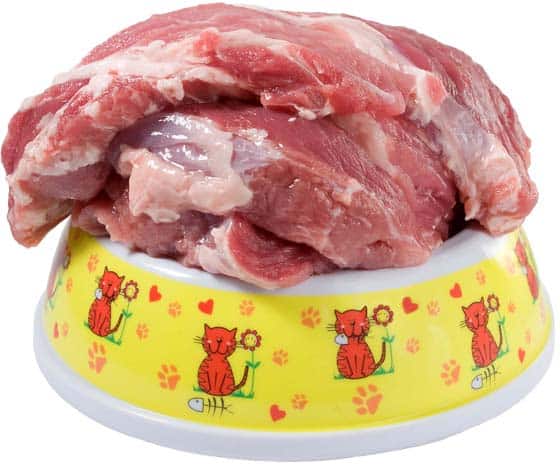
cat bowl piled high with meat

As carnivores, cats need digestible protien. Photo courtesy depositphotos/janzwolinski

An interesting study about middle-aged cats given a selection of foods and allowed to choose their own proportion of protein, fat, and carbohydrates to make up their daily energy requirements, the cats chose a diet 52% (26 grams) protein. The average body weight of cats in the study was 4.9 kg (10.8 lb for us Americans), which means the cats in this research colony chose to eat 5.3 grams of protein per kilogram of body weight a day.

Another study compared cats eating diets that were either low or high in proteins. Cats fed a 30% protein diet lost about 1.2% of their lean body mass while cats fed a 53% protein diet gained 4.2 lean body mass. The researches in this study concluded that cats needed to eat 5.28 grams of protein per kilogram of body weight a day. Those cats allowed to select the amount of protein they ate in their diet in the other study apparently had already figured that out!

Energy Requirements during Middle Age

We know from the epidemic of feline obesity that middle-aged cats can easily gain weight. This happens partly because their metabolism slows during middle age, a phenomenon that many humans can relate to. Both cats and humans can get “middle age spread” when their metabolism isn’t what it used to be when they were kittens.

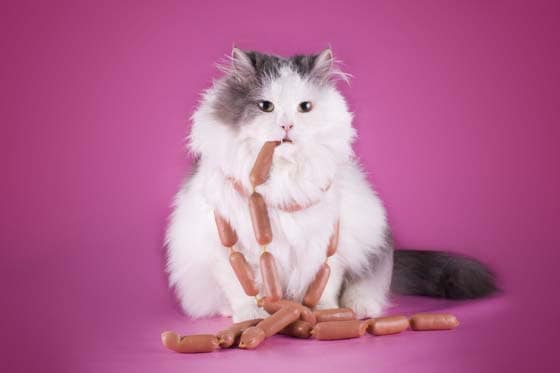
fat cat eating sausages

When a cat reaches middle age, their metabolism slows, and they can’t burn off the calories like they used to. Image courtesy depositphotos/kuban_girl

There is a lot of attention currently being focused on the feline obesity epidemic, and it’s easy to breathe a sigh of relief when your older kitty starts to finally lose some of that weight that the vet has been telling you needs come off of him. But that could actually be a sign that your cat is leaving middle age and becoming a senior.

Energy Requirements beyond Middle Age

When cats get to 10 or 12 years old, their bodies start to change. Even healthy senior cats need more calories to convert into the energy their bodies need because they no longer absorb and metabolize the proteins they eat as efficiently as they used to.

A 12 year old cat only digests about 75% of the protein he eats, so he needs even more protein in his diet to make up for it, unless you can convince him to eat 25% more. This inability to digest the protein in the cat’s diet actually increases as he gets even more geriatric. At some point, you can’t keep feeding your kitty more and more of the same food to make up for his inability to absorb nutrients like he used to. Instead, your cat needs a higher amount of digestible protein in the food he eats.

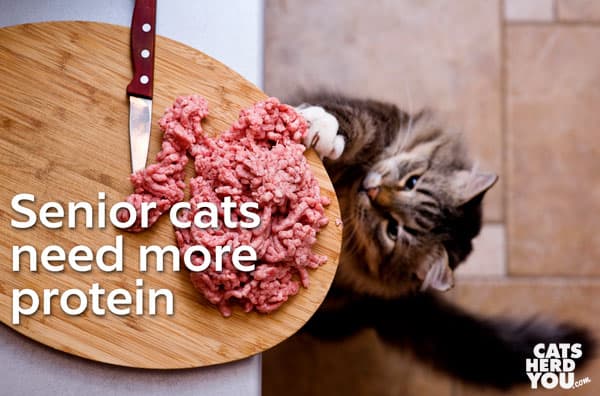
senior cats need more protein / cat stealing meat

When your cat doesn’t get enough protein to support his energy needs, he uses his body’s energy reserves. When the fat is gone, he begins to use the energy reserves in his own muscles. This is often referred to as called muscle wasting or sarcopenia. Muscle wasting is seen in a lot of elderly cats as well as elderly humans.

To prevent sarcopenia from aging, a cat needs additional calories and protein. After age 12, this need increases 10-60%, or at least 6.0 – 8.5 grams per kilogram of body weight a day.

How Much Protein is In My Cat’s Food?

Armed with this information, I went to look at Pierre’s cat food. He eats a quality food that has served him well for a long time, and since he’s a picky eater, I’m grateful that he likes the stuff.

It was time to bust out some math and figure out how many grams of protein Pierre is getting per kilogram every day to see if that might be an issue. You can follow along with your own cat food, if you want.

The Math

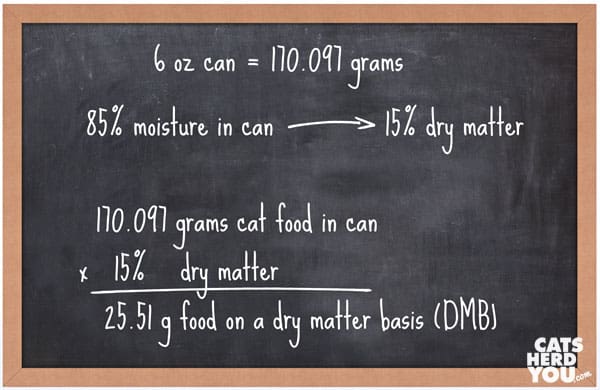
Pierre eats from a 6 oz can of food. 6 oz is the same as 170.097 grams.

To calculate things on a dry matter basis, I looked at the back of the can. 85% of the weight of his food is moisture. That means only 15% of the contents is dry matter.

If I multiply the 170.097 grams of food weight by the 15% dry matter percentage, I discover that the can contains 25.51 grams of food on a dry matter basis.

Calculating the protien in cat food example 1

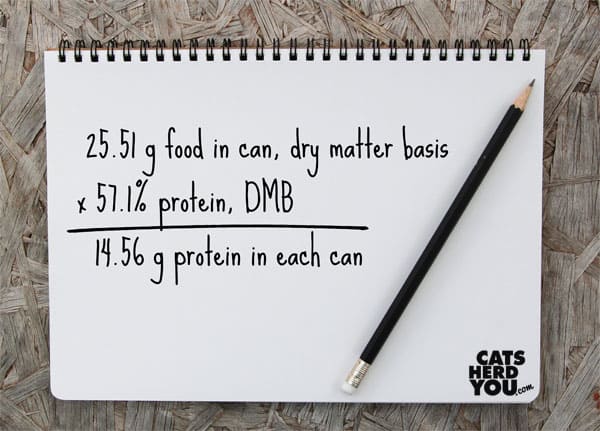
Next I went to the cat food manufacturer’s web site and looked up the percent of protein in the food by dry matter basis. Be sure you’re getting the dry matter basis number for this step! You are more likely to find an “as fed” percentage, and that isn’t the value you’re looking for. Pierre’s food is 57.1% protein on a dry matter basis. That sounded pretty promising.

I multiplied the number I calculated for grams of food in the can on a dry matter basis (25.51) by this protein percentage (57.1%) to find that there are 14.56 grams of protein in each can.

Calculating the protien in cat food example 2

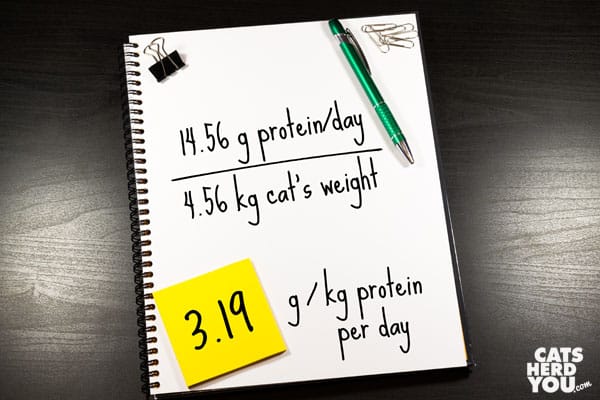
Now that I’ve calculated how much protein there is in a can, I need to figure out how much Pierre is eating per kilogram of his body weight. He eats one can a day, so we can use the protein value we already calculated for one can of his food. And at the vet last week, he weighed 10.1 lb, which converts to 4.56 kilograms.

If I divide his 14.56 grams of daily protein intake by his 4.56 kg weight, I find that he is eating 3.19 grams per kilogram per day of protein an average middle aged cat needs. It’s even further below the 6+ grams seniors who have started to have difficulty absorbing nutrients from protein need.

Calculating the protien in cat food example 3

I just discovered I’m looking for a new cat food for Pierre!

(I originally figured this all out on a spreadsheet that calculated these numbers to a lot more decimal places, but I’m breaking them down here with only a few decimal places. If you check my math and it is off by a rounding error, that’s the reason.)

What About Your Skinny, Old Cat?

As you read above, Pierre is under a veterinarian’s care, and his vet and I will be discussing this information soon. There are other medical reasons that your cat could be losing weight in his senior years, such as hyperthyroidism, diabetes, or kidney disease, so it’s important that your vet make sure your kitty is healthy before making any changes to your cat’s diet, including increasing the protein in his food.


References and further reading

Journal of Experimental Biology, Geometric analysis of macronutrient selection in the adult domestic cat, Felis catus
Nestle Companion Animal Summit Proceedings, Focus on Gerontology 2010, Dietary Protein Consumption in the Healthy Aging Companion Animal
Journal of Nutrition, High Protein Intake Affects Lean Body Mass but Not Energy Expenditure in Nonobese Neutered Cats
Insights into Veterinary Endcrinology, Optimal Protein Requirements for Older Cats and Cats with Hyperthyroidism

Share Share on email
Email
Share on twitter
Twitter
Share on facebook
Facebook
Share on pinterest
Pinterest
Share on google
Google
Share on tumblr
Tumblr
Share on linkedin
Linkedin

March 28, 2016 Filed Under: Health Tagged With: Pierre 31 Comments

  • « Previous Page
  • 1
  • …
  • 40
  • 41
  • 42
  • 43
  • 44
  • …
  • 131
  • Next Page »

Read Ashton’s Story in Rescued, Volume 2

These pawtographed books support Candy's Cats, who work tirelessly to find homes for cats in Florida.

Rescued, Volume 2: The Healing Stories of 12 Cats, Through Their Eyes. Proceeds from authographed copies benefit Candy's Cats.


Outside the US, contact us for shipping to your location.

Read Us by Email

Don't miss a thing! Cats delivered to your email.

Privacy Policy


Archives

All Rights Reserved

Articles and images on this site may not be reproduced in whole or in part without written consent. Please contact me if you are interested in reprinting or in having me write something unique for you.

Disclaimer

There are no veterinarians here. All health-related posts are the result of research and observation, but educational information is not a substitute for visiting your veterinarian. Do not self-diagnose your cat. For more information, see our disclaimer.

Policies

Disclosure Statement
Privacy Policy
Commenting Policy

Copyright © 2026 · Sometimes Cats Herd You · All Rights Reserved