







Laugh. Learn. Love cats.
Pierre: I’m in a carrier. Should he panic because it means I have to go to the vet?

Not at all! My sleepypod is out every day for me to access instead of only showing up on vet day. I can hang out in it or sleep in it. It’s a great place to hide and jump out at Newton. Every once and a while, there’s even an unexpected treat in here. So my carrier isn’t scary at all when it’s time to go to the vet.
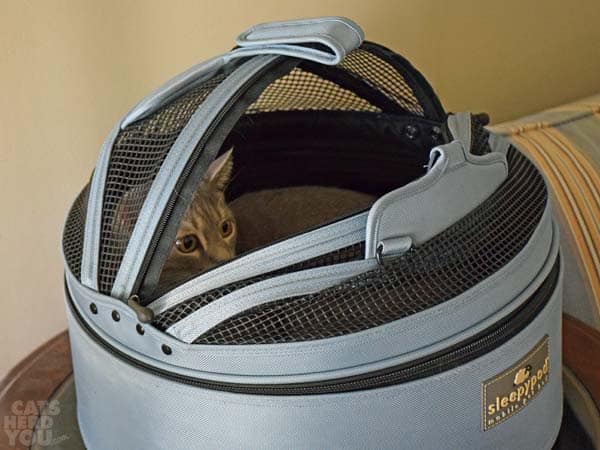
You don’t need a special carrier to help your cat get over their fear of the carrier. Just make sure that the carrier is part of your everday environment and has positive associations, like mine does.

A happy cat in a carrier is an unstressed cat!
EDIT: Looks Pierre spoke too soon about not having to go to the vet today. This post was scheduled over a week ago, and we didn’t know at the time that he would be seeing the vet about his appetite problems. He’ll be much calmer and more comfortable on the trip because the carrier isn’t a scary, foreign place, but he would still rather hang out in the carrier at home where he can jump out and scare Newton.

Rabies is considered one of the core vaccines for most cats and dogs in the US, but many people don’t know much about the disease. In honor of today’s World Rabies Day, we’re sharing some facts about rabies you may not know.
Rabies kills approximately 59,000 humans a year worldwide. Only a few cases are fatal in the US each year.
 The strong push for rabies vaccination in the United States is because it is a zoonotic disease. That means that it can be transmitted from animals to humans. The disease is found throughout the continental US, but is found most often along the east coast from Florida to Maine and in southern Arizona.
The most common rabies carriers in the US are raccoon, bats, skunks, and foxes, but dogs and cats can also catch the disease. It is important to use caution with unfamiliar animals if you don’t know their health status. Contact with an animal’s saliva (such as through a bite) or brain/nervous system tissue.
Keep in mind that even indoor pets can be exposed to rabies-carrying animals when some of these animals make dens in the basements or attics of our homes.
While the typical incubation period of rabies is three to eight weeks, it can be as little as eight days or as long as multiple years. The longest incubation time on record for the disease was in a man who was exposed to rabies before emigrating from Brazil and became symptomatic eight years later.
Because of the risk of human infection, if your dog or cat bites someone or is exposed to a rabid animal, you will be expected to show proof of up-to-date vaccination. If you can’t show proof of vaccination, your choices are:
A recent study showed that it may be possible to give pets with out-of-date rabies vaccination status an additional vaccination after exposure. At this time, local laws have not changed based on this new research.
 Rabies can’t be diagnosed in live animals
Rabies is diagnosed through the direct fluorescent antibody test. This test involves putting a fluorescent anti-rabies antibody on brain tissue to see if it binds to infected tissue. Since the test requires brain tissue, there is no accurate test for rabies in live animals.
In cats, rabies symptoms start with changes in behavior including aggression, restlessness, and lethargy. Symptoms progress to increased vocalization, loss of appetite, weakness, disorientation, paralysis, and even sudden death.
References and further reading:
American Humane Association, Rabies Facts & Prevention Tips
ASPCA, Rabies
Center for Disease Control, Rabies
Global Alliance for Rabies Control, Rabies Facts
Annals of Neurology, Phylogenetic and epidemiologic evidence of multiyear incubation in human rabies
Journal of the American Veterinary Association, Comparison of anamnestic responses to rabies vaccination in dogs and cats with current and out-of-date vaccination status
Photo credit:
depositphotos/Wavebreakmedia