Cats Herd You

Laugh. Learn. Love cats.

  • Home
  • Safety
  • Wellness
  • Rescue
  • Reviews
  • Life With Cats
  • About
  • Media Friendly
  • Contact

Arthritis in Cats

It’s World Arthritis day, and one species where arthritis goes undiagnosed is cats. As anyone who has a cat knows, cats are masters of hiding pain and discomfort from their human companions, and that can make joint disorders be very hard to diagnose until they have progressed significantly.

senior cat

Osteorthritis, also known as arthritis, is the most commonly-diagnosed degenerative joint disease in cats. It occurs when cartilage, the smooth tissue that protects the ends of bones from rubbing directly against each other within a movable joint, either wear way or are torn away. When this happens, the ends of the bones come into direct contact.

Did you just wince reading that? It sounds painful, and it can be. Bone grinding against bone results in inflammation and pain in a cat with arthritis.

Arthritis has several causes:

  • Injury to a joint
  • Gradual wear and tear on a joint over time
  • As a secondary impact of another disease that compromises the internal structure of a joint.

Although all of a cat’s bones can be susceptible to arthritis, the most obvious ones are the moving joints: Shoulders, elbows, knees, and wrists are all frequently suffer from arthritis as your cat ages, though the elbows and shoulders may be the most noticeable.

Older cats are most susceptible to arthritis. In one study of x-rays for 100 senior cats aged 10 or older most had signs of arthritis. 90% of cats over age 12 showed evidence of arthritis. Another study showed that cats begin to show joint degeneration earlier than anyone would have expected, with 30% of all cats eight years or older already having some signs of arthritis.

cat x-ray

Signs of Arthritis in Your Cat

Early signs of arthritis in your cat are likely to be so subtle you might not notice at first. Your cat may move stiffly, especially when getting up from a nap. She might also not move around as much, choosing not to make the high, graceful jumps of her youth. It’s easy to miss this last one if you have spent years trying to get your cat not to jump up on the counter and are relieved that she’s not doing it any more.

Other signs of arthritis may be mistaken for other problems. Your cat’s matted coat may not seem like a sign of arthritis, but if her spine is arthritic and it hurts to bend around for thorough grooming, she could become unkempt because of joint disease. Your cat’s claws becoming overgrown may not seem like a sign of arthritis, either, but they can be caused by less stretching of painful joints to sharpen them on your cat tree.

As arthritis progresses, you might even see your cat limp or walk oddly.

Helping Your Arthritic Cat

Making some simple adjustments around the house can make your arthritic cat more comfortable.

Make sure your cat has soft, warm, accessible places to sleep. If your kitty used to sleep only on top of the cat tree, you might not think about placing beds in draft-free locations so that she doesn’t need to struggle to climb to a comfortable resting location.

Add cat steps to locations that your cat likes to join you so that she doesn’t have  to jump up onto the sofa or bed to join you at night or up to the windowsill to watch bird TV.

senior cat on towels

Make sure litterboxes have low enough sides to be easy to enter and exit. An older cat may physically struggle to get in and out of the high-sided litterbox he once leaped into with ease.

Ensure food and water are easy to access and don’t require climbing a flight of stairs or leaping up onto a countertop.

What about Pain Relievers?

When you realize that your cat is in pain, of course you want to do something to alleviate it, but don’t give your kitty aspirin! Cats don’t have the enzyme necessary to metabolize salicyclic acid in the aspirin, so the common human medication is dangerous for them.

There are no anti-inflammatory drugs (NSIAD) for treatments of chronic musculo-skeletal disorders for cats, including arthritis. Researchers at NC State are currently enrolling cats in a clinical trial of a potential pain reliever for arthritic cats. If you are in that part of the United States and are interested your arthritic cat participating in the study, you can read more at their web site.

Talk to your veterinarian about getting your cat to a healthy weight so that extra weight isn’t causing extra stress on her painful joints. Your vet may also suggest complementary therapies like supplements or acupuncture to help give your cat relief from arthritis pain.


References and Further Reading

Cornell University College of Veterinary Medicine, Is Your Cat Slowing Down?
International Cat Care, Arthritis and Degenerative Joint Disease in Cats
NC State Veterinary Hospital, Feline Arthritis and NSAID Study
Journal of Feline Medicine and Surgery, Feline Osteoarthritis

Photo Credits

flickr/ajr595
flickr/Annie Mole
flickr/Alan

Share Share on email
Email
Share on twitter
Twitter
Share on facebook
Facebook
Share on pinterest
Pinterest
Share on google
Google
Share on tumblr
Tumblr
Share on linkedin
Linkedin

October 12, 2015 Filed Under: Health 18 Comments

Fresh Air Intruder

Ashton: We have finally had the first breath of not-summer here, which means my second favorite thing (after chicken): An open door to the front porch.

brown tabby cat by open door

Ashton: I love to smell the wild things outdoors.   * SNIFF *   What’s that? It’s not a wild thing.

brown tabby cat by open door with orange tabby cat in background

Newton: I can be wild sometimes!

Ashton: Wildly annoying, maybe. Code orange fresh air pollution.

brown tabby cat by open door with orange tabby cat outside

Share Share on email
Email
Share on twitter
Twitter
Share on facebook
Facebook
Share on pinterest
Pinterest
Share on google
Google
Share on tumblr
Tumblr
Share on linkedin
Linkedin

October 9, 2015 Filed Under: Cats Tagged With: Ashton, Newton 21 Comments

Why do Some Cats Like Olives?

My friend Anna-Marie told me recently that one of her cats is crazy for olives. I was surprised, and I had never heard of that. Then again, since I don’t like olives, there’s no likelihood that one of my cats would find one around the house, either.

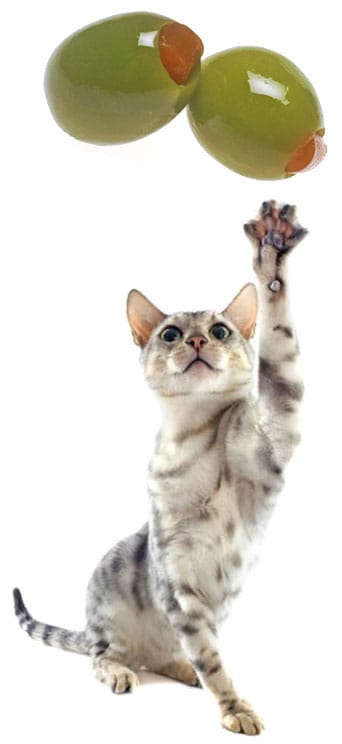
cat reaching for olivesFor the purposes of science, that was going to have to change.

In the meantime, I did some research. Olives are well-known for containing oleic acid. In fact, oleic acid is the component of olive oil responsible for its ability help to lower blood pressure in humans.

Oleic acid is also a component of the facial pheromones your cat spreads by rubbing her chin against you or objects in the house. In fact, the artificial pheromone diffusers for cats you can purchase to plug in around the house have oleic acid as an ingredient in the synthetic pheromone.

It’s likely that cats who enjoy olives are actually responding to the oleic acid in the olives. They aren’t hoping to drop one into a martini or anything.

Cats have been known to go wild over squished odorous ants, which also contain oleic acid. So there seems to be a connection. My cats may never have seen an olive, but we have had ant invasions in the past, and they were completely uninterested. Maybe the ants in Florida wear deodorant.

At any rate, it was nearly time to try this olive thing at home. Not knowing anything about olives except I don’t like them on my pizza, I went to Whole Foods and selected four different olives from the olive bar. My main criteria was that they were all different and that none of them contained garlic or onions in the ingredient list.

olives in a takeout container

I cut up very small pieces and put them on a plate for the cats to inspect.

Pierre: What did you get on your ear? It smells funny!

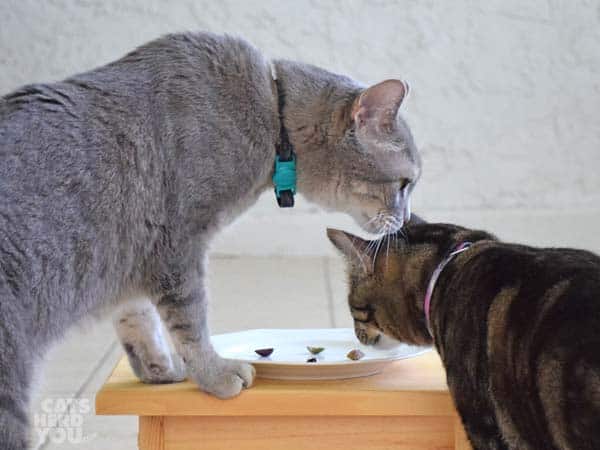
Ashton: It’s not me!    * SNIFF SNIFF *   It’s the stuff on this plate.

gray cat sniffs brown tabby cat as she sniffs olives

Newton: What ARE those things? They’re on a plate like food, but they don’t smell like food.

orange tabby cat reaches out a paw to touch olives

Ashton: If it’s on a plate, I think you’re supposed to eat it, not play with it.

Newton: I don’t see YOU eating it, Miss Smartystripes.

Ashton: I was saving whatever it is for you. Go right ahead.

Newton: No, that’s all right.   * SCRATCH  SCRATCH *

orange tabby cat buries olives as brown tabby cat looks on

Newton: We don’t know what it is, but we’re holding out for something more appetizing.

orange tabby cat stares over a plate of olive fragments

Our household test was a bit of a failure. Olives got twelve paws down here, but apparently there are lots of cats out there who really love them. Do your cats love (or hate) olives?


References and further reading

J Comp Physiol B., Dietary fats and body lipid composition in relation to hibernation in free-ranging echidnas
Proceedings of the National Academy of Sciences of the United States, Oleic acid content is responsible for the reduction in blood pressure induced by olive oil
Google Patents, Properties of cats’ facial pheromones US 5709863 A

Share Share on email
Email
Share on twitter
Twitter
Share on facebook
Facebook
Share on pinterest
Pinterest
Share on google
Google
Share on tumblr
Tumblr
Share on linkedin
Linkedin

October 8, 2015 Filed Under: Life With Cats Tagged With: Ashton, Newton, Pierre 39 Comments

Wordless Wednesday: Don’t Bring That Inside Edition

orange tabby cat with lizard

Share Share on email
Email
Share on twitter
Twitter
Share on facebook
Facebook
Share on pinterest
Pinterest
Share on google
Google
Share on tumblr
Tumblr
Share on linkedin
Linkedin

October 7, 2015 Filed Under: Cats Tagged With: Newton 27 Comments

  • « Previous Page
  • 1
  • …
  • 138
  • 139
  • 140
  • 141
  • 142
  • …
  • 494
  • Next Page »

Read Ashton’s Story in Rescued, Volume 2

These pawtographed books support Candy's Cats, who work tirelessly to find homes for cats in Florida.

Rescued, Volume 2: The Healing Stories of 12 Cats, Through Their Eyes. Proceeds from authographed copies benefit Candy's Cats.


Outside the US, contact us for shipping to your location.

Read Us by Email

Don't miss a thing! Cats delivered to your email.

Privacy Policy


Archives

All Rights Reserved

Articles and images on this site may not be reproduced in whole or in part without written consent. Please contact me if you are interested in reprinting or in having me write something unique for you.

Disclaimer

There are no veterinarians here. All health-related posts are the result of research and observation, but educational information is not a substitute for visiting your veterinarian. Do not self-diagnose your cat. For more information, see our disclaimer.

Policies

Disclosure Statement
Privacy Policy
Commenting Policy

Copyright © 2026 · Sometimes Cats Herd You · All Rights Reserved