Cats Herd You

Laugh. Learn. Love cats.

  • Home
  • Safety
  • Wellness
  • Rescue
  • Reviews
  • Life With Cats
  • About
  • Media Friendly
  • Contact

It’s National Feral Cat Day

Today is National Feral Cat Day. An estimated 70 million cats live outdoors, getting by the best they can, often in social groups called colonies. Unlike stray cats who enjoy human companionship but find themselves without it, feral cats aren’t socialized with humans, so they are afraid of them. So you can’t just adopt a feral cat that happens to live near you.

Feral cat

Ways to Help Feral Cats

If you can’t adopt feral cats, what can you do for them? You can help take care of your local colonies by making sure they have food and shelter. Something else you can do is  very important: get them neutered to prevent their having lots and lots of kittens. Areas like Florida have kittens all year round, and overpopulation can happen in a hurry. Feral cats can be trapped, neutered, eartipped to identify that they are neutered, and then returned (TNR) to their colonies where they can live out their lives but not continue to reproduce. Groups like Alley Cat Allies can teach you more about how that is done.

Many communities have groups that actively help organize affordable spays and neuters for feral cats going through the TNR process. Our local group, Alley Cat Allies, even has an agreement with our county shelter that they can get the feral catss out and return them to their colonies. This is somewhat unusual, and animal control in most areas of the country doesn’t make extra provisions for feral cats. In fact, feral cats usually die in shelters because they aren’t adoptable.

Feral black cat

What can you do where you live to help feral cats? First of all, you can spay and neuter your own cats so that you don’t risk accidentally contributing to the feral cat population in your area. You can feed feral cats. If you do feed them, check to see if you have an organization in your community to help you with trap, neuter, and return.

Also, if you live in a cold climate, you can build shelters for feral cats. Winter is coming, and feral cats will appreciate a place to escape the weather.

Most important, spread the word that feral cats are part of the community, too, and that they deserve our care and concern.


Photo credits

flickr/Quinn Dombrowski
flickr/fauxto_digit

Share Share on email
Email
Share on twitter
Twitter
Share on facebook
Facebook
Share on pinterest
Pinterest
Share on google
Google
Share on tumblr
Tumblr
Share on linkedin
Linkedin

October 16, 2015 Filed Under: Rescue 17 Comments

Your Cat Isn’t Going To Make You Crazy

cat tilts head sidewaysOne of the persistent stories that won’t go away is that your cat will make you crazy by infecting you with toxoplasmosis. In our clickbait internet culture, sensational headlines about “Your Cat is Making You Crazy” are sure to bring in the readers, so the story continues to pop up again and again, slowly turning into an urban myth. Like most urban myths, what started with a grain of truth is wrapped in a whole lot of not-so-true.

What is Toxoplasmosis, Anyhow?

A single-celled parasite called Toxoplasmosa gondii causes a disease called toxoplasmosis, which infects an estimated 60 million people in the US. Healthy immune systems keep the parasite from causing illness, so very few people actually have symptoms. However, pregnant women and those with poor immune systems are told to be cautious.

People can be exposed to T. gondii from:

  • Eating undercooked, contaminated meat (especially pork, lamb, or venison)
  • Accidentally ingesting contaminated meat due to cross-contamination (handling it and not washing your hands thoroughly, using cutting boards and utensils on undercooked meat and then using them for other food without properly sanitizing them)
  • Drinking contaminated water
  • Accidentally ingesting the parasite after cleaning a litter box of a cat who is shedding T. gondii and not cleaning your hands or other surfaces that feces comes into contact with
  • Accidentally ingesting contaminated soil by not washing your hands after gardening, or by eating unwashed fruit or vegetables from a garden
  • Mothers can infect unborn children
  • Infected blood transplants or organ transplants
  • Unprotected sexual intercourse with a partner infected with toxoplasmosis

Toxoplasmosis - high magnificationSince infected cats shed the oocysts that contain the parasite in their feces, pregnant women are warned by their healthcare providers to take extra precautions about cleaning their cat’s litterbox to prevent potential infection, so many women have already heard of toxoplasmosis through their doctor.

How this Story Got Started on the Internet

A pair of studies were published in the past few years that helped excite a lot of clickbait headlines.

A 2012 study, Brain cancer mortality rates increase with Tosoplama gondii seroprevalence in France, noted that in France, regional mortality rates were higher where the level of T. gondii parasite was higher in the population. Headlines around the world insisted that your cat was going to kill you with toxoplasmosis, despite the fact that this wasn’t the conclusion of the study at all. The study also pointed out that T. gondii prevalanence in pregnant women were lowered over a twelve-year period, probably due to improvements in meat production that reduced contaminants, and that brain cancer related deaths have increased over time due to science’s ability to detect brain cancer. The study’s conclusion said “this novel evidence of a significant statistical association between T. gondii infection and brain cancer does not demonstrate causation,” and the authors called for further research. The actual conclusion of the study was lost in the sensational headlines and not mentioned in the stories carried in the worldwide media.

Book with magnifying glass

A study published in 2015, Is childhood cat ownership a risk factor for schizophrenia later in life?, caused similar, overly-sensational stories that are still showing up in popular science magazines and web sites. This study cited answers from a previous questionnaire and concluded that individuals with mental illnesses were more likely to have had a cat in their home when they were children. Since the study didn’t account for the many other variables in the children’s homes, the study itself said, “We urge our colleagues to try and replicate these findings to clarify whether childhood cat ownership is truly a risk factor for later schizophrenia.” Unfortunately, once more, the media ignored this conclusion in the interest of telling a more interesting story.

Why do these stories go racing around the internet? Bad journalism.

Why Your Cat Won’t Make You Crazy or Give You Brain Cancer

If you’re still convinced that T. gondii is the problem and that it will cause mental health issues and/or brain cancer, your cat still isn’t to blame.

cat with back to cameraCats aren’t the way that people are exposed to T. gondii come into contact with it. Humans most commonly contract it by eating undercooked meat that contains T. gondii in the tissue. Contact with contaminated soil (combined with poor hygiene) and eating unwashed vegetables are also significant risk factors.

If your cat is exposed to T. gondii, she acquires immunity and isn’t likely to become infected unless she has an immune problem. So if kitty does become infected, she only passes oocysts containing the T. gondii parasite for two weeks, ever. After your cat leaves feces in the litterbox, the oocysts in the feces incubate for one to five days before they open and are infectious. This means if you scoop your cat’s litterbox once a day, even if your cat is shedding the T. gondii parasite, you’re getting it out of there before it could infect anyone else. (You’re scooping the litter box every day anyhow, aren’t you? If not, your cats will thank you!)

If You’re Still Worried about Toxoplasmosis

It’s unlikely that you will contract toxoplasmosis from your cat, but if you are pregnant or have a compromised immune system, it’s a good idea to be careful. To reduce your risk:

  • Avoid undercooked meat.
  • Wash all uncooked vegetables thoroughly.
  • Wash all cutting boards and utensils that might have come in contact with meat before using them.
  • Wear gloves when gardening or working in soil for other reasons. If you don’t wear gloves, wash your hands thoroughly afterward
  • Ask your spouse, friends, or neighbors to help out with litter box duties while you’re pregnant. Alternatively, wear rubber gloves when changing the litter and thoroughly wash your hands afterward.
  • Scoop your cat’s litter every day.
  • Keep your cat indoors to prevent your cat from being exposed to T. gondii.

What Can You Do about these Stories

The biggest thing we have to fear from scary headlines about our cats making us crazy or giving us brain cancer is the spread of misinformation.

black cat with laptop

When you see a scary headline, take a moment to do a little research and see whether it’s true before sharing it on Facebook or forwarding it to all of your friends in email. Refusing to share and being knowledgeable enough to let others know that they are sharing bad information is the only way to stop rewarding the media for their misinformed, sensationalist headlines that can hurt cats or leave them homeless.

Updated January 2016 to add reference to sexual transmission.


Research and Further Reading

Centers for Disease Control and Prevention, Toxoplasmosis FAQ
Humane Society of the US, Pregnancy and Toxoplasmosis
Journal of the Schizophrenia International Research Society, Is childhood cat ownership a risk factor for schizophrenia later in life?
Journal of Molecular Epidemiology and Evolutionary Genetics in Infectious Diseases, Brain cancer mortality rates increase with Toxoplama gondii seroprevalence in France
The Royal Society Biology Letters, Cat ownership is neither a strong predictor of Toxoplamsa gondii infection nor a risk factor for brain cancerMedical Hypotheses Journal, Toxoplasmosis can be a sexually transmitted infection with serious clinical consequences. Not all routes of infection are created equal

Photo credits:

Wikimedia Commons/Toxoplasmosis
depositphotos/DepositNovic
depositphotos/cynoclub
depositphotos/HASLOO

Share Share on email
Email
Share on twitter
Twitter
Share on facebook
Facebook
Share on pinterest
Pinterest
Share on google
Google
Share on tumblr
Tumblr
Share on linkedin
Linkedin

October 15, 2015 Filed Under: Health 31 Comments

Ya Gotta Have Heart

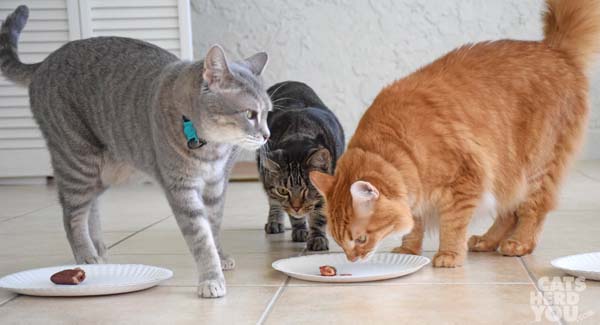
We got three chicken hearts, one for each of us!

Newton: What is this? The head peep said “treat” when she called us in here, but…

Ashton: It looks kind of tasty, actually.

Pierre: You kitties can have mine. This isn’t food. I’ll be back when there’s salmon.

Gray tabby cat leaves while orange tabby cat and brown tabby cat look at chicken heart

Newton: I’m not gonna try this first. YOU try it, Ashton.

Ashton: Why do I always have to try it first?

brown tabby cat and orange tabby cat look at chicken hearts

Ashton: I’m just going to take this…

brown tabby cat picks up chicken heart

Ashton: ….. over here.

brown tabby cat leaves with chicken heart

Newton: I’m not sure the head peep is going to like that there.

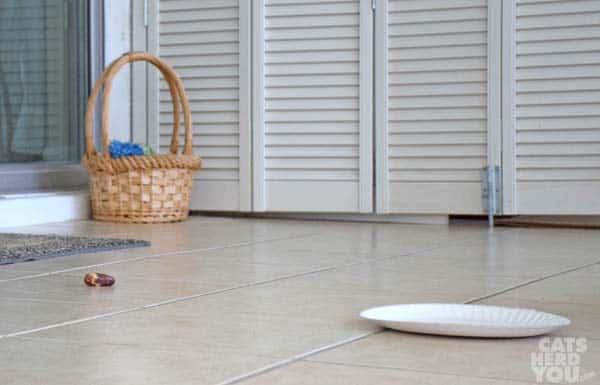
Ashton: Don’t worry about it. I’ll clean it up later.

chicken heart on the floor

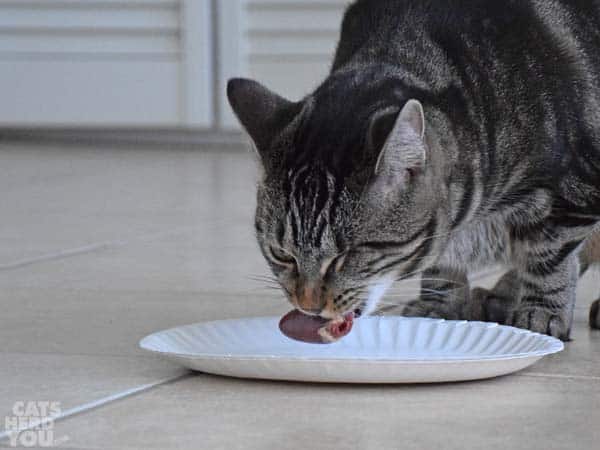
Newton: Wow, you really are eating that thing, aren’t you?

Ashton: It’s CHICKEN. Of course I am! I wonder if I can get more of these for my chicken emporium?

orange tabby cat watches brown tabby cat eat chicken heart

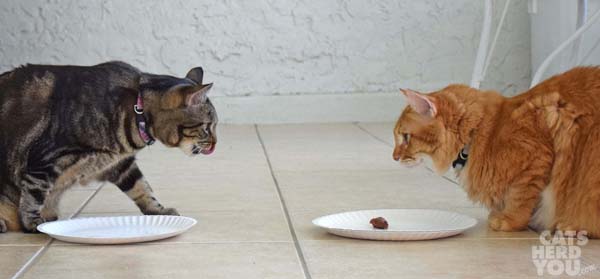
Ashton: Are you going to finish that? I’d hate to see it go to waste.

brown tabby cat eyes orange tabby cat's chicken heart

Newton: Something tells me this chicken heart isn’t making it to your chicken emporium…


Chicken Leg IconHave you seen the rest of Ashton’s chicken capers? I you missed them, you can catch up any time.

Share Share on email
Email
Share on twitter
Twitter
Share on facebook
Facebook
Share on pinterest
Pinterest
Share on google
Google
Share on tumblr
Tumblr
Share on linkedin
Linkedin

October 14, 2015 Filed Under: Cats Tagged With: Ashton, Newton, Pierre 20 Comments

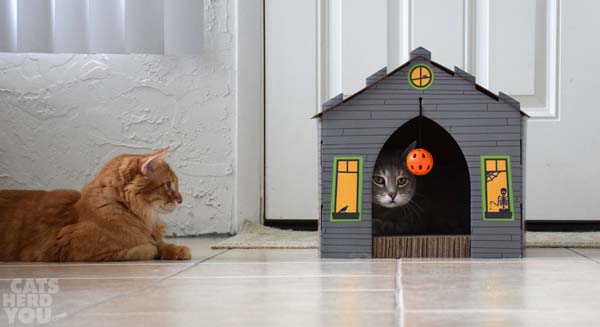
Haunting the Haunted House

Newton: I think my haunted house may be haunted. I was evicted by a gray ghostly cat!

orange tabby cat watched gray tabby cat in haunted house

Newton: Should I be afraid? Or should I pounce on him?

orange tabby cat looks skeptical

Pierre: You know I can hear you from in here, don’t you?

Gray tabby cat looks out of haunted house at orange tabby cat

Share Share on email
Email
Share on twitter
Twitter
Share on facebook
Facebook
Share on pinterest
Pinterest
Share on google
Google
Share on tumblr
Tumblr
Share on linkedin
Linkedin

October 13, 2015 Filed Under: Cats Tagged With: Newton, Pierre 21 Comments

  • « Previous Page
  • 1
  • …
  • 137
  • 138
  • 139
  • 140
  • 141
  • …
  • 494
  • Next Page »

Read Ashton’s Story in Rescued, Volume 2

These pawtographed books support Candy's Cats, who work tirelessly to find homes for cats in Florida.

Rescued, Volume 2: The Healing Stories of 12 Cats, Through Their Eyes. Proceeds from authographed copies benefit Candy's Cats.


Outside the US, contact us for shipping to your location.

Read Us by Email

Don't miss a thing! Cats delivered to your email.

Privacy Policy


Archives

All Rights Reserved

Articles and images on this site may not be reproduced in whole or in part without written consent. Please contact me if you are interested in reprinting or in having me write something unique for you.

Disclaimer

There are no veterinarians here. All health-related posts are the result of research and observation, but educational information is not a substitute for visiting your veterinarian. Do not self-diagnose your cat. For more information, see our disclaimer.

Policies

Disclosure Statement
Privacy Policy
Commenting Policy

Copyright © 2026 · Sometimes Cats Herd You · All Rights Reserved