Cats Herd You

Laugh. Learn. Love cats.

  • Home
  • Safety
  • Wellness
  • Rescue
  • Reviews
  • Life With Cats
  • About
  • Media Friendly
  • Contact
You are here: Home / Archives for Safety

Houseguests and Scaredy Cats

Do you have a scaredy cat at your house? We do. We actually have two. Pierre has been a scaredy cat for many years, but Ashton makes him look brave. Ashton’s default position is to hide. So when houeguests come to visit, Ashton’s phobias of anything out of the ordinary kick in. Visitors who are here less than three or four days don’t even see her. She vanishes into the depths of the bedroom closet or under the bed. Or if she’s caught where she doesn’t feel safe to get to the bedroom, she hides under the sofa.

What can you do to help your scaredy cat get through a visit from houseguests?

Make a Safe Place

Your scaredy cat will find a place that feels secure from the houseguest intruders. You don’t have to do that part. What you can do is make sure that place remains a sanctuary for your kitty. As much as your houseguests may want to visit with your kitty, if he is scared, let him feel that his hiding place is safe by not letting visitors barge into the safe closet or corner kitty under the bed. This is especially important if your visitors are children who may not understand being respectful of frightened, resident cats.

Pierre_in_closet_hanging_clothes_sm

Keep a Routine

With houseguests around, you’re probably on the go at odd hours. If you can, try to feed your scaredy cat at as close to the regular time as possible. Your kitty’s internal clock knows what time breakfast is supposed to happen even when your alarm doesn’t go off, and keeping some of the regular routines will help her feel more normal while things in the house are changed.

As a bonus, if your houseguests are late sleepers and kitty is used to eating early, It’s great “act normal” time for you both.

Make Sure Important Stuff is Within Reach

Ashton won’t come out into the living room in front of strangers no matter what. She is one of the most food motivated cats who ever lived, but she won’t venture into sight of the scary people for dinner.

Be prepared to feed your cat in an out-of-the-way place that is convenient to her safe hiding spot. This isn’t to say that you need to feed your kitty under the bed, but if your cat is hiding under the bed, you might want to gently close the bedroom door and put down her dish in that room.

Ashton_hides_under_sofa_sm

Similarly, make sure there’s a water dish handy where your cat doesn’t have to venture near scary people to drink. Likewise the litter box. Some cats can hold it for a long time, but some may need to use the box, and you don’t want them not to have any options available but your bedroom closet.

A little preplanning can make a visit from houseguests a little less stressful for your scaredy cat… and for you, too!

Share Share on email
Email
Share on twitter
Twitter
Share on facebook
Facebook
Share on pinterest
Pinterest
Share on google
Google
Share on tumblr
Tumblr
Share on linkedin
Linkedin

September 25, 2014 Filed Under: Safety Tagged With: Ashton, Pierre 11 Comments

National Prescription Drug Take Back Day

We’re updating this page because it’s relevant again now. The National Prescription Drug Take-Back Day is coming on October 22nd, 2016, and we want to be sure you’re ready. So dig out those leftover pills you could never get into your hard to pill cat. There’s a safe way to dispose of them near you! You can find locations that will be accepting prescription drugs, no questions asked, by checking the National Take Back Initiative Collection Site Search or by calling 1-800-882-9539.

There are a lot of ways that you shouldn’t dispose of things.

Pierre_in_trash_basket_sm

Flushing your unused medications down the toilet or drain is a bad idea. The US Geological Survey has already found levels of drugs such as antibiotics, hormones, and contraceptives in 80% of the rivers and streams tested in part of a nationwide study. Additional studies have shown that fish and other wildlife can be adversely affected by medications, even when they are expired.

Instead of flushing medications, check to see if there are drug take-back events in your area one of the following ways:

  • Call your city or county government’s household trash and recycling service to ask whether a drug take-back program is available in your community. Some counties hold periodic household hazardous waste collection days, where over-the-counter and prescription drugs are accepted at a set location.
    Ask your pharmacist whether he or she knows of any medicine disposal programs in your area.
  • Find a local, independent pharmacy in your area who participates in drug disposal through disposemymeds.com.
  • Check the U.S. Drug Enforcement Administration’s web site for National Prescription Drug Take-Back Event information.
  • Ask your veterinarian. They may be willing to include unused medications originally purchased through them in shipments to their medical waste company.

If there aren’t any drug take-back events in your area, you can purchase special postage-paid packages from your local pharmacy that send medications back to a medical waste company. Some medications are ineligible for this program so read the fine print before you purchase.

The same guidelines can be used for disposal of human medications, though your veterinarian is unlikely to be willing to take back unused human medication. Keeping our groundwater safe is everybody’s responsibility!

Share Share on email
Email
Share on twitter
Twitter
Share on facebook
Facebook
Share on pinterest
Pinterest
Share on google
Google
Share on tumblr
Tumblr
Share on linkedin
Linkedin

September 18, 2014 Filed Under: Safety Tagged With: medication disposal, Pierre, Safety 11 Comments

Coyotes and Outdoor Cats Don’t Mix

Coyote_sign_02_smA sign recently appeared in our neighborhood that made us sad. One of our neighbors lost their cat to a coyote and wanted to warn everybody else so that it didn’t happen to them, too.

Lots of people think of coyotes as creatures who live on the prairies, and they remember them as part of wild west tales. Maybe you think of coyotes as desert-dwellers because you remember the coyote who never quite caught the road runner in the cartoons. That used to be true.

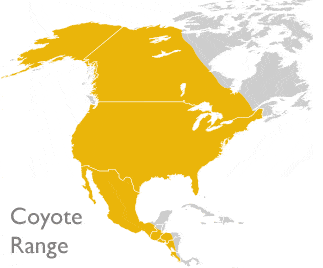
Coyoyte_range_02a_xsLSince the 1700s, coyotes have expanded their range first to the west and then eastward until they are found in all of the continental United States from eastern Alaska through New England and all the way south into Mexico and Panama.  Coyotes aren’t confined to rural areas any more, either. We live close enough to Walt Disney World to hear the fireworks at night, but we have had coyotes kill cats within a few hundred yards of our house.

Coyotes eat nearly anything. They will hunt rabbits, mice, or livestock. Coyotes are opportunistic hunters, and will kill cats, small dogs, and other pets.  They will also eat fruit and berries. This makes them hardy survivors, and difficult to eradicate.

Since coyotes have established themselves in areas through natural range expansion rather than being introduced the way that dumped exotic pet animals are, they aren’t considered non-native introduced species. However, they travel long distances and don’t have any natural predators, which means that they colonize new areas quickly. Coyotes are more aggressive in January during mating season and in late April and early May, when most litters are born.

Coyote_arizonaWhat can you do to keep your cat safe from coyotes in your area?

  • Keep your cat indoors from dusk until dawn.
  • If your cat demands access to the outdoors at night, consider a sturdy, coyote-proof catio.
  • Feed your cat indoors, or feed outdoors during the day so that food isn’t left out at night. This may be an important consideration for the timing of feedings for TNR colonies.
  • In treeless or open areas, you can provide “cat posts” which are 4×4 posts at least ten or twelve feet high with a platform on top which a cat can scale but a coyote can’t.
  • Never feed coyotes, and cut off food sources to make your neighborhood less attractive to them. This includes:
    • Securing your trash containers from being tipped over or opened
    • Picking up fruit or berries that fall on the ground
    • Covering compost
    • Hanging bird feeders out of reach of coyotes and not overfilling them to prevent spills

Only you can decide whether visits to the outdoors are worth the risk to your cat, but take the threat of coyotes seriously if they are preying in your area.


Coyote range map and Coyote photo thanks to Wikimedia Commons

Share Share on email
Email
Share on twitter
Twitter
Share on facebook
Facebook
Share on pinterest
Pinterest
Share on google
Google
Share on tumblr
Tumblr
Share on linkedin
Linkedin

September 11, 2014 Filed Under: Safety Tagged With: Cats, Safety 18 Comments

Keeping Cats Cool in the Summer Heat

Even though we’re indoor cats, we live in Florida, where it’s warm most of the year. Our seasons are summer with a few months months of not-summer. Cats who live in places where heat waves are less frequent may live in homes without air-conditioning, so knowing how to keep cool can help prevent hyperthermia, especially in kittens and elderly cats.

Make Cool Spots Available

Give your cat access to rooms with cool things they can lay on. Tile floors or ceramic bathtubs, even the back of your toilet are places that your cat may sprawl to feel the cool surface. In our house, we have a sunroom connected to the house by a sliding glass door, and the metal track of the door was a favorite spot for Rhett, one of the cats who came before. His white paws were often smudgy from the grease in the sliding door track where he would sprawl for comfort on hot days.

Pierre_sprawls_on_tile_sm

You can make an extra cool spot in your house by freezing water in a three-quarters full water bottle (leave room for expansion as the water freezes) and wrapping a towel around it. Use this as the opposite of a winter heating pad. Instead, think of it as a cool buddy that your cat can cuddle up to in order to cool off. Don’t forget that this is going to be damp, so you will need to either put it somewhere that won’t be damaged by moisture or protect it from moisture. We like to use incontinence pads to protect things from moisture. They are inexpensive and can be purchased by the case from warehouse stores, and they will let you put things like a towel with an icy water bottle in it anywhere you want without worrying that it will get your furniture wet, since the pad has a plastic backing.

Provide Plenty of Fresh Water

ice_cubes_smMake sure your cats have plenty of water, and check its level often. Warm weather means they will go through it faster, and it will also evaporate more quickly, meaning that smaller bowls of water will vanish a lot more quickly than you expect. You can add ice cubes to the water to cool it down temporarily, but some cats will fish out ice cubes to play with them, so monitor the bowls the first time you do that, especially if your bowl is in an area that the floor could become slippery when wet from melting ice.

Keep Out the Sun

Close curtains or blinds to prevent sun from further heating rooms in your house where your cat prefers to sleep during the day. This will also help with your air conditioning bill. This may mean less time for your cat to watch the birds and squirrels outside your window, but the birds and squirrels are probably resting in the heat of the day, too.

Southern and western exposure windows are the ones likely to heat up your house the most. Our sunroom has both south and west-facing windows, and we keep them closed for most of the day in the summer to try to keep cool. In the late afternoon, opening the room’s west-facing blinds can make the temperature jump ten degrees in a short period of time, so we just Ashton poke her head through if she wants to see what is going on around that side of the house.

Use Fans to Maximize Circulation

electric_fan_smPoint a fan where your cat can enjoy the breeze it creates. A fan helps humans cool off by evaporating sweat from your skin, and cats don’t sweat all over the way that humans do. That means that a fan isn’t quite as efficient for helping cool your cat as it is to cool you, but moving air around your cat that is cooler than her body temperature does help to draw heat away. If your cat is willing to let you wet her down with a damp washcloth, this effect works even better, but we won’t let a damp cloth anywhere near us.

Don’t forget that some fans are easier to tip over than others. If your cat is rambunctious or has climbing tendencies, a fan that sits on the floor is a safer choice than one on a tall pedestal that has a higher center of gravity and could be prone to toppling.

Save Strenuous Exercise for the Cooler Hours

You probably go out for your daily jog in the early morning to avoid the sizzling summer heat, and it’s no different for your cat. Don’t encourage strenuous play in the heat of the day. Playtime is important, and it’s great bonding between cat and human, but it can wait until after the house cools down. Or set your alarm a little early in the morning and have extra play time then.

You may regularly play with your cat until he is panting, but panting is also a sign of heat stress. Don’t push your cat’s exercise when it’s hot so that you can’t tell one from the other. And if your cat begins to act unusual after summer exercise, with rapid pulse and breathing, redness in his tongue and mouth, lethargy, or stumbling after a case of the midday zoomies, don’t assume he’ll be fine. Heat exhaustion signs like those need veterinary followup.


References

Heat Stroke in Cats, Pet MD.
How to Keep Your Pets Safe in the Summer Heat, American Humane Association

Share Share on email
Email
Share on twitter
Twitter
Share on facebook
Facebook
Share on pinterest
Pinterest
Share on google
Google
Share on tumblr
Tumblr
Share on linkedin
Linkedin

July 31, 2014 Filed Under: Safety Tagged With: Cats, keeping cool, Safety, summer heat 18 Comments

  • « Previous Page
  • 1
  • …
  • 5
  • 6
  • 7
  • 8
  • 9
  • …
  • 13
  • Next Page »

Read Ashton’s Story in Rescued, Volume 2

These pawtographed books support Candy's Cats, who work tirelessly to find homes for cats in Florida.

Rescued, Volume 2: The Healing Stories of 12 Cats, Through Their Eyes. Proceeds from authographed copies benefit Candy's Cats.


Outside the US, contact us for shipping to your location.

Read Us by Email

Don't miss a thing! Cats delivered to your email.

Privacy Policy


Archives

All Rights Reserved

Articles and images on this site may not be reproduced in whole or in part without written consent. Please contact me if you are interested in reprinting or in having me write something unique for you.

Disclaimer

There are no veterinarians here. All health-related posts are the result of research and observation, but educational information is not a substitute for visiting your veterinarian. Do not self-diagnose your cat. For more information, see our disclaimer.

Policies

Disclosure Statement
Privacy Policy
Commenting Policy

Copyright © 2026 · Sometimes Cats Herd You · All Rights Reserved