Cats Herd You

Laugh. Learn. Love cats.

  • Home
  • Safety
  • Wellness
  • Rescue
  • Reviews
  • Life With Cats
  • About
  • Media Friendly
  • Contact
You are here: Home / Archives for Safety

Washer and Dryer Safety

Our washer broke recently. You wouldn’t think this would be a big deal to us cats since we don’t wear clothes, but Pierre loves his clean sheets more than just about anything else. Our old washer was pretty old.

Old Washer

Well, maybe not quite that old. But it was old. And our new washer is all fancy and opens on the front.

kitty in washer

Doesn’t that look like a great place to hang out if you’re a cat?

Of course, that’s not a photo of one of us. Our washer is in the garage, and we aren’t allowed out there. Lots of kitties live in houses where the washer and dryer are right inside the house, and there is no way that we would be able to resist such a tempting hiding place.

Unfortunately, a lot of cats have trouble resisting staying out of washers and especially warm dryers. That can be really dangerous. How often do you check the inside of your washing machine or dryer before starting to put laundry in there? Unless you said “every single time,” there’s always the risk that your kitty may have gone in there to take a nap when you weren’t looking. Washers with dirty clothes smell like their favorite people — you — just like your laundry basket does, and that makes them especially inviting. Not to mention that dryers are often warm. We all know how much cats like finding warm spots to rest.

We know someone whose kitty was sleeping in the dryer when it was started, and it didn’t turn out well, and we don’t want this to happen to you! Things you can do to help prevent this include:

  • Always checking the inside of the washer and dryer before putting in clothes or running it, even if it was unattended only briefly.
  • Securely closing the doors that access laundry rooms.
  • Closing the washer and dryer door between loads to prevent access. For washers that get musty if left closed and do not have a built-in way to prop them slightly ajar, look into getting a gadget to hold them ajar just enough for air to dry the washer without allowing access to your kitty.

With a little extra diligence, your cat can be safe even around your tempting front-loading washer and dyer.


Photo Credits

Washing the Old Way by Dean Wiles on Flickr
Fate by Andrew Follow on Flickr

Share Share on email
Email
Share on twitter
Twitter
Share on facebook
Facebook
Share on pinterest
Pinterest
Share on google
Google
Share on tumblr
Tumblr
Share on linkedin
Linkedin

October 9, 2014 Filed Under: Safety Tagged With: Safety, washer 23 Comments

Houseguests and Not-So-Scaredy Cats

Last week, we talked about what you can do to make the houseguest visit a little easier for your timid cat. What about the cat who is the opposite? We have one of those. Newton is endlessly fascinated with visitors and wishes we had more of them more often. Especially if they have easily-opened luggage.

Newton looks thoughtful

With a timid cat, you make sure the cat has a comfort zone while guests are in the house. With a brave cat, your role is more to make sure that your visitors don’t do anything that will accidentally cause a problem with your cat. For instance, does your cat get treats? If not, be sure the houseguests know. Your brave cat may be putting on a fetching enough face that houseguests will fall for it, and kitty can end up eating things that aren’t on his diet.

It’s probably best if houseguests zip or latch their luggage shut when it’s unattended. Some kitties like to steal objects from the luggage of unsuspecting visitors. Or even unzipped purses. Newton has been caught with his head and shoulders stuffed in a visitor’s purse as he explored its contents.

depositphotos/Okssi68

If your houseguests aren’t cat people, be aware of what they might leave out in the bathroom to be sure that none of it is hazardous to your kitty. Human medications are number one on the ASPCA’s list of common hazards to cats, and they are most likely to be left out or dropped in the bathroom. Hair rubber bands are also nearly irresistible to kitties, but can be life-threatening if eaten.

If you keep the lid of the toilet closed to prevent your cat from drinking treated toilet water, be sure your guest knows… or just keep the door shut to the bathroom altogether.

Speaking of closing doors, the one thing that may be a problem with visitor-loving cats that isn’t with timid cats is that they might follow a houseguest right out the door. Houseguests who aren’t used to watching for cats at exterior doors may leave doors ajar without realizing it is a hazard. For safety, consider closing your brave cat in a room at times when houseguests are most likely to leave the door ajar, such as when luggage is being brought in and out the door.

It’s fun to have a cat who enjoys visitors. A few precautions are all it takes to make the visit a rewarding one for your cat and eliminate worry for you.

Share Share on email
Email
Share on twitter
Twitter
Share on facebook
Facebook
Share on pinterest
Pinterest
Share on google
Google
Share on tumblr
Tumblr
Share on linkedin
Linkedin

October 2, 2014 Filed Under: Safety Tagged With: Cats, Newton, Safety 19 Comments

National Prescription Drug Take Back Day

We’re updating this page because it’s relevant again now. The National Prescription Drug Take-Back Day is coming on October 22nd, 2016, and we want to be sure you’re ready. So dig out those leftover pills you could never get into your hard to pill cat. There’s a safe way to dispose of them near you! You can find locations that will be accepting prescription drugs, no questions asked, by checking the National Take Back Initiative Collection Site Search or by calling 1-800-882-9539.

There are a lot of ways that you shouldn’t dispose of things.

Pierre_in_trash_basket_sm

Flushing your unused medications down the toilet or drain is a bad idea. The US Geological Survey has already found levels of drugs such as antibiotics, hormones, and contraceptives in 80% of the rivers and streams tested in part of a nationwide study. Additional studies have shown that fish and other wildlife can be adversely affected by medications, even when they are expired.

Instead of flushing medications, check to see if there are drug take-back events in your area one of the following ways:

  • Call your city or county government’s household trash and recycling service to ask whether a drug take-back program is available in your community. Some counties hold periodic household hazardous waste collection days, where over-the-counter and prescription drugs are accepted at a set location.
    Ask your pharmacist whether he or she knows of any medicine disposal programs in your area.
  • Find a local, independent pharmacy in your area who participates in drug disposal through disposemymeds.com.
  • Check the U.S. Drug Enforcement Administration’s web site for National Prescription Drug Take-Back Event information.
  • Ask your veterinarian. They may be willing to include unused medications originally purchased through them in shipments to their medical waste company.

If there aren’t any drug take-back events in your area, you can purchase special postage-paid packages from your local pharmacy that send medications back to a medical waste company. Some medications are ineligible for this program so read the fine print before you purchase.

The same guidelines can be used for disposal of human medications, though your veterinarian is unlikely to be willing to take back unused human medication. Keeping our groundwater safe is everybody’s responsibility!

Share Share on email
Email
Share on twitter
Twitter
Share on facebook
Facebook
Share on pinterest
Pinterest
Share on google
Google
Share on tumblr
Tumblr
Share on linkedin
Linkedin

September 18, 2014 Filed Under: Safety Tagged With: medication disposal, Pierre, Safety 11 Comments

Coyotes and Outdoor Cats Don’t Mix

Coyote_sign_02_smA sign recently appeared in our neighborhood that made us sad. One of our neighbors lost their cat to a coyote and wanted to warn everybody else so that it didn’t happen to them, too.

Lots of people think of coyotes as creatures who live on the prairies, and they remember them as part of wild west tales. Maybe you think of coyotes as desert-dwellers because you remember the coyote who never quite caught the road runner in the cartoons. That used to be true.

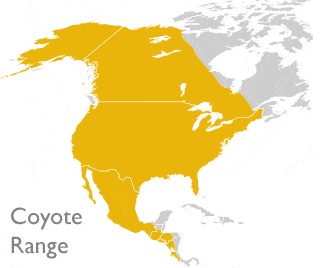
Coyoyte_range_02a_xsLSince the 1700s, coyotes have expanded their range first to the west and then eastward until they are found in all of the continental United States from eastern Alaska through New England and all the way south into Mexico and Panama.  Coyotes aren’t confined to rural areas any more, either. We live close enough to Walt Disney World to hear the fireworks at night, but we have had coyotes kill cats within a few hundred yards of our house.

Coyotes eat nearly anything. They will hunt rabbits, mice, or livestock. Coyotes are opportunistic hunters, and will kill cats, small dogs, and other pets.  They will also eat fruit and berries. This makes them hardy survivors, and difficult to eradicate.

Since coyotes have established themselves in areas through natural range expansion rather than being introduced the way that dumped exotic pet animals are, they aren’t considered non-native introduced species. However, they travel long distances and don’t have any natural predators, which means that they colonize new areas quickly. Coyotes are more aggressive in January during mating season and in late April and early May, when most litters are born.

Coyote_arizonaWhat can you do to keep your cat safe from coyotes in your area?

  • Keep your cat indoors from dusk until dawn.
  • If your cat demands access to the outdoors at night, consider a sturdy, coyote-proof catio.
  • Feed your cat indoors, or feed outdoors during the day so that food isn’t left out at night. This may be an important consideration for the timing of feedings for TNR colonies.
  • In treeless or open areas, you can provide “cat posts” which are 4×4 posts at least ten or twelve feet high with a platform on top which a cat can scale but a coyote can’t.
  • Never feed coyotes, and cut off food sources to make your neighborhood less attractive to them. This includes:
    • Securing your trash containers from being tipped over or opened
    • Picking up fruit or berries that fall on the ground
    • Covering compost
    • Hanging bird feeders out of reach of coyotes and not overfilling them to prevent spills

Only you can decide whether visits to the outdoors are worth the risk to your cat, but take the threat of coyotes seriously if they are preying in your area.


Coyote range map and Coyote photo thanks to Wikimedia Commons

Share Share on email
Email
Share on twitter
Twitter
Share on facebook
Facebook
Share on pinterest
Pinterest
Share on google
Google
Share on tumblr
Tumblr
Share on linkedin
Linkedin

September 11, 2014 Filed Under: Safety Tagged With: Cats, Safety 18 Comments

  • 1
  • 2
  • 3
  • …
  • 5
  • Next Page »

Read Ashton’s Story in Rescued, Volume 2

These pawtographed books support Candy's Cats, who work tirelessly to find homes for cats in Florida.

Rescued, Volume 2: The Healing Stories of 12 Cats, Through Their Eyes. Proceeds from authographed copies benefit Candy's Cats.


Outside the US, contact us for shipping to your location.

Read Us by Email

Don't miss a thing! Cats delivered to your email.

Privacy Policy


Archives

All Rights Reserved

Articles and images on this site may not be reproduced in whole or in part without written consent. Please contact me if you are interested in reprinting or in having me write something unique for you.

Disclaimer

There are no veterinarians here. All health-related posts are the result of research and observation, but educational information is not a substitute for visiting your veterinarian. Do not self-diagnose your cat. For more information, see our disclaimer.

Policies

Disclosure Statement
Privacy Policy
Commenting Policy

Copyright © 2026 · Sometimes Cats Herd You · All Rights Reserved