Cats Herd You

Laugh. Learn. Love cats.

  • Home
  • Safety
  • Wellness
  • Rescue
  • Reviews
  • Life With Cats
  • About
  • Media Friendly
  • Contact
You are here: Home / Archives for Safety

Warm Weather Travel Safety: Pets in Hot Cars

Warm weather has arrived all over the country. (Except maybe for our friend Crepes who had snow last week, but Chicago doesn’t count.) With warm weather comes something we all need to remember: never leave a pet in a parked vehicle.

You’re probably thinking that this is a cat blog, and dogs in parked cars are the real problem. Why are we even talking about it here? The head peep helps drive transports when cats need to be moved through the state. Many of our readers work in rescue, and may have to bring cats to adoption events weekly. And, let’s face it, nearly all of us have to go to the vet sometime, unless we are lucky enough to have a vet who makes housecalls. So remembering safety in cars is important for all of us.

Ashton_Peers_out_of_carrier001_sm

Oh, it’s not too hot out. I’ll just leave a window cracked while I run into the store!

A study published in the Official Journal of the American Academy of Pediatrics about the potential for heat stress on children in cars tested the temperature rise in a car in weather ranging from 72 to 96 degrees Fahrenheit. The study found that regardless of the outside ambient temperature, the rate of temperature rise inside the car was not very different. The average increase was 3.2 degrees Fahrenheit every 5 minutes, with 80% of the temperature rise occurring during the first 30 minutes. The average increase in temperature inside the car was 40 degrees Fahrenheit.

thermometer_rising_half_to_full

Leaving the windows open 1.5 inches didn’t help decrease the rate of the temperature rise in the car very much. Instead of 3.9 degrees every five minutes, the temperature inside the car rose 3.1 degrees every five minutes. The final temperature inside the car was the same whether the windows were completely closed or cracked open.

Why do cars heat up so much on even moderate days?

Cars create what is known as the greenhouse effect. Glass is transparent to solar radiation at short wavelengths, so short-wavelength IR (infrared) radiation passes through the car windows into the vehicle. Everything in the car absorbs the short-wave IR (infrared) radiation (dashboard, steering wheel, seats, etc.) becomes warmer. The warmed objects inside the ar give off long-wavelength infared light. The glass of the car is not transparent to long-wavelength IR, so instead of allowing it to pass through like it did the energy from the sun, it absorbs it and emits it back into the car.

The head peep will admit it… she has left us in an unattended car before. When we have early morning vet appointments, there’s a nearby coffee shop with parking in the shade of the building, and she has run in to pick up coffee. Now that she has read these numbers, it won’t ever be happening again, even if the car is in the full shade of the early morning. Our safety is more important than a latte!

What can you do if you see an animal locked in a parked car?

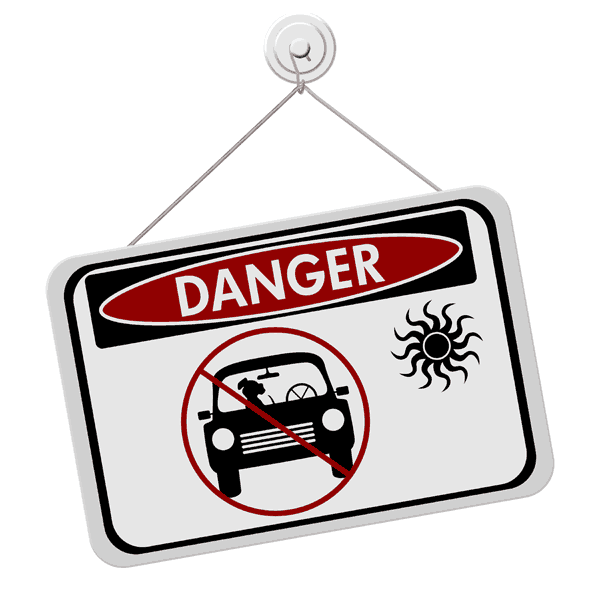
Since not everyone realizes how quickly parked cars can become dangerous, pets may still be left in parked cars by well-intended owners. What can you do to help if you see an animal locked in a parked car, especially on a hot day?

  1. Try to locate the car’s owner. Hopefully, they are nearby and will respond quickly when you start looking for them.
  2. Go to the security office or store manager for nearby shops and ask them to page the person that owns the car. Stay with the car to be sure that the owner returns.
  3. Call 911. If local security cannot help you, call the authorities for assistance. Fourteen states have laws against leaving pets unattended in vehicles, and even if your state doesn’t have that law, animal cruelty laws may apply to the situation, so don’t hesitate to ask for help for a trapped pet, especially if they are showing signs of heat distress.
Danger_Dog_in_Parked_Car_sm

Keep safety in mind whenever animals go along for the ride in warm weather!


References:
The Do it Yourself Greenhouse, How do Greenhouses Work?
Journal of the American Academy of Pediatrics, Heat Stress from Enclosed Vehicles Moderate Ambient Temperatures Cause Significant Temperature Rise in Enclosed Vehicles
PAWS Animal Adoption Center, What to do if You Find an Animal Locked in a Hot Car
Animal Legal and Historical Center, Table of State Laws that Protect Animals Left in Locked Vehicles

Share Share on email
Email
Share on twitter
Twitter
Share on facebook
Facebook
Share on pinterest
Pinterest
Share on google
Google
Share on tumblr
Tumblr
Share on linkedin
Linkedin

May 22, 2014 Filed Under: Safety Tagged With: dogs in hot cars, pets in parked cats, Safety 18 Comments

National Animal Disaster Preparedness Day

Are you prepared?

Newton_looks_disapproving

We aren’t talking about Cat Scouts — we hear they are always prepared. We are asking about having a disaster plan for your pets. With hurricane season just around the corner in our part of the country, National Pet Disaster Preparedness Day is a good time to check and see if you’re prepared in case of emergency.

Do you have ID? Collar with tag and registered microchip both give the maximum ability to get pets back who go astray during a disaster. If you have changed telephone numbers recently, verify that you have updated the number on tags and with the chip registry.

Do you have a disaster kit handy? Disaster kits are good to have on hand if you need to evacuate, and they are also filled with handy things in case disaster strikes and you are at home with local stores or delivery services not operating. A disaster kit should be in some kind of a durable bin or bag and contain:

  • Food for at least five days. If you use dry food, package it in something airtight and rotate it every six months so it doesn’t go bad. Don’t forget to include bowls. Paper bowls are a good idea since they are lightweight and you don’t have to worry about cleaning them.
  • Water for at least five days. You probably have this for yourself, but don’t forget your pets!
  • Litterbox with litter, scoop, and trash bags to dispose of used litter. There are disposable litterboxes on the market. Disposable foil pans like you would use for making a turkey can work for this, too.
  • Medications and written instructions on how you give them, especially if your routine varies at all from what is on the prescription label. (If you cut pills in half and dose twice a day, for example)
  • A copy of medical records, especially proof of recent vaccines. If you have to board your pet during an evacuation, you’ll need that documentation.
  • Written information about feeding schedules and medical conditions that could be left with a boarding facility if necessary. You may have compiled this already for a pet sitter. If so, you can use a copy of the same information here.
  • Current photos and descriptions of pets to use in case you are separated from them during a disaster. It’s a good idea to also have a photo of yourself with your pets for a quick proof of ownership. Tip: You can put all of the photos and other documentation on a thumb drive to make it compact rather than carrying it all on paper.

Disaster_Preparedness002

Do you have cat carriers for everyone? You may only take one or two cats to the vet at a time, but if you have more cats than that, make sure you have enough carriers to go around in case of evacuation. If you aren’t going to use the additional carriers for anything other than emergencies, less-expensive plastic carriers have the advantage of being stackable if you’re in tight quarters, and most of them break down for compact, nested storage.

Newton Inspects Cat Carriers

Do you know where to go in case of evacuation? Not everyone is pet friendly, so it’s a good idea to ask around before you need to find a place to go in an emergency. Places you might go include:

  • Local evacuation centers. Do the ones in your area make provisions for pets? More of them are including this in their contingency planning, but you should check before assuming that they do. Contact your local emergency management agency well ahead of a disaster — not after — to ask how to research this for your locality.
  • A family member or friend in a nearby region or state who might accommodate you? It’s always better to ask now rather than showing up in their driveway in an emergency!
  • Pet friendly hotels. Do you know where to find pet-friendly hotels? Several internet sites include listings, such as:
    • Bring Fido
    • Dog Friendly
    • Go Pet Friendly
    • Marriott Dog-Friendly Hotels
    • Pets Welcome
    • Trips with Pets

Keep in mind that when there is a disaster that causes an evacuation, lodging fills up fast.

What if you are away from home when disaster strikes? Talk to a trusted friend or neighbor about helping evacuate and meet you with your pets in a safe location away from the disaster.

We all hope that disaster won’t strike us, but better to be prepared and not need the plan than need a plan and have no idea what to do!

Share Share on email
Email
Share on twitter
Twitter
Share on facebook
Facebook
Share on pinterest
Pinterest
Share on google
Google
Share on tumblr
Tumblr
Share on linkedin
Linkedin

May 10, 2014 Filed Under: Safety Tagged With: Newton 9 Comments

National Chip Your Pet Month

Pierre: Hey, everybody. Did you know that May is National Chip your Pet Month?

Ashton: Chip your pet? Where? When can we start? I love corn chips! Potato chips too!

Ashton_approaching_sm

Pierre: They don’t mean corn chips. they mean microchips, Ashton. You have one, and so do I. They are to help us in case we get lost. The American Humane Association (AHA) estimates that over ten million dogs and cats are lost or stolen in the United States every year. One in three pets are lost during their life at some point.

Ashton: Those are scary numbers! I don’t want to be lost! I’ll miss the potato chips!

Pierre: A study by the Journal of the American Veterinary Medical Association shows:

  • 52% of microchipped dogs were reunited with an owner versus 22% of unchipped dogs
  • 38% of microchipped cats were reunited with an owner versus 2% of unchipped cats

ChipChart3

Ashton: So having a chip means that a lost cat or dog has a better chance of getting home again?

Pierre: It does. We shouldn’t rely on it alone. The AHA recommends that pets wear collars as a primary means of identification. It says right on their web page: “All cats and dogs need to wear collars with ID tags, rabies vaccination tags and city or county licenses (where applicable).” Collars let anyone who finds a lost cat or dog to help them get home by just reading the tag and calling the number on it.

Pierre_stylin_in_collar

Ashton: So microchips are a like a backup for a collar and tag, since they don’t fall off, and they last a lifetime?

Pierre: That’s right. Even if your we are completely indoor cats, unexpected disasters can strike, like scary weather. Many pets were reunited with owners after hurricane Katrina only because of the microchips they carried. Some as many as five years later!

Ashton: What are people waiting for? They should get microchips now. And potato chips, too.

Pierre: Many shelters, humane societies, and veterinarians have special pricing on microchips for your cat or dog during May in honor of Chip Your Pet Month, so if you’re thinking about getting a chip for your pet, this could be a cost-effective time to do it. Just remember that getting the chip inserted is the first step, and registering the chip is the second step. Without doing both, no one knows how to call you if your pet is lost.

Ashton: And if they don’t know who to call, your cat can never get home in time for potato chips.

Pierre: I think this diet has gone to your brain.

Share Share on email
Email
Share on twitter
Twitter
Share on facebook
Facebook
Share on pinterest
Pinterest
Share on google
Google
Share on tumblr
Tumblr
Share on linkedin
Linkedin

May 1, 2014 Filed Under: Safety Tagged With: Ashton, microchip, Pierre, Safety 20 Comments

National Hairball Awareness Day

Pierre: Hey, Newton, do you have a trichobezoar?

Newton: Isn’t that a little personal?

Pierre and Newton on Cat Tree

Pierre: Not a… Oh, never mind. A trichobezoar is a fancy word for hairball.

Newton: Have you been reading the internet again? The last time you did that, you ended up telling me about the Nigerian prince who wanted to send you a million green papers.

Pierre: *grumbles* He would have if you hadn’t stopped him.

Pierre surfs the net

Newton: So what’s this about hairballs, anyhow?

Pierre: Well, today is National Hairball Awareness day.

Newton: I’m plenty aware of them, thanks. Being the long-haired cat in the house, and it’s springtime. I’m more aware of them than you are.

Pierre: But do you even know what they are?

Newton: They’re the things that make me make this sound. Want to hear it? *breathes in*

Pierre: Oh, no, don’t make that noise unless you mean it! They happen because when you groom yourself, you end up swallowing some hair, and not all of it goes all the way through to the litterbox.

Newton: No, some of it I leave in strategic locations instead. Like right next to the bed where the head peep is sure to step in it first thing in the morning.

Pierre: I’m glad you mentioned her. I have an idea about how she can help you have less hairballs.

Pierre has an idea

Newton: Really? How?

Pierre: She can brush you every day.

Newton: She has to catch me first. Manly mancats do not subject themselves to the brush.

Newton_looks_perplexed_sm

Pierre: But it would mean less hairballs coming back up in the middle of the night when you’re trying to sleep. And the brush feels good. You’ve seen her brush me.

Newton. Yes, but you aren’t as mancatly as I am. No WAY that brush is getting near this beautiful coat.

Pierre: *sigh* That’s why you have to get manscaped, because you won’t have the brush. That’s all right. That leaves more brush for me, then, and no hairballs, either. Hairballs, if you can’t pass them, can cause complications that require surgery, so everyone else, let your peeps brush you for Hairball Awareness Day. Cough up less and play more!

Share Share on email
Email
Share on twitter
Twitter
Share on facebook
Facebook
Share on pinterest
Pinterest
Share on google
Google
Share on tumblr
Tumblr
Share on linkedin
Linkedin

April 25, 2014 Filed Under: Safety Tagged With: Newton, Pierre 21 Comments

  • « Previous Page
  • 1
  • …
  • 8
  • 9
  • 10
  • 11
  • 12
  • 13
  • Next Page »

Read Ashton’s Story in Rescued, Volume 2

These pawtographed books support Candy's Cats, who work tirelessly to find homes for cats in Florida.

Rescued, Volume 2: The Healing Stories of 12 Cats, Through Their Eyes. Proceeds from authographed copies benefit Candy's Cats.


Outside the US, contact us for shipping to your location.

Read Us by Email

Don't miss a thing! Cats delivered to your email.

Privacy Policy


Archives

All Rights Reserved

Articles and images on this site may not be reproduced in whole or in part without written consent. Please contact me if you are interested in reprinting or in having me write something unique for you.

Disclaimer

There are no veterinarians here. All health-related posts are the result of research and observation, but educational information is not a substitute for visiting your veterinarian. Do not self-diagnose your cat. For more information, see our disclaimer.

Policies

Disclosure Statement
Privacy Policy
Commenting Policy

Copyright © 2026 · Sometimes Cats Herd You · All Rights Reserved