Cats Herd You

Laugh. Learn. Love cats.

  • Home
  • Safety
  • Wellness
  • Rescue
  • Reviews
  • Life With Cats
  • About
  • Media Friendly
  • Contact
You are here: Home / Archives for Rescue

Owned or Semi-Owned Cats: Spay them All

It’s no secret that there are far more cats than there are homes, leading to a huge feral cat population. This is a problem not just in the US but in many other countries around the world. Part of this growing problem is sometimes blamed on people feeding these feral cats but not making sure they are also spayed or neutered.

A recent study looked at the differences in how people cared for cats falling into different categories:

notch-eared stray catSemi-ownership – Where the human did not think of themselves as the cat’s owner, but they had interacted with the cat for at least a month and fed the cat either frequently or always.

Ownership of passively-acquired cat – Where the human thought of himself to be the cat’s owner and had acquired the cat passively, such as taking in a formerly semi-owned cat..

There are no estimated numbers of how many semi-owned cats there are in the US today. An estimated 30-40 million community cats include feral, unowned, and semi-owned cats. A lot of the messages to spay and neuter cats are understandably aimed at people who consider themselves cat owners, since they are the ones who make the medical decisions about their feline family members. However, in this study, passively-acquired cats in Australia had a 99% spay/neuter rate. The US spay/neuter rate among owned cats is 85%, so messages to spay and neuter cats may be mostly preaching to the choir!

Semi-owned cats, on the other hand, have a lower rate of spay/neuter. In this Australian study, 47% of semi-owned cats were spayed or neutered. As a result, the semi-owned cats were more likely to had at least one litter of kittens, contributing to the ongoing feline overpopulation problem. Community cats contribute 80% of the feline birthrate annually. That’s a lot of kittens coming from feral, unowned, and semi-owned cats.

With so many kittens coming from this group of cats, should some of the effort currently going to into sending the message to spay and neuter owned cats be redirected to telling people that if you feed a cat, you also need to spay or neuter the kitty, too? The semi-owned cats seem to be the easiest part of the community cats to reach for spay/neuter efforts.

If you feed a stray, spay a stray


References and further reading:

PLOS One, Cat Ownership Perception and Caretaking Explored in an Internet Survey of People Associated with Cats
Journal of Applied Animal Welfare Science, Admissions of cats to animal welfare shelters in Melbourne, Australia
HSUS, Managing Community Cats
Journal of the AVMA, Humane strategies for controlling feral cat populations

Share Share on email
Email
Share on twitter
Twitter
Share on facebook
Facebook
Share on pinterest
Pinterest
Share on google
Google
Share on tumblr
Tumblr
Share on linkedin
Linkedin

September 24, 2015 Filed Under: Rescue 23 Comments

Adopt a Less-Adoptable Pet Week

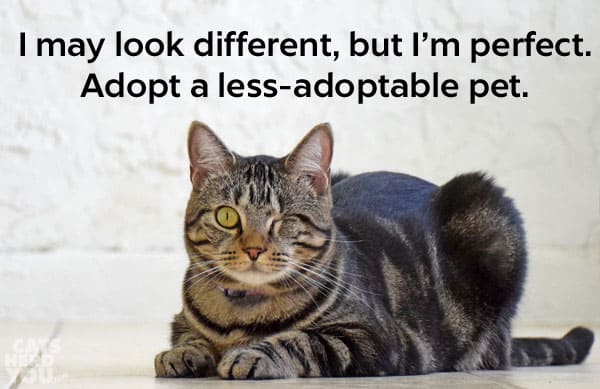
Adopt a Less-Adoptable Pet Week is a cause close to our hearts because Ashton is a less-adoptable cat.

one-eyed brown tabby cat: I may look different, but I'm perfect. Adopt a less-adoptable cat.According to a survey, 99% of shelters and rescue organizations have pets they are having difficulty placing in good homes. These “less-adoptable” pets fall into several categories.

Less Adoptable Cat Types

Senior Cats

Many adopters decide against senior cats because they are adopting after losing a previous pet, and they don’t want to imagine that happening again for a very long time. The thought of losing a senior cat to old age in only a few years makes them choose to adopt younger cats. Adopters may also be afraid of senior cats developing expensive medical conditions with their advanced age.

gray_tabby_rexWith the aging of the baby boom generation, a growing number of senior pets who lived their entire lives with a single human find themselves homeless when their human who becomes unable to take care of them due to their own age-related issues or even because of their human’s death. When the remaining family members are unable to care for the cat, frightened, disoriented senior pets don’t appear to be good potential companions and are harder to adopt.

Given time to settle into a new home, seniors can make wonderful, loving companions, great for adopters who want a cat to cuddle with but don’t want to have to wear a young cat out with a lot of exercise and play every day.

Shy Cats

Like the frightened senior pets mentioned above, shy cats don’t warm up to potential adopters when they come to a shelter or rescue organization to look for a new companion. Shy cats don’t “show well,” and their shyness can look like aggression when they are especially afraid at adoption events. The same cat that hisses at a potential adopter when being pulled out of the safety of his cage at an adoption event will come out of his shell after being given more time to warm up to strange humans, but it’s hard for the shy cat to get the chance to let his personality shine.

Shy cats can blossom in foster homes, but it can be hard for a potential adopter to take a shelter’s word that the cat cowering in their litterbox will be friendly and outgoing in their home environment once they have time to adjust to new surroundings.

Special Needs Cats

There are many types of special needs cats, such as diabetic cats or cats that need special diets for ongoing conditions. Each of these may worry potential adopters because they aren’t sure if they understand what care the cat will need, even though the extra care is often minimal. Education is key to understanding how much or little care a special need cat will require.

meowing silver tabbyOne of the most common conditions that causes cats to be considered special needs is Feline Immunodeficiency Virus (FIV), found commonly among stray cats. While there is a lot of lingering fear and misunderstanding about the transmission of this virus, studies have shown that friendly FIV-positive and negative cats live together without transmitting the disease. While FIV-positive cats should see their vet more promptly at any sign of illness, they can also live long, happy lives with their human and feline families. Still, lingering fear and misunderstanding make these cats harder to adopt.

Imperfect Cats

Many cats are simply imperfect. Even though they need no extra care, they may be missing an eye like our Ashton or a leg like our Cousin Earl. Others might have tattered ears or visible scars. These imperfections are usually from a previous mishap, and the cats simply aren’t as appealing to potential adopters on sight.

These different-looking cats are just as wonderful companions as their two-eyed or four-legged companions, but they are often overlooked because they don’t look as appealing.

Bonded Pairs

Cats who are relinquished to a shelter or rescue together sometimes turn to each other for comfort. It’s no wonder that the rescue organization decides that they must go to a home together so that they can continue to rely on each other for solace during stressful transitions and play together during joyful times. Not everyone wants to adopt two cats, or if they do, they may not want the particular combination of personalities, colors, or other characteristics that the bonded pair represents.

two longhaired cats

Bonded pairs of cats, with each other to help their confidence, may adapt more quickly to new situations then they would alone, but some adopters still hesitate.

Cats Who Must be “Onlies”

At the other end of the spectrum, cats who must go to homes with no other cats can take longer to adopt because the most likely adopters already have one or more cats. Some only cats also need to be the only pet in the home so they can’t join a household with dogs or other pets, either. This limits their potential pool of adopters and keeps them at the shelter or rescue group longer.

These “only” cats bond closely to their human family members, especially since they have no other feline companions.

Black Cats

People who work in shelters and rescues continue to report that black cats with wonderful personalities take longer to adopt than their more colorful counterparts. Black cats may not show well in the muted light of cages in shelters or may be victims of superstitions about their being unlucky. Anyone who has lived with a black cat can report that they are anything but unlucky, but are great companions with winning personalities.

black cat

What Shelters Are Doing to Help

Most shelters work to get their less-adoptable pets extra attention, knowing that they are going to take more families considering them than average before one decides that they have found the perfect companion.

Some shelters and rescues offer programs that help defray the potential costs of medical care that might put people off of adopting seniors or special needs cats. Others offer foster-to-adopt arrangements so that shy cats have time to come out of their shell in a home environment and show their potential adopter what loving companions they can be.

A number of shelters are also working hard to find innovative ways to help seniors keep their less-adoptable pets, serve as long-term foster homes, and adopt senior pets of their own.

Shelter outreach and programs alone won’t help place all of their less-adoptable pets. The next time you’re looking for a new family member, think beyond a kitten to a less-adoptable cat who could be a perfect fit for your family!


References and further reading:

Petfinder, Adopt a Less Adoptable Pet Week
The Veterinary Journal, Transmission of feline immunodeficiency virus (FIV) among cohabiting cats in two cat rescue shelters

Photo credit:

depositphotos/cynoclub

Share Share on email
Email
Share on twitter
Twitter
Share on facebook
Facebook
Share on pinterest
Pinterest
Share on google
Google
Share on tumblr
Tumblr
Share on linkedin
Linkedin

September 21, 2015 Filed Under: Rescue Tagged With: Ashton 30 Comments

How Families Search for Lost Pets

As we saw in last week’s post about the month-long search for Phoebe that involved our entire neighborhood, some families go to great lengths to find their lost pet. The ASPCA conducted a survey to better understand how often cats and dogs are lost and what their families to recover them.

While the survey discovered that over the past five years, approximately the same percentages of households had either a cat or dog go missing (14% of households with dogs and 15% of households with cats), the difference in statistics for cats and dogs reveal real differences in how people search for lost pets and how likely they are to locate them.

Lost Pets and Identification

The study found that nearly all of the dogs but under 1/3 of the lost cats were wearing collars. Over half of the dogs and cats wearing a collar had some form of identification on it.

Ashton wears a collarUnder 1/4 of dogs and 11% of cats had microchips at the time they were lost. A surprising 11% of dogs and 56% had no identification at all when they were lost, including no rabies, license, ID tag, or microchip. With so many pets lost without identification, how many could possibly make it home safely?

Looking for Lost Pets

There are a lot of ways to search for lost pets, and not all of them proved successful strategies. Over ¾ of households who lost pets said that they waited for their pet to come home. 75% searchers for dogs went to the shelter to look for a lost pet, while only 22% of searches for cats checked the shelter.

Percentage of pets searched for at sheltersAcross the board, a smaller percentage of families with lost cats are tried various strategies to get them home, including putting an ad in the paper or calling veterinarians. It almost seems that the families with cats believed the myths about cats being independent.

Finding Lost Pets

Nearly half of the dogs were located by searching the neighborhood, while 20% came home on their own. On the other hand, 59% of cats returned on their own, and under 1/3 were found by searching the neighborhood.

missing_cat_sign_xsA tag or microchip bearing the family’s information information brought 15% of dogs home but only helped bring 2% cats home. Half of those who searched for dogs said they had unsuccessfully tried hanging signs around the neighborhood, but only 17% of searches for cats tried it.

More Effort to Return Cats to Owners Needed

The survey showed that although a similar percentage of cats and dogs were lost, there was a much lower use of identification on cats as well as a lower overall rate of cats returning to their families.

A previous pair of studies about lost cats and dogs found that families do not check their local shelter until their cat has been missing for three days compared to one day for dogs. Additionally, families only visited the shelter once every eight days looking for their cat, while the families of dogs checked the shelter every three days.

Whether it’s a mistaken belief that cats can take care of themselves or some other factor, it’s important be more proactive than the average cat’s family to make sure that your missing cat gets home safely. Cats like Phoebe wouldn’t find their way home from far away on their own, but a family’s reaching out and being persistent can be the difference it takes to get a kitty home to the family again.


References

Animals, Frequency of Lost Dogs and Cats in the United States and the Methods Used to Locate Them
Journal of the American Veterinary Medical Association, Search and identification methods that owners use to find a lost dog
Journal of the American Veterinary Medical Association, Search and identification methods that owners use to find a lost cat

Share Share on email
Email
Share on twitter
Twitter
Share on facebook
Facebook
Share on pinterest
Pinterest
Share on google
Google
Share on tumblr
Tumblr
Share on linkedin
Linkedin

June 25, 2015 Filed Under: Rescue 15 Comments

What to do When a Cat is Lost

Your indoor cat doesn’t have a collar or a microchip, and she has somehow gotten out of the house. What do you do? This happened to one of our neighbors recently. If you’re Christine Williams, you don’t give up hope, and you keep working to get your lost cat home.

Phoebe Phoebe was a healthy, 12 year cat who had lived her whole life in the comfort of an indoor home with Christine. Christine came in very late from work one Monday night and tiredly accepted her boyfriend’s assurance that he had seen Phoebe in the other room. The next morning, she realized that something was wrong and that Phoebe was actually missing. The automatic feeder dropped Phoebe’s meal into the bowl at 8:55 am, and Phoebe didn’t come running to eat it, so Christine knew that Phoebe had been gone since sometime after last night’s dinnertime.

“I tore apart the house… event turned the sofa upside-down,” Christine says. She searched the three-block area. Lost pet web sites said that an indoor cat is usually within a 200 foot radius of the house, but there were no bushes or hiding places around the house… or around any of the neighbor’s houses. Christine was worried that the neighbor’s cat had frightened Phoebe away, or the lawn service which had been through the neighborhood that morning.

When the first day’s searching didn’t turn up the orange tabby, she realized that she was going to have to get more methodical in her searches to bring Phoebe home safely.

 Reach Out on Social Media

Phoebe “I was never a Facebook person,” Christine admits. But to find Phoebe, Christine didn’t just get active on Facebook, she joined other websites, including Nextdoor, which is a social network limited to your neighborhood.

A few days after Phoebe went missing, I started this Facebook campaign. Phoebe’s feeder would give her food at 8:55 at night, so I put it outside in case she could hear it. I asked people to send good thoughts, vibes, prayers, whatever at that time. I really believe in the power of positive thought. So every night at 8:55, I would post a photo of Phoebe and say ‘Phoebe come home!’” Soon, she would run into work who would flash her a thumbs-up and say “8:55!”

 Put up Signs

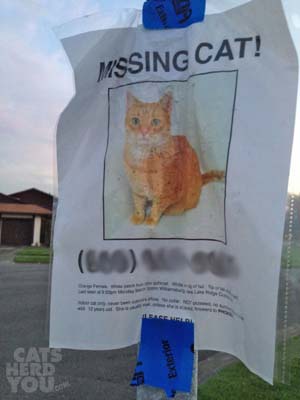
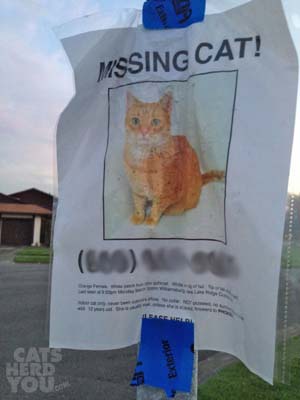
Missing cat signAt first, Christine put hastily-created flyers in her neighbor’s mailboxes. “I found out later I shouldn’t do that. It’s not legal to put things in mailboxes.” she says. Soon, she was putting flyers up at every intersection in the neighborhood and handing them out to nearby businesses.

“This was our staging area,” Christine explains, pointing to an area just inside her front door. “ We had posters on one side, and then we had flashlights and we had treats and catnip and toys. Every time we came home we had to get into a routine because we would be coveed in grass and stuff so we would leave all of our stuff out by the front door.”

 Canvass the Neighborhood

“That first week, I was crawling in every busy, every nook, every cranny within a four block radius, which is pretty much the whole neighborhood,” Christine explains. There were porches with ripped screen enclosures that worried her because Phoebe might have gotten access to a space that was out of the reach of the search.

“I met so many neighbors,” Christine says. “When I was sure that no one in the area hadn’t heard about Phoebe, I met an older gentleman who lives alone and is disabled. His door was open, and Phoebe could have walked right in.”

 Leave Hints for the Lost Cat’s Senses

Christine had the feeder outside to make the sound of dropping a meal every night at 8:55 pm. She left the door to her sunporch open to let the smell of the familiar place out, and she walked through the wooded area between her home and likely hiding places to make a scent trail that a cat could follow to get home.

She even left clothing out to help enhance the scent trail. Being able to alert the neighborhood by social media that she was going to leave clothing outside meant that it was less likely to be removed by well-meaning neighbors.

 Talk to Neighbors

“Every time I was out walking, people would ask, ‘Hey have you found your cat?’ ‘No, I’m still looking.’ The neighbors were super-great”, Christine says.

Phoebe She got lots of phone calls with potential Phoebe sightings. She got to know the routines of the neighborhood… and the neighborhood cats, especially the surprising number of orange ones. “Every night at 6:00 I would get a call saying ‘I see a cat and it might be yours!’ so I would say okay and run out there. As the month went on, I didn’t always go immediately and would ask them to snap a picture and have them send it to me first. And I’d say, ‘Yeah, that’s that other cat again!’ Then he would go to the patio homes for the evening, then over by the gas station around midnight. The midnights were crazy because I would get calls at midnight and jump out of bed to run over there.”

Another neighbor around the corner from Christine had two orange cats who he would let out when he got home from work, then let back in around 9pm every day. One Sunday morning, Christine started to get calls that an orange cat had been sighted, but when she got there to check it out, it was one of the neighbor’s two orange cats. “What are you doing out?” Christine asked the cat. “You’re supposed to be in your garage right now!”

PhoebeAbout a week after Phoebe went missing, a resident in a nearby neighborhood righted an overturned wheelbarrow in her yard and something orange darted out. She contacted Christine the next day. Christine went to take a look, but the cat was long gone. It was the only call she got while Phoebe was missing that Christine wasn’t able to find the cat that the caller told her about. Since it was located further from home than any other call and across a busy road, she was fairly certain the cat couldn’t have been Phoebe. To be safe, Christine started putting up flyers in that neighborhood, too.

One woman called and apologetically said that she had seen an orange cat dead by the roadside. The woman said it had been a week or two earlier, and she couldn’t give an exact location or even a road name. But the caller was insistent that it was Phoebe that she had seen. “I was skeptical,” Christine says, “but I was shaken up by it.”

Hire Dogs

After three weeks of searching, Christine started to wonder she wasn’t limited by her senses, and she started wishing she had a search dog who could smell for Phoebe. She did a little research and it turned out there was one in the area who performed search and rescue and was for hire. “The dog sniffed Phoebe’s bed and then walked around with his handler… I told the dog handler about the call the night before from the woman insisting that Phoebe had been hit by a car. The handler said that the dog would know. He could tell if Phoebe was deceased or had left the area.”

There was so much rain since Phoebe went missing that the dog couldn’t get a good trail, but the dog signaled in the back yard of a house down the street that had a lot of landscaping and rockwork. The dog handler said that Phoebe had spent time there.

“The dog gave us hope. It said that Phoebe was still alive, still in the area.” That helped determine a location to set up a feeding station to try to draw Phoebe in.

Phoebe

Wildlife Camera and Humane Trap

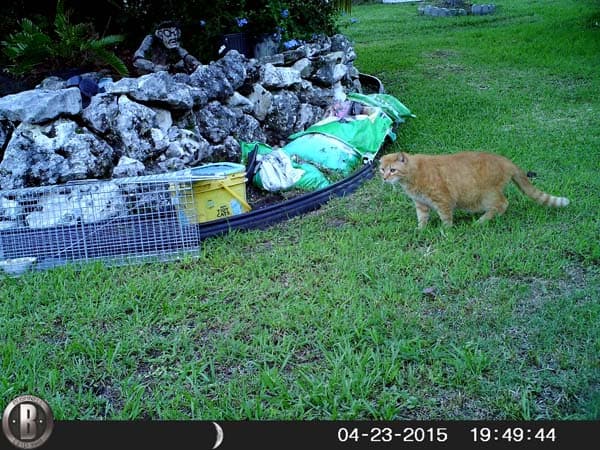
Christine rented a wildlife camera that could take photos both day and night, and she set it up to point to the feeding station. “While I was searching the neighborhood, I had seen 30 or 40 cats. There’s a food bowl out on each street. At least one,” Christine says. “And there are so many more. There were cats I’d never seen while searching coming up to the food bowl.”

When she checked the wildlife camera, a cat started to appear there that looked a lot like Phoebe. She couldn’t see if the cat was identical, but at nearly four weeks missing, Christine was grasping at straws.

orange cat captured by wildlife camera

One of the neighbors mentioned having seen an orange cat. So Christine set up a trap and settled in for a long evening of waiting. “At 7 pm, we caught a cat. It was orange, and I went up to it. I was thinking, could it be her? It looked just like her, but it wasn’t her. He was missing an ear, like it was mangled.”

orange cat in trap

The disappointment of trapping an orange cat and having it not be Phoebe was difficult after four weeks of searching. “I was sitting on the ground crying. That was a huge, huge blow. I thought, what are we doing?”

Don’t Give Up

After four weeks of searching and the disappointment of the orange cat, Christine was disheartened. “We decided early on we weren’t going to give up because of the stories you hear online where cats are found five or six months later,” she says. She made plans to print up more flyers and send out another blast through the neighborhood, asking people to look on porches, under things, and around vacant homes.

A month after Phoebe went missing, Gwendolyn, the neighbor who had previously overturned the wheelbarrow and seen the orange cat dart out posted a message to the neighborhood Nextdoor web site that she thought she had seen Phoebe.

Another neighbor saw the message and ran outside to get Christine’s phone number from one of the flyers and called her.

Nextdoor_Phoebe02

At the same time, another neighbor also called Christine to give her the information.

Nextdoor_Phoebe03

Christine called Gwendolyn back and she told her about a vacant house nearby. Christine hurriedly closed the windows on the house that were open to try to lure Phoebe with the scent of home and ran to the car. When she arrived, she searched the area where Gwendolyn had seen the orange cat, but she couldn’t find anything.

“I thought as long as I was here, I should search around the other houses. Then I realized I was going to miss the 8:55 food drop and prayers on Facebook. I posted that I was out following up on a lead and would miss it, but for everyone to still send happy thoughts at 8:55,” Christine says. She walked down the block shaking a cup of treats, looking in bushes and drains. Then she walked back up behind the houses on the block. It was getting so dark that she was running into low-hanging tree limbs. She saw neighborhood cats and thought this couldn’t possibly be the place, since Phoebe doesn’t like other cats.

“Then I thought I heard a sound ‘Phoebe!’ I called. A little face popped out from behind a bird of paradise plant ‘Phoebe!’ I knelt down and reached out a hand with the treats, and she came running up to me,” Christine recalls. “And I thought, ‘What just happened? Was it really that easy?’” She picked Phoebe up and realized that she still had a flashlight in one hand and her car keys buried in her pocket. “I was holding her trying to figure out what to do. You can hold her a little, but she starts to squirm.” Christine abandoned her flashlight. “I was right next door to where I had parked. She was clawing my back at this point, and she was so, so skinny. I got her into the car and I locked the car like she could somehow get out if I didn’t lock the doors.”

Christine started the car for a careful drive home as Phoebe at in the back seat, and she saw that the clock read 8:55. All of the positive thinking from her friends had helped bring Phoebe home. And a lot of neighbors all looking out for one little, orange cat.

Nextdoor_Phoebe04

Phoebe Found

Missing Cat Found sign Phoebe was checked out by a vet the morning after her return, and she didn’t have a scratch on her, though she had lost half of her body weight. She has since been microchipped, just in case she gets out again.

Two days later, another neighborhood cat was killed by coyotes a block away from where Christine ultimately found Phoebe. Christine found her just in time.

Six weeks later, Phoebe is slowly regaining weight after her drastic weight loss during her time lost. And Christine has a new appreciation for her neighborhood and for her neighbors. “People were so supportive,” she says. It was ultimately neighbors looking for Phoebe and a little help from social media that helped get Phoebe home.

Special thanks to Christine Williams for taking the time to tell me the story her month-long search for Phoebe. There’s much more to the story I had to edit for space.

Share Share on email
Email
Share on twitter
Twitter
Share on facebook
Facebook
Share on pinterest
Pinterest
Share on google
Google
Share on tumblr
Tumblr
Share on linkedin
Linkedin

June 18, 2015 Filed Under: Rescue 21 Comments

  • « Previous Page
  • 1
  • …
  • 3
  • 4
  • 5
  • 6
  • 7
  • …
  • 11
  • Next Page »

Read Ashton’s Story in Rescued, Volume 2

These pawtographed books support Candy's Cats, who work tirelessly to find homes for cats in Florida.

Rescued, Volume 2: The Healing Stories of 12 Cats, Through Their Eyes. Proceeds from authographed copies benefit Candy's Cats.


Outside the US, contact us for shipping to your location.

Read Us by Email

Don't miss a thing! Cats delivered to your email.

Privacy Policy


Archives

All Rights Reserved

Articles and images on this site may not be reproduced in whole or in part without written consent. Please contact me if you are interested in reprinting or in having me write something unique for you.

Disclaimer

There are no veterinarians here. All health-related posts are the result of research and observation, but educational information is not a substitute for visiting your veterinarian. Do not self-diagnose your cat. For more information, see our disclaimer.

Policies

Disclosure Statement
Privacy Policy
Commenting Policy

Copyright © 2026 · Sometimes Cats Herd You · All Rights Reserved