Cats Herd You

Laugh. Learn. Love cats.

  • Home
  • Safety
  • Wellness
  • Rescue
  • Reviews
  • Life With Cats
  • About
  • Media Friendly
  • Contact
You are here: Home / Archives for Rescue

Scan that Stray

Last October, Lisa, one of the members of our local rescue community lost her cat Skittles. A former stray, Skittles had been hit by a car, and Lisa had nursed him back to health, eventually adopting him. While Lisa was out of town, Skittles escaped from the house. After a great deal of searching, a heartbroken Lisa resigned herself to never seeing Skittles again.

Earlier this month, the microchip company called Lisa to tell her that her cat had been reported found. A woman had been feeding the friendly stray cat, but as winter came to a close, the woman who was feeding Skittles was preparing to move back north for the summer months. She took Skittles to vet’s office, where his microchip was found, five months after he went missing.

Now Skittles is home where he belongs, and he is getting all of the love and affection he can handle. And he has a sink as a throne, too.

Skittles in sinkFrightening contingencies like these are the reason that we microchip cats, but there’s a second half to the task of getting your cat chipped and registered. Someone has to read the chip to help your cat get home. This is why it’s really important to scan that “stray” cat. The cat you think was left behind by your neighbor who just moved out might actually belong to someone two streets over who is frantically searching for her. Don’t assume. Go ahead and scan for a microchip to help be sure that someone isn’t looking for their lost friend.

When you find a lost cat, you can get the chip scanned several places:

  • Most animal shelters. The ones I spoke to said that they would be willing to scan for a chip without taking the cat into the shelter population. Call and ask what the procedure is for scanning a lost pet, and clearly identify if you are taking responsibility for the cat rather than having him or her admitted to the shelter.
  • Rescue groups. Many other rescue organizations have chip readers, too. Some areas even have groups specifically for helping reunite people with lost pets, and they are the likeliest to have a microchip scanner.
  • A veterinarian’s office. Vets implant chips and also read them. Be sure to let them know that you’re just bringing the cat in to be scanned, not for an actual appointment, and many vets perform this service at no charge.

Scan that stray. It can be the key to help get the kitty back to his home.
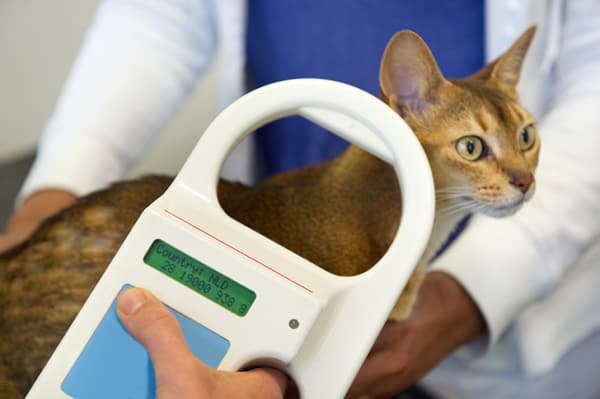
Checking for Microchip implant by cat


Photo credits:

Cat with microchip scanner, depositphotos/ivonnewierink
Skittles in sink, Lisa Moore

Share Share on email
Email
Share on twitter
Twitter
Share on facebook
Facebook
Share on pinterest
Pinterest
Share on google
Google
Share on tumblr
Tumblr
Share on linkedin
Linkedin

April 23, 2015 Filed Under: Rescue 22 Comments

Q & A with Jackson Galaxy

I was fortunate to have the chance to talk to Jackson Galaxy during his visit to Global Pet Expo. Jackson is a cat behaviorist best known for his hit Animal Planet television show My Cat from Hell. He is also author of two books, Cat Daddy and Catification.

Q: What was missing from the market that you wanted to create with your product line, the Jackson Galaxy Collection by Petmate?

Jackson Galaxy at Global Pet ExpoJG: Well everything’s missing. Honestly, cats have been so underserved, and all I’ve been doing for twenty years is collecting information and talking about what is missing in people’s homes. Working with their cats saying, “Why don’t we have this and why don’t we have that?” and really all I was waiting for was the right partner.

Petmate not only jumped on board but gave me free rein. Not only are we putting out what I think are really quality products and innovative products but I get to test them out and take them on my show and revise them. I’m working on new versions of everything at all times. The great thing is that Petmate provides the malleability for me to continually reinvent what I do, because the cats give me the information and I want to give you that information. So that’s really all I was waiting for. And you know, I’m really proud of what we’re doing.

Q: So are those toys what fill up your guitar case? What’s in that guitar case, anyhow?

JG: The guitar case is toys, is food, it’s black lights, it’s, cleansers. What else is in there? My lunch… Tons of stuff. You know, everything but a guitar.

Q: So that’s what you do in your spare time?

JG: That’s funny. Spare time!

The funny thing is that all I did for thirty years was play music and then work with cats. Now I work with cats and then play music. But free time  has been not quite forthcoming.

Q: Have you been finding time for your music?

JG: No. We just wrapped the sixth season a couple days ago and now it’s about time to make that music so people don’t think I’m a charlatan.

Q: So when are we doing to see an album?

JG: It’ll probably come more in the form of songs you can download from iTunes. I don’t have the time to record ten songs, but I definitely have time to record two or three.

Q: You have a new foundation. Can you tell me a little bit about it?

Jackson GalaxyJG: The Jackson Galaxy Foundation just got our 501(c)(3) nonprofit status which I’m more than psyched about. The objective is to take all of the years of shelter work I’ve done and apply it to the shelters that need help. And it’s not just about shelters, it’s about everybody who works for sheltered animals. But that could also mean feral cats, it could mean rescued farm animals. It’s an equal task we have here.

We can reach our no-kill objective. We’re in the home stretch, I think. When I started in this world twenty years ago, we were killing in the neighborhood of thirteen million animals a year in animal shelters. We’re down to about 3 or 4 million. We’re still in the millions, but we’re in the home stretch, and I believe that my foundation can help shelters adopt more cats first and foremost. I can help shelters get their cats into good homes, and get them adopted in a way they will stay in those homes. The work that they’re doing, that’s really the important thing.

Nobody gets how hard it is to work in an animal shelter or in a rescue or be a feral trapper. Nobody gets it. I want to be able to recognize these guys and reward out of the box thinking. Listen, I wouldn’t be here if my boss in my shelter didn’t say, You want to go to people’s homes and make it so those cats don’t come in here? Go for it!” If that wasn’t the case, I wouldn’t have this career.

I want to pay that back and I want those folks to be able to make a living — a good living — out of doing what’s best for animals. There’s a misconception that just because you want to give your live to animals you have to life to animals you have to take a pledge of poverty. You don’t have to make that choice. You just have to take action, and we want to reward that.

Q: So what’s next for you?

JG: We’ve got a bunch of stuff. Right now, the foundation takes center stage. Getting that off the ground, staffing it, making sure that’s ready to go. I’m writing my next book right now. I’m writing my next book, and the followup to Catification will be coming out for the holidays this year. It’s called Catify to Satisfy. That’ll be fun!

I’m working on a one-man show. Not really a speaking tour as much as it is a theatrical event around cats, and that should be fun, hopefully again that will be coming up.

I’m always doing shelter visits, so chances are that’s where you’ll see me. And who knows, maybe we’ll be filming more Cat from Hell, maybe not. But there’s more TV projects in the works.

Share Share on email
Email
Share on twitter
Twitter
Share on facebook
Facebook
Share on pinterest
Pinterest
Share on google
Google
Share on tumblr
Tumblr
Share on linkedin
Linkedin

March 19, 2015 Filed Under: Rescue Tagged With: interview 22 Comments

Blog the Change: Helping Hospice Patients Keep Pets

BlogtheChangeToday is a special Topical Thursday post because we’re joining with bloggers around the world in the Blog the Change for Animals event to highlight an issue where you can make a difference for animals.

Many of you probably read the story last month about Joan Price, a woman who had unexpectedly entered hospice at an assisted living facility after a hospital stay, leaving her cat, Isis alone in Joan’s apartment. Luckily for Joan, her story came to the attention of the amazing Dorian Wagner, who used Facebook to help find both an immediate foster and a permanent adopter for Isis. There’s much more to the heartwarming story, and it’s still ongoing.

Joan and Isis found a whole group of caring people on the internet to make sure that Isis was well cared for, but a lot of people in hospice and their pets aren’t that fortunate. While pets may be a source of great comfort for hospice patients, they can also be a source of worry when the patient can’t provide the kind of care their pets need. Caregivers focused on taking care of the hospice patient are often too busy with those tasks to be able to take care of pets.

Tortoiseshell_cat02How can you help?

A small but growing number of nonprofit hospice organizations recognize this and are implementing “pet peace of mind” programs. These programs are designed to help keep pets at home at a time when the terminally ill need their comfort the most. Those nonprofit hospices are often seeking volunteers to feed pets, scoop litterboxes, walk dogs, and even provide transportation from the hospice patient’s home to veterinarians or groomers.

Some of these hospice programs also help with placement planning for the pets so that the hospice patient has the peace of mind of knowing that their beloved cat or dog will have a good home if their family doesn’t have one to offer. Our local hospice organization even has PetFinder listings to help locate great homes for the pets of their patients who have nowhere else to go.

You may not be able to participate in helping care for the now-famous Isis, but there are pets of hospice patients in your community. You can make a difference close to home by making time in your schedule to help care for a cat or dog for a hospice patient. If you’re thinking of adding to your family with a new pet,  consider making an adoption commitment for a kitty or pup of a hospice patient when it’s time for the patient to give up their beloved pet.

The patient’s peace of mind that their beloved pet is safe and cared for is priceless.

Share Share on email
Email
Share on twitter
Twitter
Share on facebook
Facebook
Share on pinterest
Pinterest
Share on google
Google
Share on tumblr
Tumblr
Share on linkedin
Linkedin

January 15, 2015 Filed Under: Rescue 33 Comments

What Causes Long Stays for Black Cats in Shelters?

A study published last October in the Journal of Applied Welfare Science examined the adoption records from a no-kill shelter in New York State to see if physical attributes of the cats influenced the length of stay of cats and kittens in the shelter. Unsurprisingly, younger, lighter-colored cats were adopted more quickly than older cats with darker coats. The real surprise for me was reading that the cats with the greatest length of stay were yellow. Black cats didn’t have the longest stays at the shelter whose data was studied.

black catBut ask anyone who works or volunteers in cat rescue, and they all seem to have a “black cat who no one will adopt” story. Were the numbers in this study that far off?

The ASPCA looked at a broader number of adoptions by looking at the data from fourteen of their partner  communities in their Comprehensive Animal Risk Database to look at the risk for black dogs and cats compared to other colors. With nearly 300,000 dogs and cats in their data set, they discovered that more black dogs and cats entered the shelters than any other colors. 33% of the cats entering the shelter system were black.

No wonder there are a lot of black cats waiting for homes in shelters. There’s an oversupply!

The numbers for adoptions showed 31% of the cats adopted from the shelters were black, so there is still a shortfall of black cat adoptions. The sheer numbers of black cats in the system means they can’t be adopted fast enough.

With the black gene being a dominant one, there aren’t likely to be a lower proportion of black cats needing homes in shelters any time soon. So whether the reason that there are so many black cats needing homes is that people prefer other colors of cats or whether there are just so many awesome black cats needing homes, there are obviously more than enough black cats to go around for everybody. The important thing is the make everyone enthusiastic about adopting them so that they don’t stay in shelters or rescues too long and can get into loving forever homes.


References:

Journal of Applied Animal Welfare Science,  Age, Breed Designation, Coat Color, and Coat Pattern Influenced the Length of Stay of Cats at a No-Kill Shelter
ASPCA Professional, Black is the new White
Photo credit: depositphotos/Taden1

Share Share on email
Email
Share on twitter
Twitter
Share on facebook
Facebook
Share on pinterest
Pinterest
Share on google
Google
Share on tumblr
Tumblr
Share on linkedin
Linkedin

January 8, 2015 Filed Under: Rescue 20 Comments

  • « Previous Page
  • 1
  • …
  • 4
  • 5
  • 6
  • 7
  • 8
  • …
  • 11
  • Next Page »

Read Ashton’s Story in Rescued, Volume 2

These pawtographed books support Candy's Cats, who work tirelessly to find homes for cats in Florida.

Rescued, Volume 2: The Healing Stories of 12 Cats, Through Their Eyes. Proceeds from authographed copies benefit Candy's Cats.


Outside the US, contact us for shipping to your location.

Read Us by Email

Don't miss a thing! Cats delivered to your email.

Privacy Policy


Archives

All Rights Reserved

Articles and images on this site may not be reproduced in whole or in part without written consent. Please contact me if you are interested in reprinting or in having me write something unique for you.

Disclaimer

There are no veterinarians here. All health-related posts are the result of research and observation, but educational information is not a substitute for visiting your veterinarian. Do not self-diagnose your cat. For more information, see our disclaimer.

Policies

Disclosure Statement
Privacy Policy
Commenting Policy

Copyright © 2026 · Sometimes Cats Herd You · All Rights Reserved