
As we saw in last week’s post about the month-long search for Phoebe that involved our entire neighborhood, some families go to great lengths to find their lost pet. The ASPCA conducted a survey to better understand how often cats and dogs are lost and what their families to recover them.
While the survey discovered that over the past five years, approximately the same percentages of households had either a cat or dog go missing (14% of households with dogs and 15% of households with cats), the difference in statistics for cats and dogs reveal real differences in how people search for lost pets and how likely they are to locate them.
Lost Pets and Identification
The study found that nearly all of the dogs but under 1/3 of the lost cats were wearing collars. Over half of the dogs and cats wearing a collar had some form of identification on it.
 Under 1/4 of dogs and 11% of cats had microchips at the time they were lost. A surprising 11% of dogs and 56% had no identification at all when they were lost, including no rabies, license, ID tag, or microchip. With so many pets lost without identification, how many could possibly make it home safely?
Looking for Lost Pets
There are a lot of ways to search for lost pets, and not all of them proved successful strategies. Over ¾ of households who lost pets said that they waited for their pet to come home. 75% searchers for dogs went to the shelter to look for a lost pet, while only 22% of searches for cats checked the shelter.
 Across the board, a smaller percentage of families with lost cats are tried various strategies to get them home, including putting an ad in the paper or calling veterinarians. It almost seems that the families with cats believed the myths about cats being independent.
Finding Lost Pets
Nearly half of the dogs were located by searching the neighborhood, while 20% came home on their own. On the other hand, 59% of cats returned on their own, and under 1/3 were found by searching the neighborhood.
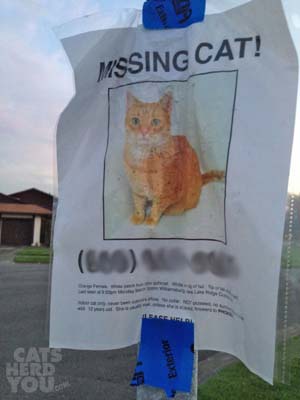 A tag or microchip bearing the family’s information information brought 15% of dogs home but only helped bring 2% cats home. Half of those who searched for dogs said they had unsuccessfully tried hanging signs around the neighborhood, but only 17% of searches for cats tried it.
More Effort to Return Cats to Owners Needed
The survey showed that although a similar percentage of cats and dogs were lost, there was a much lower use of identification on cats as well as a lower overall rate of cats returning to their families.
A previous pair of studies about lost cats and dogs found that families do not check their local shelter until their cat has been missing for three days compared to one day for dogs. Additionally, families only visited the shelter once every eight days looking for their cat, while the families of dogs checked the shelter every three days.
Whether it’s a mistaken belief that cats can take care of themselves or some other factor, it’s important be more proactive than the average cat’s family to make sure that your missing cat gets home safely. Cats like Phoebe wouldn’t find their way home from far away on their own, but a family’s reaching out and being persistent can be the difference it takes to get a kitty home to the family again.
References
Animals, Frequency of Lost Dogs and Cats in the United States and the Methods Used to Locate Them
Journal of the American Veterinary Medical Association, Search and identification methods that owners use to find a lost dog
Journal of the American Veterinary Medical Association, Search and identification methods that owners use to find a lost cat


That’s sad that so few people work hard to find their kitties!
The Cats Protection League and the RSPCA only release cats to their new owners after they have been micro chipped. Our vets always checks ours haven’t moved when we are unlucky enough to visit them!
Luv Hannah and Lucy xx xx
How sad that more humans don’t put in more effort to look for their cats.
It’s just unimaginable that so few people look for lost cats. Just one more way they’re looked at as “disposable” pets. So sad.
What poor statistics for the kitties. It makes me so sad for them. When two of my cats were missing (luckily I never had more than that), signs were up in less than 24 hours, calls had been made to all local vets with photos faxed to them, and photo and description added to the local shelters web-site, with constant calls to them. Of course, as I mentioned in the previous post about Phoebe, all the kitties wear collars with I.D. 24/7. Thanks for pointing out the differences and maybe getting some individuals to change the way they go about things.
guys…a well written post today…thanx for takin de time ta write thiz & post thiz…round heer when a kitteh leeves de shelter….him iz chipped bee for him walks out de door with hiz new peepulz…. & sum peepulz round heer go ta grate lenghtz ta look for ther missin kitteh, otherz….knot sew much sew 🙁
Such interesting and scary statistics! We don’t wear collars because of all of our fur and we don’t have microchips (yet). Mom Paula is seriously considering the microchip, even though we stay indoors. She’s very concerned that if we got out, someone would grab us and keep us and if there was a microchip, a vet could realize the cat didn’t belong to that person. We wonder if all vets scan for microchips when new pets visit…
Lost is sad, people should act quickly and not give up too soon.
Excellent post. Sad statistics for kitties. I think microchips are very important for us.
ugh – that makes us nuts. mom cringes every time she is at the clinic and hears someone refuse to chip their pets. of course, people need to keep them updated too – our rescue has gotten several cats with info that is out of date and we can’t contact anyone.
True, people should not give up too soon in finding their furry best pals.
Very interesting statistics ! It’s scary that so few people look actively for their lost cat. Purrs
Do you know how my Aunt searched for her lost cat? She went to Bermuda. I’m so disappointed. Poor BB. Apparently cat parents feel that since there are so many shelter cats, theirs can be quickly replaced.
This is a really good post. Very informative. We wear collars with ID because Mommy is a big worry wort. And we’re chipped, too. It’s sad that not everyone looks for their lost cats.
Sad that more humans don’t put in more effort to look for their cats 🙁