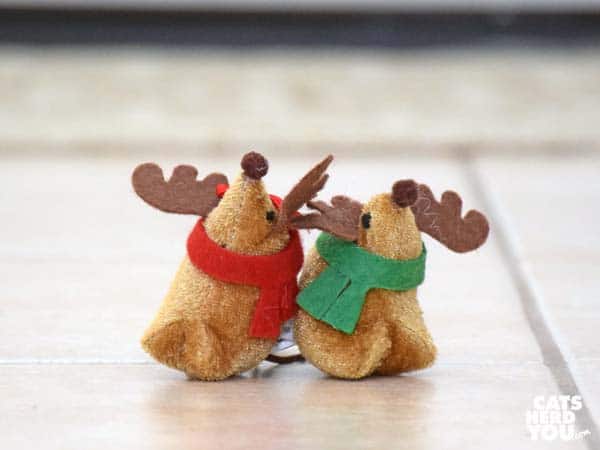
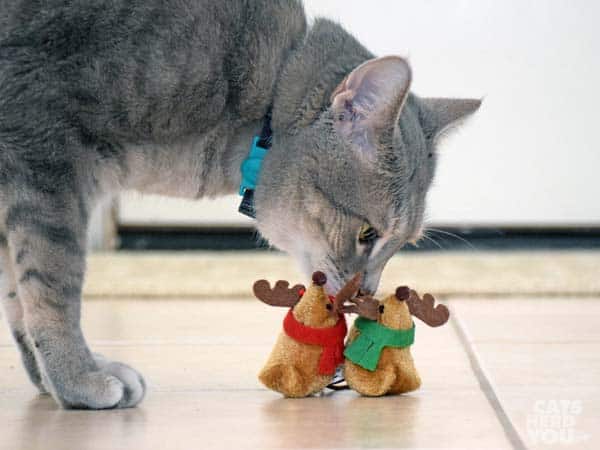
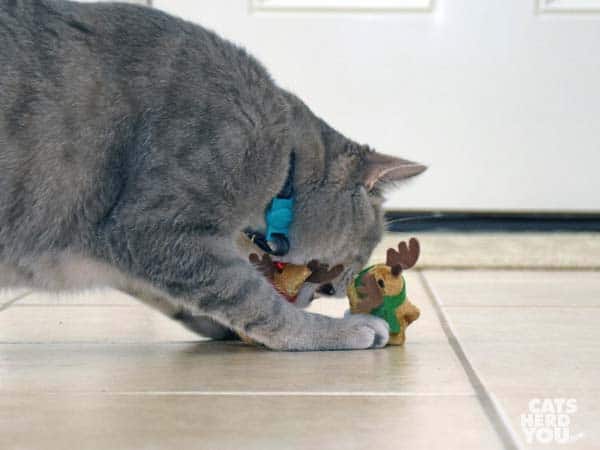
Merry Christmas to all of our friends who are celebrating today. You make our world a brighter, more wonderful place, and we treasure each and every one of you.


Laugh. Learn. Love cats.
If you were reading along last week, I posted some tips for your cat photography about lighting. I’m not really a photographer. I didn’t even stay in a Holiday Inn Express last night! But I have taken enough photos of my own cats to know some of what works… and I can talk about it on a fairly nontechnical basis to other hobbyists like you.
My remaining tips for your cat photography:
Cats sleep 18 hours a day. They also have short attention spans a lot of the time unless food is involved. That means if your camera is put away in a safely locked cabinet inside a difficult-to-open case, by the time you fetch the camera to take a photo, the precious moment you wanted to capture is long gone. Protecting your camera is great unless it keeps you from using it for taking the pictures you want to get!
So get your camera out of storage and have it where you can grab it to take a quick photo when the cute happens. When I’m home on the weekend during the hours where my house has decent natural light, my camera is usually on my desk where it’s easy to access.
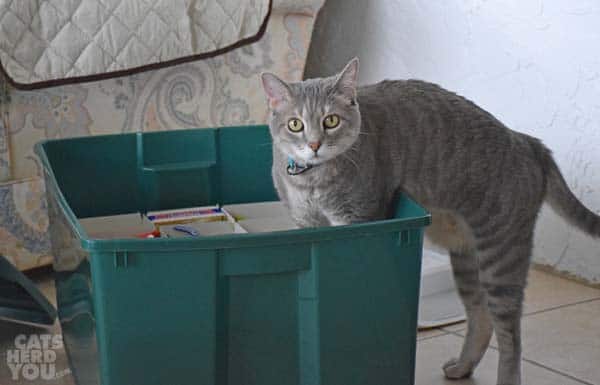
This also means anticipating. Before I started to set up my Christmas tree this year, I put my camera on a table in the room where I was assembling the tree. That’s how I caught Pierre shopping through the box of ornaments.
Okay, I’m not going to lie here. My cats are mostly lazy. If Ashton didn’t have to walk from where she sleeps to the food bowl, she probably wouldn’t get any exercise at all if she had anything to say about it. Sometimes I look over the photos I’ve taken recently only to realize “Hey, they’re just sitting around!”
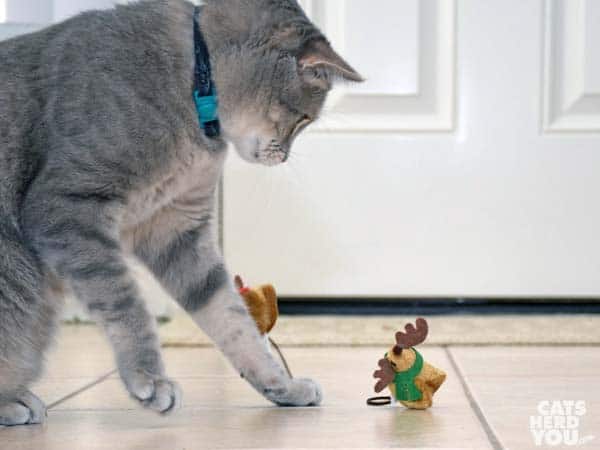
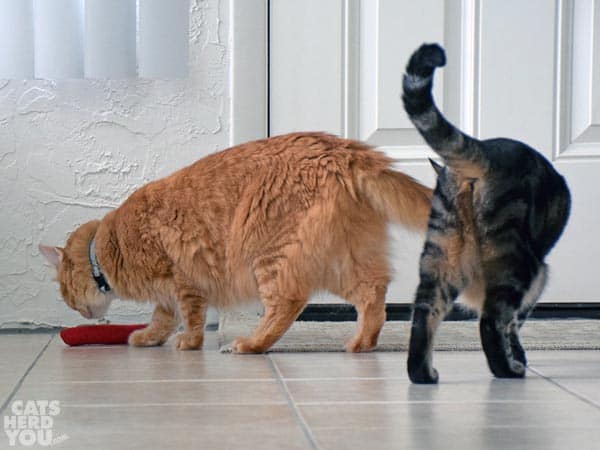
To get your kitties moving, take advantage of the curiosity cats are known for: Grab something unusual and put it in the middle of the floor, and don’t let your cat into the room until you’re ready with the camera. You may only have 30 seconds or a minute, but that first inquisitive exploration of a new thing is golden.

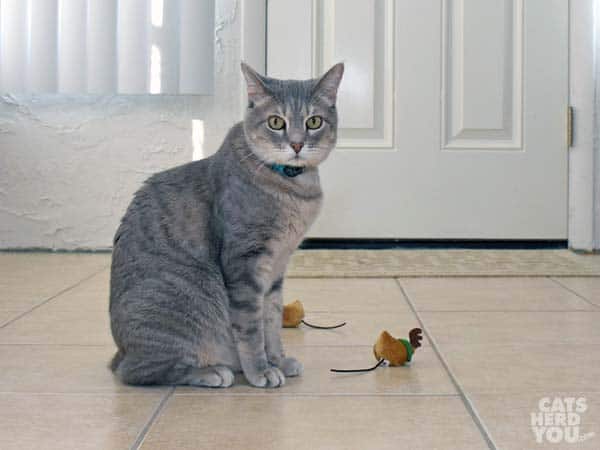
Bonus tip: If you can, put the object somewhere between you and the entrance door. If the kitty enters the room from beyond the new object and approaches it, you’ll be viewing her from the front or side. If your kitty walks past you to see the object, you’re going to be seeing her tail, which probably isn’t the end you prefer to photograph. Newton and Ashton demonstrate:
A cat’s world is at their eye level. When you take photos of them from your standing height, you tend to look down at them and not see their face or their line of sight, which makes the image less engaging. To enter a cat’s world, try getting down flat on the floor and view the world from their perspective. It’s a lot easier to see your kitty’s face, and even if they aren’t facing you, you may be able to capture the intensity of your kitty’s expression as he focuses elsewhere.

Since so much cat photography is indoors, what’s in the background of the photo is even more important than in outdoor photos, especially if you don’t have a fancy camera. When you take a photo of a dog — or anyone else — standing in a field and you focus on the subject, pretty much all cameras will consider the stuff on the other end of the field as outside of the focus range, so you get a pleasing, out-of-focus effect for the background.

Inside, walls are closer than a line of trees across a field, so with many cameras, your background doesn’t soften into as much of a pleasing blur. Consider trying to photograph your cat in front of a plain or uncluttered background to avoid it becoming a distraction.

Speaking of distractions, but take a hard look the stuff in the background when you’re photographing your cat. Try to look through a stranger’s eyes. You may not normally pay attention to that pile of towels you set aside to donate to your favorite shelter next week. The person looking at a photo of your cat sitting in front of those towels is going to think “why isn’t that cats climbing Mt. Towelmore?” instead of thinking about how cute your cat is. Keep them focused on the cute!
Less-busy backgrounds in photos aren’t just more appealing to the eye, they’re also a lot easier to manipulate in your photo editing software if you decide to do that later.
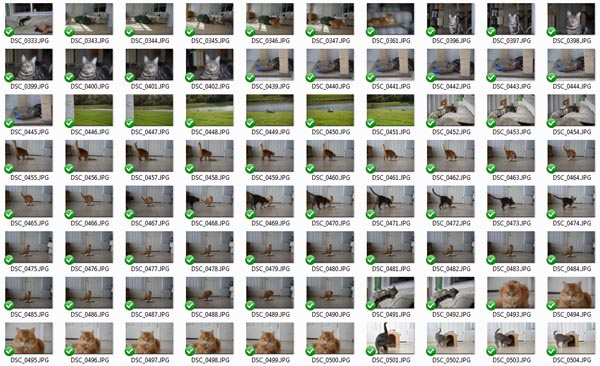
I’m always surprised when someone says they took a photo of their cat and it didn’t come out. You took just one photo? Were you worried about how much it was going to cost at the Fotomat to develop it? In our digital age, you can discard photos you don’t like, so don’t be shy about taking plenty. You can always delete them later! A professional photographer wryly called this approach “spray and pray,” but it usually yields my best results. As a non-professional photographer, I can’t be trusted to make a masterpiece on the first shot, and it’s not unusual for me to download 200 photos from a single session with the cats… and keep 5 or 6.
Here’s a screenshot of a folder of unprocessed folders. You can tell from the thumbnails that I take multiple variations of nearly everything!
If you are catching your cat in action, like playing actively with a toy, use the burst mode on your camera to take several photos in rapid succession. Even smartphones are making burst mode available on their cameras. This allows you to to not have to wait for that exact, right instant to snap a photo. Instead, you have a series of freeze-frame photos of the action to choose from.
Hopefully these tips have given you some ideas about things you may not have been doing in your photography that help you capture the photos you want of your kitty.
CC image courtesy usfotografie on flickr