One of the first things I noticed five years ago after the surgery to remove Ashton’s eye was how much it changed the shape of one side of her face. Even before the swelling from the surgery went away, that whole side of her face looked surprisingly smaller, almost deflated.
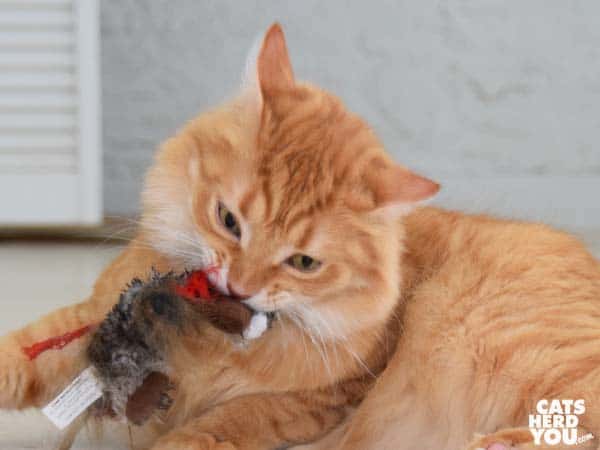
It’s something I see every day, so I don’t think about any more, and until now, I never took a photo that showed the difference in the shape of that side of her face and a normal cat’s. But the photo below happened to be at the exact right angle.

Do you see how you could practically put a ruler along her whole cheekbone, it’s so flat? (Pro tip: don’t stick a ruler in Ashton’s face. Her lack of depth perception means she really doesn’t like that kind of thing.)
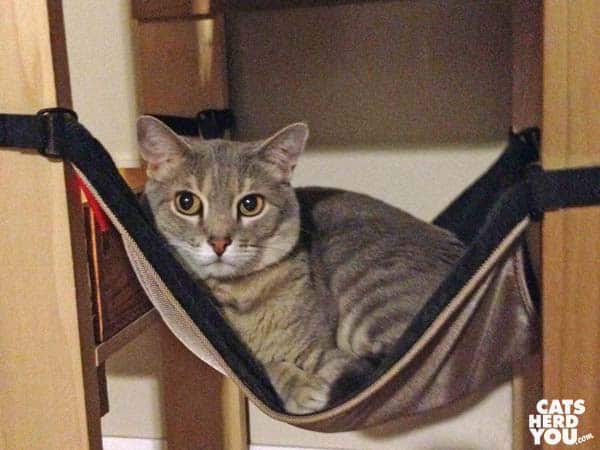
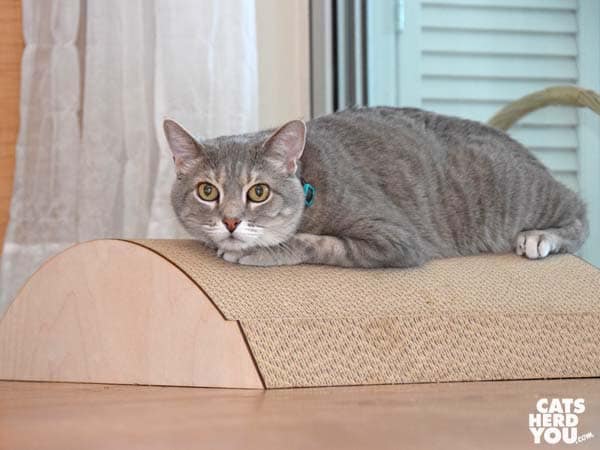
Compare the shape of the left side of Ashton’s face to the shape of Pierre’s face, taken at a similar angle.

His face bows outward. It is especially noticeable in the area below his eye, known as the maxillary region. You can see it curves inward to meet the corner of his eye. Ashton’s face does not have that curve. While there is a bone in that part of a cat’s face, the maxilla (the namesake of the maxillary region), it isn’t enough to give the face that characteristic shape. Your cat’s eye does a bit part of that, too.
Of course, the shape of Ashton’s face doesn’t make any difference in how she feels or behaves. Her permanent wink makes her that much more endearing.