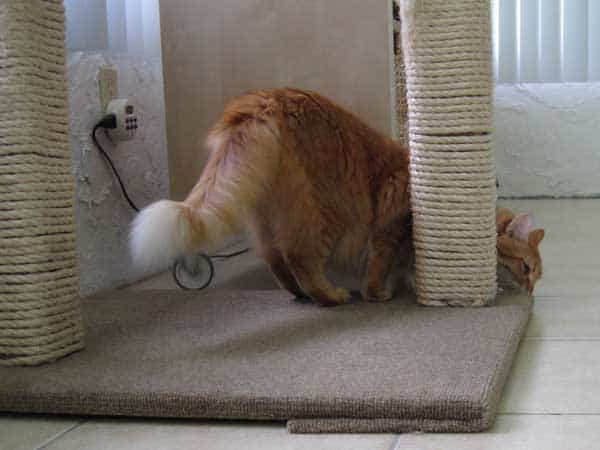
Cats Herd You

Laugh. Learn. Love cats.

  • Home
  • Safety
  • Wellness
  • Rescue
  • Reviews
  • Life With Cats
  • About
  • Media Friendly
  • Contact
You are here: Home / Archives for Cats

My Writing Process Blog Tour

Newton: We were invited to participate in the My Writing Process blog tour by the kitties of The Cat on my Head (and their human, Janet). They have been blogging since July of 2012, and one of the really fun things about visiting their site is reading the their sidebar. You don’t read sidebars often, but they used to have original poetry there, and now they feature tales from the cat scouts. It’s a fun bonus to keeping up with Lily Olivia, Mauricio, Misty May, Giulietta, Fiona, Astrid, Lisbeth, and Calista Jo.

The blog tour asks you to answer a series of questions, so I had better get started!

Newton WritingActually, I’m going to delegate this questions-answering stuff to the head peep. This sounds too much like work, and I’m a spokescat. I’m too handsome to do work.

What am I Working On?

The most time-consuming posts for the blog are Topical Thursday posts, since they usually require research. I often have one or two of them in draft form and try to have at least one ready to go. At the moment, I’m gathering photos for a draft about alternative litterboxes and finishing photo edits for a blog post about a visit to Big Cat Rescue last week.

I’m also working on getting more familiar with our local rescue community to better locate the special needs cats in our area to be featured as adorable adoptables. Rescuing Ashton made me realize how many less-adoptable cats were out there, and they all deserve to be part of families the way she is. The local cat rescue community isn’t very cohesive, so this is an ongoing challenge.

Additionally, I’m working on some research for a (non-cat-related!) urban fantasy novel that I may draft during this November’s NaNoWriMo event. I have a rough draft of another completed, but unlike a lot of writers, I write novels because I enjoy the process, not because I want to publish them. Yes, I write novels for fun. That probably defines a writer!

How Does My Writing Process Work?

I keep a list of potential Topical Thursday subjects in a couple places… some are on my phone in the Notesy app, which replicate to my PC using Dropbox. Others are in text files in a designated folder on my PC, which is backed up to Dropbox so that I can access it anywhere. I sometimes begin drafting topics in Notesy on my phone so I have a head start before I sit down if I find time when I’m away from the PC. Otherwise, I sit down at the computer and write up the topical post, then go hunting for relevant photos.

My process for writing most other posts about the cats is the opposite. I take a ton of photos, then go through a folder of raw photos to find the ones that can help tell a story… then it’s just a matter of helping the story along with some dialogue or narrative.

Unlike a lot of other folks these days who use laptops exclusively, I do my work primarily at a desktop computer. I have a geeky background in gaming where desktops are preferred for their graphics processing power, and though I don’t have time to play games on the computer any more, I stick to some of the workflows on the bigger PC. One of the things I use a lot is multiple monitors. I usually write on my left screen and edit photos on the right screen. This has the bonus effect of making it harder for Pierre to stand completely in front of all of my monitor space when I absolutely need to get something done.

Pierre: I heard that!

Pierre helps make the magic happen

Challenge accepted!

Pierre in front of computer monitors

The blog is currently publishing Monday through Friday, and I try to have the week’s post queued up by Sunday night so that I can work on other things and find time to visit everyone else’s blogs during the week. I use a WordPress plugin that displays a little calendar and marks the dates that have future posts. It’s very satisfying to see a week’s worth of day’s marked off ahead of time, and I had no idea how much of a relief it would be to not scramble for a new post nightly.

Why Do I Write What I Do?

I’m a writer. I have been writing most of my life, and I have written professionally for many years. But my professional writing is boring, technical stuff, not anything you would be interested in reading here!

I started writing Topical Thursdays features in part because it seems like among my friends, I’m the one that everyone comes to when they have a cat question. I realized that I end up knowing things about cats that others don’t simply because I read about them. I’m not an expert about anything about cats, but I like consolidating the information I know and gathering new facts to complete the picture. Occasionally, a Topical Thursday post goes live, and I have second thoughts, afraid that the content is totally obvious. When that happens, inevitably someone who I respect comments that they didn’t know about whatever it was. That really makes me glad I spend the time writing those posts.

For the rest of the blog, I post about the cats and their interactions because they’re in charge and they wouldn’t have it any other way.

Pierre: Weren’t you supposed to be writing? I don’t even see a rough draft here.

Newton: No peeking!
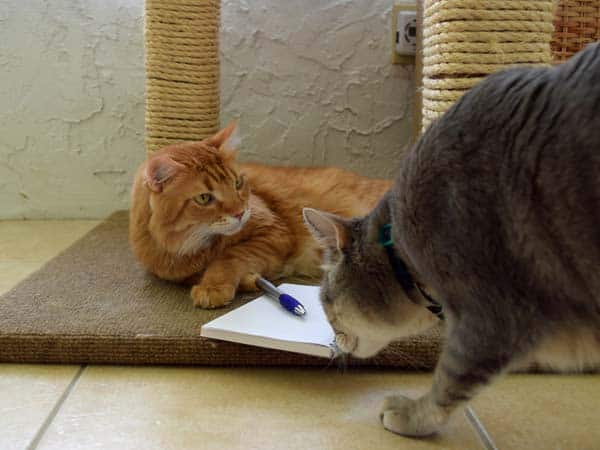
Pierre checks Newton's Deadline

Newton: The last part of the blog tour rules is that we are supposed to pass this on to three other writers. The problem is that I was lurking in the kitchen for treats instead of keeping track of who has already done the tour. So if no one has invited you yet, please consider yourself invited by me!

Share Share on email
Email
Share on twitter
Twitter
Share on facebook
Facebook
Share on pinterest
Pinterest
Share on google
Google
Share on tumblr
Tumblr
Share on linkedin
Linkedin

August 25, 2014 Filed Under: Cats Tagged With: Cats, Newton, Pierre 19 Comments

Our Friend Sparkle

The cat blogosphere is a big family, but some personalites stand head and whiskers above the others. Sparkle the Designer Cat was one of those.

ripsparkle_smFor more than a decade, she shared advice and wit on her blog. She was the first to jump in and help homeless animals or animals in need. And she was almost always the first to comment on our blog after it posted in the wee hours, so we nearly always woke up to see her name first thing in the morning.

Her advice made many of us better cats, and her example has made us better citizens of the animal community.

Like so many others talking about Sparkle around the blogosphere and on social media today, we will miss her, and we share the sorrow at losing the little part of her that was part of our family. We’re especially reaching out to to her human to let her know how sorry we are for her loss.

We will never forget Sparkle, and we’ll always keep her in our hearts. Thank you, Janiss, for sharing her with all of us.

Share Share on email
Email
Share on twitter
Twitter
Share on facebook
Facebook
Share on pinterest
Pinterest
Share on google
Google
Share on tumblr
Tumblr
Share on linkedin
Linkedin

August 21, 2014 Filed Under: Cats Tagged With: Cats

Seniors: Untapped Homes for Homeless Cats in Need

An increasing percentage of our human population is made of older adults. In the US, the majority of people over age 65 live independently, and an estimated 14% live with pets. Caring for pets can give older adults a strong sense of purpose. Older adults are more prone to social isolation, and in older adults with fewer social contacts, a study found that those having a strong attachment to a pet reported lower rates of recent illness than those who were less attached.

Pets are good for older adults, but only 14% live with pets. Using 2010 US census figures, back-of-the-envelope math says that there are 30.7 million adults over age 65 in the US living independently who have no pets. Is this an untapped source of homes for pets in need?

Helping Seniors Adopt

There may be obstacles that prevent seniors who would otherwise make good, doting homes for pets from adopting such as:

  • Fear of leaving their pets homeless if they are hospitalized or have to go to a nursing home
  • Inability to afford annual veterinary expenses on fixed income
  • Inability to afford adoption fees

Senior Woman Relaxing In Chair At Home With Pet CatGroups are starting to establish programs to help seniors who would otherwise make great homes for pets get past these potential pitfalls. Initiatives like the PAWS Seniors for Seniors program in Lynwood, WA match senior cats and dogs with senior citizens for reduced rate adoption and include extra followup as well as a guaranteed place that the adopted pet can go in case of long-term hospitalization or entry to nursing home. The Seniors for Seniors program at Animal Aid in Gippsland, Australia not only discounts adoption fees, but also offers half price routine veterinary fees and two pickup and delivery trips for the pet to and from the shelter each year to use their services.

Seniors as Foster Homes

Some senior citizens don’t feel up to the full-time responsibility of caring for a cat or dog, but they have plenty of time and love to spare certain times of the year. This can happen when seniors travel during parts of the year or when they are snowbirds and live in different areas of the country during the winter and summer. These seniors can still be vital parts of the rescue community by being foster homes for pets in need.

Programs like the Pets Alive Animal Sanctuary’s joint program with Orange County California’s Office for the Aging’s Senior for Seniors Pet Foster Program match seniors with senior pets. Like most foster programs, the rescue organization covers the costs, and the senior provides the loving care of the foster in need.

Shelter Programs Help Seniors Keep Pets

retiree couple with catIt’s clear that some shelters can afford to be more generous than others when it comes to post-adoption perks for seniors, but reduced-rate or free adoptions on pets who are matched to the disposition of the senior’s home are programs that most shelters an afford when they often run reduced rate or free adoptions other holidays or occasions.

Some seniors may not be able to adopt because their senior community won’t allow pets for fear they will be responsible for a cat or dog when a resident becomes ill or is hospitalized. Meeting with the senior community management and discussing the issue may help, especially if your shelter has a policy offering to take back the senior’s adopted pet in case of the senior’s illness or hospitalization.

With a little support, many seniors who previously weren’t able to have cats or dogs can open their homes and their hearts to sharing them with pets. Both the pets and the seniors benefit, so it’s a real win-win for everyone!


References

Waltham Pocket Book of Human-Animal Interactions, Waltham
Pet ownership and attachment as supportive factors in the health of the elderly, Pet Partners
A profile of Older Americans: 2011, Department of Health and Human Services USA
Seniors Can Save Lives of Homeless Pets, Animal Shelter Tips
Photo courtesy Matt Buck on Flickr

Share Share on email
Email
Share on twitter
Twitter
Share on facebook
Facebook
Share on pinterest
Pinterest
Share on google
Google
Share on tumblr
Tumblr
Share on linkedin
Linkedin

August 21, 2014 Filed Under: Rescue Tagged With: Cats, rescue, seniors 11 Comments

How to Build a Cat Tree

Pierre: We’re going to let the head peep write this post, because the idea of our cat tree being torn apart was too much to bear, and we all looked away. Only she knows what happened when our cat tree was refurbished, so we’ll let her tell how it worked.

Where's my cat tree?

It had been over fifteen years since the rug on the old cat tree had been replaced. The recarpeting job meant completely disassembling the tree, which was a great opportunity to capture photos of how to build a cat tree.

Materials

This cat tree was originally over-engineered with much heavier and higher quality materials than you usually find in a commercially-available cat tree, but it has lasted over 15 years, including five moves, two of which were at the mercy of professional interstate movers. You could substitute other materials, but our tree is made of the following:

  • plywood_size_01aA 44 x 24″ sheet of 3/4″ thick Plywood cut into:
    • 24 x 28″ (for base)
    • 16 x 11″ (for top)
    • 16 x 13″ (for middle tier)
      (Hint: Your local home improvement store will cut pieces to size for you when you purchase the wood there. When I originally built the tree, I didn’t know anyone with a saw. You don’t have to have one, either!)
  • An 8′ length 4 x 4 (which is actually 3 1/2 x 3 1/2″, something that people like me who don’t usually do carpentry find puzzling), cut into:
    • 48″
    • 26.25″
    • 21.25″
  • Carpet
    I bought a 4.5 foot length of a 6′ wide carpet for this project at the local home improvement store. The previous carpet that lasted fifteen years was thick and had a padded backing. This carpet is thinner and doesn’t have a backing. It is easier to manipulate the thinner carpet, but it won’t last as long.
  • Sisal rope
    The uprights of the cat tree were already wrapped since this was a refurbishment, so I can’t say how much you need. I can promise you’ll use more than you expect. This post doesn’t go over how to wrap the sisal, but I talked a little about a sisal refurbishment in a previous post.

Cat_tree01_sm

Also used in this project:

  • White glue (like Elmer’s)
  • Staple Gun with both 1/4″ and 1/2″ staples
    You might be able to get away with just 1/2″ staples, but it’s a lot easier to staple the 1/4″ staples through a single thickness of carpet and use the 1/2″ only when you have to staple through multiple thicknesses
  • Drill with a Phillips head driving bit. A magnetic drive guide helps keeps screws straight but isn’t necessary.
  • Long screws (2 1/2″)

Preparation

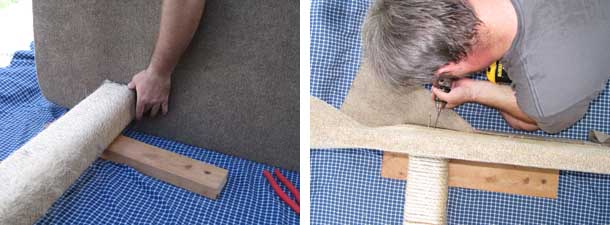
Gluing_carpet_edge_xsCut up the carpet to the appropriate size. I honestly didn’t measure, so I can’t give exact sizes, but make sure it wraps well around each piece of wood. After cutting the carpet, to prevent it from fraying, brush on a thick bead of white glue (I used Elmer’s) and make sure that it gets down into the fabric of the carpet edge so that it holds the little bits that might tend to fray. I used two layers of glue, to be sure I really got it down in there. I’m told that fabric glue might have been a better choice, but Elmer’s seems to work (and I didn’t know about the fabric glue until later). Let it dry completely. I clipped it to a line and let it dry overnight, until the glue had dried clear.

Do a rough assembly of parts and use a pen or pencil to mark where the upright posts of the cat tree meet the base. You’ll use this as the bottom of the platform, to guide you where to put the posts. Having a friend on hand to help hold things together at this point is helpful, because it’s like putting Jenga back together again, only the pieces are heavy. The goal of this step is to make sure that when you attach the upright pieces, you know where they should go so that you don’t attach upright pieces too far apart for the upper tiers to reach across them.

Assembly

Lay the largest piece of plywood on the piece of carpet cut for it and wrap the carpet around the edges. Use the staple gun to attach the carpet partway along the bottom, but don’t attach it all the way. Leave the parts where you drew the locations for the uprights unstapled for now so that you can attach the carpet over them last and cover any protruding screw heads to protect your floor.

stapling carpet on base

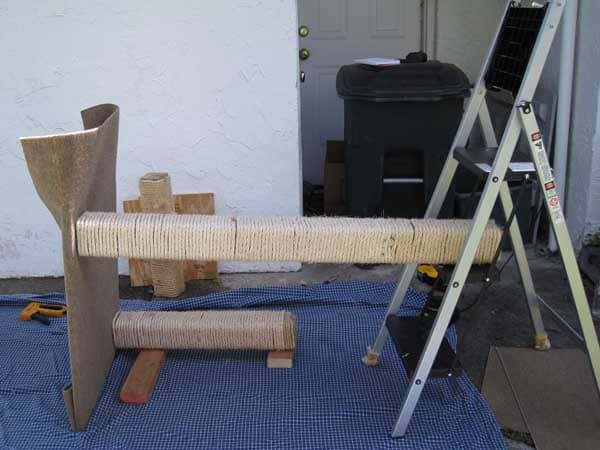
Now the tricky part starts. Use something to prop the upright post so that it lays flat but is the appropriate distance from the edge of the base. We used scrap wood that was left over from a previous project. Then position the first upright post in place against the base and screw through the base into it. Use at least three or four screws to be sure that it’s really secure. Remember, your cat is going to be launching on and off of this thing, so keeping it sturdy is important.

attaching the base to an upright

Turn the base and attach the second post to it the same way. It helps if you can support the already-attached post, since it’s heavy and can make the base unwieldy. A step ladder proved a good height to prop the existing post while the second one was attached.

Attaching the second post to the base

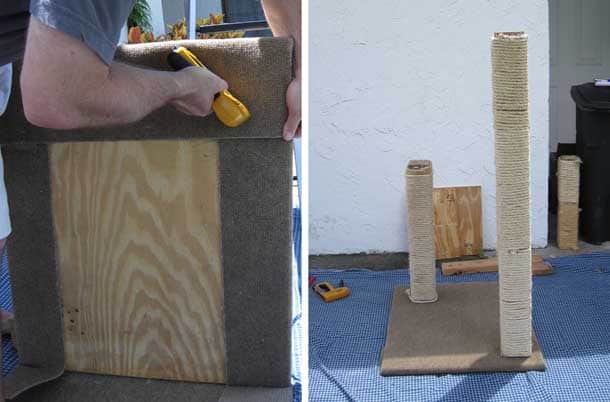
Once both posts are attached to the base, finish folding the rug around the bottom of the base and staple it securely. You can use a hammer to really knock the staples flat and make sure they won’t scratch your floor.

cat_tree_08a_baseattached

Next, lay the remaining platforms on their respective pieces of carpet. Fold the carpet around them and staple securely. You will need the 1/2″ staples for the places that the carpet overlaps in several thicknesses. Again, you can use a hammer to make sure that the staples are flush with the wood.

Cat_tree_09a_carpeting_platforms

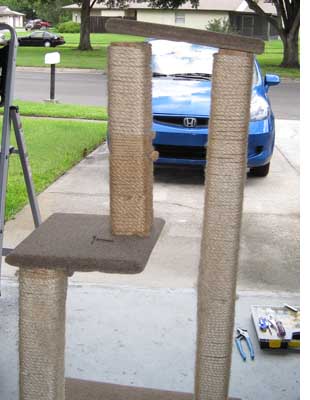
Position the corner of the middle platform on the shorter post and screw it on.

Cat tree screws are flush in carpetIf you drive the screws directly down into the carpet and tighten them flush, they will vanish into the texture of the carpet, and they won’t pose a hazard to the cats when they use the tree.

You want to make sure that nothing is sticking up or through the platforms that could poke up and injure a cat climbing on the tree, and also make sure that all screws and other hardware are flush with the wood so that they don’t pose any kind of an injury hazard. Having a tree hurt them is a sure way to prevent a cat from ever using it again.

(This is the point in the project where Florida’s daily 4pm rainstorm arrived several hours early, and the whole project had to relocate to the garage. I only took a couple photos in the garage because I may overshare a lot of things, but my messy garage is not one of them.)

cat_tree11_top_platform_xs_LAttach the corner of the small, top platform to the tall pole.

Now you have the middle platform attached to the shorter pole and the top platform attached to the tall pole. This allows you to adjust the location of the final pole so that it spans the distance between the middle and top platforms.

Screwing them in is a little tricky. This would have been easier if the rain hadn’t driven us indoors, so I don’t have photos of the attachment process. Screw the top of the pole into the top platform, then lay down and screw up through the middle platform to screw the bottom of the pole securely to the middle platform.

If the cat tree was being made from scratch, the final step would be to wrap the poles in sisal rope. Since since this was a refurbishment, they were already wrapped, and the cat tree could go back into the house.

The result…

Newton: This doesn’t smell quite like my cat tree.

cat_tree12_inspectorN_sm

Newton: Hey, Pierre, what do you think?

Pierre: *sniff sniff* You’re right. This doesn’t smell the same.

pierre and newton on refurbished tree

Pierre: It’s acceptable. But it’s going to take some time for it to smell the right way. Don’t do that to my tree again soon, okay?

cat_tree13_pierre_sm


Special thanks to the manpeep for his help with recarpeting the cat tree and for doing all the stuff with power tools. The project went much faster with his help!

Share Share on email
Email
Share on twitter
Twitter
Share on facebook
Facebook
Share on pinterest
Pinterest
Share on google
Google
Share on tumblr
Tumblr
Share on linkedin
Linkedin

August 14, 2014 Filed Under: Cats Tagged With: cat tree, Cats, diy, Newton, Pierre 18 Comments

  • « Previous Page
  • 1
  • 2
  • 3
  • 4
  • 5
  • 6
  • Next Page »

Read Ashton’s Story in Rescued, Volume 2

These pawtographed books support Candy's Cats, who work tirelessly to find homes for cats in Florida.

Rescued, Volume 2: The Healing Stories of 12 Cats, Through Their Eyes. Proceeds from authographed copies benefit Candy's Cats.


Outside the US, contact us for shipping to your location.

Read Us by Email

Don't miss a thing! Cats delivered to your email.

Privacy Policy


Archives

All Rights Reserved

Articles and images on this site may not be reproduced in whole or in part without written consent. Please contact me if you are interested in reprinting or in having me write something unique for you.

Disclaimer

There are no veterinarians here. All health-related posts are the result of research and observation, but educational information is not a substitute for visiting your veterinarian. Do not self-diagnose your cat. For more information, see our disclaimer.

Policies

Disclosure Statement
Privacy Policy
Commenting Policy

Copyright © 2026 · Sometimes Cats Herd You · All Rights Reserved