Cats Herd You

Laugh. Learn. Love cats.

  • Home
  • Safety
  • Wellness
  • Rescue
  • Reviews
  • Life With Cats
  • About
  • Media Friendly
  • Contact

Very Meowy Christmas

We have really enjoyed having a tree in the house this past month.

In fact, we take shifts guarding it. We spend time there morning …

one-eyed brown tabby cat in front of christmas tres

… noon ….

orange tabby cat under christmas tree

… and night!

gray tabby cat under christmas tree

Cupcake heard the rumor that the whole tree thing is about to pay off, so she’s going to wait right here to see what happens.

black and white tuxedo kitten in christmas tree

We’re wishing all of our friends a Merry Christmas if that’s what you celebrate today. But most of all, we wish every one of of you a day full of peace and joy.

And catnip. Lots of catnip.

Share Share on email
Email
Share on twitter
Twitter
Share on facebook
Facebook
Share on pinterest
Pinterest
Share on google
Google
Share on tumblr
Tumblr
Share on linkedin
Linkedin

December 25, 2017 Filed Under: Cats Tagged With: Ashton, Cupcake, Newton, Pierre 24 Comments

Squirrel Watchers

Cupcake: Mr. Newton! Come quick! Leaves are moving!

black and white tuxedo kitten looks out screen door

Cupcake: Hi, Miss Ashton. Did you see these leaves?

Ashton: Lots of times. Look up. There’s something even better.

black and white tuxedo kitten and one-eyed brown tabby cat look out screen door

Cupcake: Whoa! Mr. Newton! Come quick!

Newton: What’s going on, kid?

gray tabby cat, black and white tuxedo kitten, orange tabby cat, and one-eyed brown tabby cat look out screen door

Cupcake: Do you see what’s up in the tree?

Newton: So close, but so far away, kid. 

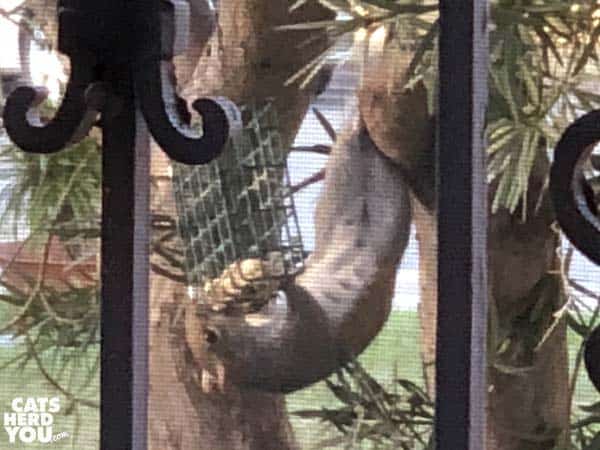
acrobatic squirrel eats upside-down

Pierre: You woke me up for a squirrel outside? I thought I told you not to wake me up unless the squirrel was inside.

gray tabby cat, black and white tuxedo kitten, orange tabby cat, and one-eyed brown tabby cat look out screen door

Cupcake: Do you think it’s hard to eat upside-down? 

Ashton: I never tried. Why don’t you turn your bowl upside-down at dinner and I’ll try eating it.

acrobatic squirrel eats upside-down

Share Share on email
Email
Share on twitter
Twitter
Share on facebook
Facebook
Share on pinterest
Pinterest
Share on google
Google
Share on tumblr
Tumblr
Share on linkedin
Linkedin

December 22, 2017 Filed Under: Cats Tagged With: Ashton, Cupcake, Newton, Pierre 16 Comments

Hyperthyroidism and Your Cat

Another friend of ours just had a cat diagnosed with hyperthyroidism, and I wanted to share an overview of the things I shared with her. Having had four hyperthyroid cats in our family, this is something I’m familiar with.

What is hyperthyroidism?

Hyperthyroidism is a hormone disorder in cats, where the thyroid gland produces too much of the thyroid hormone. Cats with hyperthyroidism often lose weight, seem restless or even hyperactive. Some hyperthyroid cats can even seem aggressive.

What you can’t see from the outside is that a hyperthyroid cat’s body has to work a lot harder with all these extra thyroid hormones telling it to go, go, go. That makes the condition hard on a cat’s heart and kidneys.

hyperthyroid

The thing your vet often doesn’t say is that all hyperthyroid cats have a tumor, usually benign, in their thyroid causing it to overproduce. I had four hyperthyroid cats, including one that went through radioactive iodine treatment, and no one vet said the word tumor to me! This experience doesn’t seem unusual, and as far as I can tell, some vets leave that detail out to keep explanations simple.

What causes hyperthyroidism?

This is a question under much debate. In humans, hyperthyroidism is often caused by the autoimmune disorder Grave’s Disease or by iodine insufficiency. It’s not clear what causes it in cats. It is possible that flame retardants in our furniture and sofas may contribute to this condition in cats. There is also a theory that PBDEs and polychlorinated biphenyls (PCBs), found in the fish ingredients in cat foods, may be to blame.

How is feline hyperthyroidism treated?

There are four ways you can treat a hyperthyroid cat:

  • Anti-thyroid medication
  • Radioactive iodine (I-131) treatment
  • Surgical thyroidectomy
  • Prescription food

Anti-thyroid medication

The most common form of treatment is an anti-thyroid drug. This prevents the peroxidase enzyme and iodine in your cat’s system from being used by the thyroid gland to create as much thyroid hormone. Since this treatment reduces the amount of thyroid hormone based on the amount of the drug taken, there is often a period of trial and error to get it adjusted so that it does its job without going too far and making the cat hypothyroid, which can cause other health issues.

pillbox with cats printed on it Daily pill box with cats printed on it. Photo credit: flickr creative commons/Lisa Risager

This treatment also does not address the underlying issue that there is a tumor in the thyroid gland which will continue to grow. Over time, the thyroid gland can become significantly enlarged, or the tumor itself can change from benign to cancerous.

Radioactive iodine (I-131) treatment

Today, treatment with radioactive iodine (I-131) is considered the treatment of choice for hyperthyroidism in cats. Since iodine is required for the thyroid gland to function correctly and generate thyroid hormones, a radioactive form of iodine that can destroy thyroid cells is used to treat the overactive thyroid. While the thyroid gland stores iodine, no other parts of the cat do, so the treatment is localized and focused to the problem gland. The tumor is destroyed, and the cat is cured of hyperthyroidism.

This kind of treatment is not invasive, but it is performed on an inpatient basis at a specialty veterinarian because of the need for the facility to have special licenses to handle the nuclear material. They generally keep a cat from 3 to 7 days while most of the radiation is emitted from the cat’s body.

gray and white cat among pillows My cat, Rhett, had radioactive iodine treatment for his hyperthyroidism.

I-131 treatment isn’t perfect. A small percentage of cats require a second round of treatment when the first isn’t fully effective. Additionally, despite the dose of radioactive iodine used for treatment being less than it was five years ago, there is a possibility of a cat becoming hypothyroid and being unable to create enough thyroid hormone on his own. Many cats who are hypothyroid look great and don’t show any signs of low thyroid. If they do, your vet will advise supplementing with a hormone replacement.

Surgical thyroidectomy

Before I-131 treatment was available, the removal of the thyroid gland by surgery was a treatment employed by veterinarians. Usually, both lobes of the thyroid gland are removed, since otherwise the disease usually recurs within a few years.

This is not considered the favored course of treatment, because it is a long surgery, and patients with hyperthyroidism are often senior or geriatric cats who often also have issues with their heart or kidneys that make extended anesthesia risky. Because this treatment removes both lobes of the thyroid, cats must be supplemented with thyroid hormone for the rest of their lives, which is not ideal.

This treatment is no longer in very much in the US, and some veterinary schools have even stopped teaching students how to perform it.

Prescription food

A newer form of managing hyperthyroidism is through a cat’s diet. Prescription anti-thryoid diets are available that don’t contain iodine. Without iodine, the thyroid doesn’t have all of the necessary ingredients to generate the thyroid hormone, so it can’t overproduce it.

Kibble Cat kibble. Photo credit: flickr creative commons/rfduck

This food is controversial, since it does nothing to treat or remove the tumor causing the hyperthyroidism. In order to remove the iodine, most of the protein is removed, as well, and much of the protein is provided from non-animal sources. Although the thyroid overproduction is controlled, muscle wasting continues because when the cat’s diet is too low in protein, the body starts to consume its own muscles for an energy source.

Another problem with this approach is a practical one. Cats don’t like this food. In a cat food manufacturer study, 225 cats began the trial, and after only two weeks, only 60 cats remained because the others rejected the food. Yet to work, a cat has to eat this food and only this food, with no treats or other snacks to prevent any iodine entering the cat’s diet from other food sources. This kind of discipline is hard to make possible, especially in a multi-cat home.

Every cat is different

What’s right for your hyperthyroid cat may be different than mine. What was right for one of my cats wasn’t the same for the next of my hyperthyroid cats. Your vet will guide you through the pros and cons of different treatment options.

The main thing to remember is that as scary as it is to hear that your cat has hyperthyroidism, there are lots of options for helping your cat feel better.


Research and further reading:

Journal of Feline Medicine and Surgery, Hyperthyroidism in cats: what’s causing this epidemic of thyroid disease and can we prevent it?
Environmental Science & Technology, Higher PBDE Serum Concentrations May Be Associated with Feline Hyperthyroidism in Swedish Cats
NAVC Conference 2017, Hyperthyroid Diagnosis and Treatment
American Thyroid Association, Radioactive Iodine
Insights into Veterinary Endocrinology, The Best Diet to Feed Hyperthyroid Cats

Share Share on email
Email
Share on twitter
Twitter
Share on facebook
Facebook
Share on pinterest
Pinterest
Share on google
Google
Share on tumblr
Tumblr
Share on linkedin
Linkedin

December 20, 2017 Filed Under: Health 14 Comments

Good News, Bad News, Good News

Cupcake’s outing on Saturday had some ups and downs. It started out well.

Good News

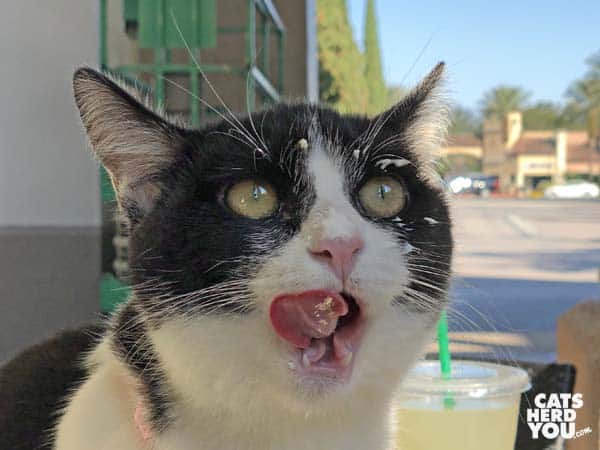
Her favorite coffee shop patio was open again after weeks of being closed due to painting. And she got some whipped cream from her favorite baristas.

black and white tuxedo cat licks whipped cream from face

Bad News

Then the painters arrived. At first, they were doing quiet painting things. Then the big noises started.

You can see the high lift behind Cupcake in the photo above. When it suddenly started beeping and moving, Cupcake was not happy at all. The party was over.

To try to end her outing on a positive note, we decided to do one of her favorite things: shopping.

black and white tuxedo cat in front of bird enclosure

Good News

We visited the big box pet store to see some her friends who work there. She also saw her bird friends who live there, at least until they find forever bird homes.

No, Cupcake, we can’t be a forever bird home.

black and white tuxedo cat plays with pink toy

Cupcake sprawled on top of the cat trees and let one of the passing customers play with her while I explained how Cupcake’s harness fits.

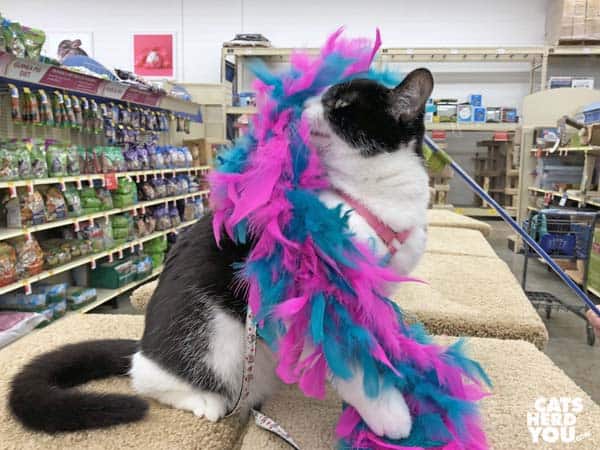
She also tested out some of the feather toys, but she can’t decide which is her favorite. She said she wants to think about it and try again next time we visit.

black and white tuxedo catplays with blue and pink feather toyThis wasn’t our most successful outing, but any outing that ends with grabbing feathers is one Cupcake calls a success. We can’t wait for them to finish painting the coffee shop patio so Cupcake can spend some time there. Hopefully before the end of the year.

Share Share on email
Email
Share on twitter
Twitter
Share on facebook
Facebook
Share on pinterest
Pinterest
Share on google
Google
Share on tumblr
Tumblr
Share on linkedin
Linkedin

December 18, 2017 Filed Under: Cats Tagged With: Cupcake 19 Comments

  • « Previous Page
  • 1
  • …
  • 44
  • 45
  • 46
  • 47
  • 48
  • …
  • 494
  • Next Page »

Read Ashton’s Story in Rescued, Volume 2

These pawtographed books support Candy's Cats, who work tirelessly to find homes for cats in Florida.

Rescued, Volume 2: The Healing Stories of 12 Cats, Through Their Eyes. Proceeds from authographed copies benefit Candy's Cats.


Outside the US, contact us for shipping to your location.

Read Us by Email

Don't miss a thing! Cats delivered to your email.

Privacy Policy


Archives

All Rights Reserved

Articles and images on this site may not be reproduced in whole or in part without written consent. Please contact me if you are interested in reprinting or in having me write something unique for you.

Disclaimer

There are no veterinarians here. All health-related posts are the result of research and observation, but educational information is not a substitute for visiting your veterinarian. Do not self-diagnose your cat. For more information, see our disclaimer.

Policies

Disclosure Statement
Privacy Policy
Commenting Policy

Copyright © 2026 · Sometimes Cats Herd You · All Rights Reserved