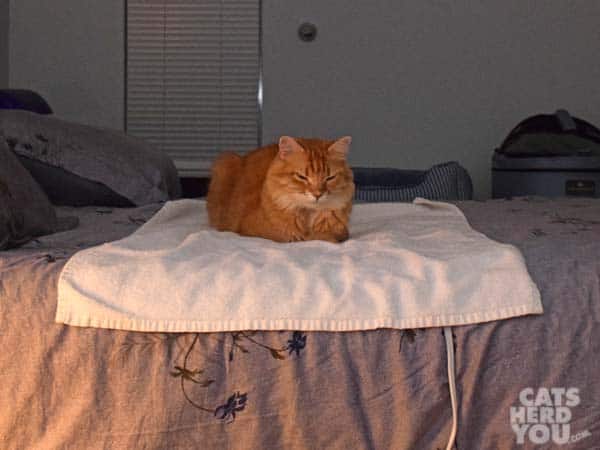
I’ve written before about how hyperthyroidism is of special concern to me since I saw an 80% rate of the disease in my previous generation of cats, much higher than the “over 10%” prevalence rate in the general population. When new research came out last week about a potential link between hyperthyroidism and cat food ingredients, it really caught my attention.

Setting the Stage: What is Hyperthyroidism?
Hyperthyroidism is a hormonal disorder in cats where the cat’s thyroid gland overproduces the thyroid hormones. Elevated thyroid hormones can cause weight loss, hyperactivity, vomiting, and even aggression.
In humans, hyperthyroidism is linked to Grave’s disease and iodine insufficiency, but there is no definitive answer to the question of what causes it in cats.
Previous Theories about Feline Hyperthyroidism Causes
In the past, a few strong theories about what causes feline hyperthyroidism have been discussed in scientific literature.
BPA
One theory was that hyperthyroidism was caused by the chemical bisphenol A (BPA). As with human canned foods and beverages, BPA was added as a lining to the inside of cat pop top lids to prevent corrosion and extend shelf life. The chemical then absorbed into the food in the container, which was of eaten by cats.

A study showed that cats eating canned food with pop top lids were at a higher risk of developing hyperthyroidism. The study itself didn’t implicate BPA, but at the time, BPA was used to line cat food pop top lids. BPA has been found to be a thyroid receptor agonist, which could lead to hyperthyroidism. The pet food industry has since phased out BPA from lining can lids.
Flame Retardants
Another theory was that flame retardants used in household goods leach out of our sofas, carpets, and plastics and combine with household dust to deposit in a cat’s fur. Those chemicals are then ingested during grooming.

A study in Sweden showed that cats with hyperthyroidism had elevated levels of polybrominated diphenyl ethers (PBDEs), which are flame retardants. PBDEs were removed from the market in the US in 2005, but household goods purchased before then would still contain them.
A New Theory: Fish Ingredients
A new study looks at PBDEs and polychlorinated biphenyls (PCBs) levels in both pets and pet foods. Like PBDEs, PCBs are now banned in the US due to a variety of health impacts including disrupting thyroid hormone levels.
Researchers noted that both environmental pollutants also have been seen in fish, which is a common ingredient in commercial cat food recipes. They tested levels of both chemicals levels in dog and cat foods. They found that PCB levels are significantly higher in cat food than in dog food and that levels were higher in kibble than in canned foods. Fish is a more common ingredient in cat than dog food, and canned foods with fish were higher in PBDEs. In fact, in the study, “chicken and tuna” food for cats had higher PBDE levels than “chicken and tuna” food for dogs.

The researchers did blood tests on cats who ate the foods and found that cats retain a much larger load of byproducts from PCBs and PBDEs than dogs. They pointed out that hyperthyroidism in dogs is very rare, and that a cat having a much lower capacity to metabolize chemicals that are common in fish may be a reason that we see a higher number of cases of hyperthyroidism in cats.
What this Means for Cat Food Consumers
As anyone who has already tried to limit fish in their cat’s diet because of allergies or out of concerns about mercury, phosphorous, or magnesium levels can tell you, it’s hard to do. Fish is found in more foods than you expect, and the labeling requirements for cat food allow it to be used in recipes that don’t include it in the product name. It isn’t unusual to read the ingredient panel of “chicken entree” and discover it also contains fish. This is especially true of bargain-priced foods.

Additionally, cats are often seen as convenience pets, and they are frequently fed dry food because that’s convenient, too. The concerns raised in this study about the thyroid-disrupting chemicals being much higher in dry foods are one more argument against the popular kibble diets.
My previous generation of cats were fed primarily kibble, and I wasn’t much of a label reader for much of their lives, so it’s likely they ate more fish than I realized. Perhaps this contributed to the higher-than-average hyperthyroidism level I saw in my household. I’ll never know for sure, but anything I can do to keep from having to face giving pills to the three worst pill-taking cats in the world is something I’ll keep in mind whenever I feed them.
Research and further reading:
Journal of the American Veterinary Association, Epidemiologic study of relationships between consumption of commercial canned food and risk of hyperthyroidism in cats
Endocrinology, Bisphenol-A, an environmental contaminant that acts as a thyroid hormone receptor antagonist in vitro, increases serum thyroxine, and alters RC3/neurogranin expression in the developing rat brain. http://www.ncbi.nlm.nih.gov/pubmed/15498886
Environmental Science and Technology, Higher PBDE Serum Concentrations May Be Associated with Feline Hyperthyroidism in Swedish Cats
Environmental Health Perspectives, Blocking Brain Development, How PCBs Disrupt Thyroid Hormone
Environmental Science and Technology, Organohalogen Compounds in Pet Dog and Cat: Do Pets Biotransform Natural Brominated Products in Food to Harmful Hydroxlated Substances?
Photos courtesy
sorsillo on depositphotos
Autumn Barnes on flickr creative commons
RasulovS on depositphotos
Tom Woodward on flickr creative commons