Cats Herd You

Laugh. Learn. Love cats.

  • Home
  • Safety
  • Wellness
  • Rescue
  • Reviews
  • Life With Cats
  • About
  • Media Friendly
  • Contact
You are here: Home / Archives for Life With Cats

Confident Cats: Nature or Nurture?

Ashton is not a confident or outgoing cat. When a new object comes into the house, she is the last cat to enter the room and examine it, after she is sure Newton and Pierre have both have seen it first and assured her it isn’t dangerous. When the doorbell rings, she vanishes.

One-eyed brown tabby cat with the message - Confident Cats - Nature or Nurture

Is her lack of confidence part of her nature, or did her experiences nurture the behavior along the way? The answer could be a little bit of both.

Cat Socialization and Confidence

Cats are much more receptive to socialization when they are kittens under eight weeks old. Things they learn during that developmental period become part of their “normal” world, and the more new people they meet during this time, the more likely they are to think new people are no big deal.

Introducing kittens to new objects, situations, and locations can help them grow into confident adult cats, too. The more cats learn they are safe anywhere they go, the more confident they will be later in life.

Ashton_Peers_out_of_carrier001_wm2

Kittens who grow into cats whose only experience with going anywhere but their own home has ever been to the vet are more likely to be frightened instead of confident.

Feline Genetics and Confidence

Behavior isn’t like a cat’s eye color or coat pattern. There is no gene for being friendly or for other behaviors. This means that any effects of a cat’s genes on behavior are indirect.

orange cat nudges brown tabby kitten with paw

Knowing this, it’s surprising that a cat’s likelihood to be confident and friendly is partly an inherited trait. More than one study has found that kittens who are friendlier toward humans have fathers who are friendlier toward humans. This sounds like it could be something they learned during kittenhood from their parents, but the results held true even when kittens never saw their father.

Cats Can Learn Confidence

Even fearful cats like Ashton can learn confidence over time. It took her five years, but she now allows my husband to pet her when she is on the cat tree.
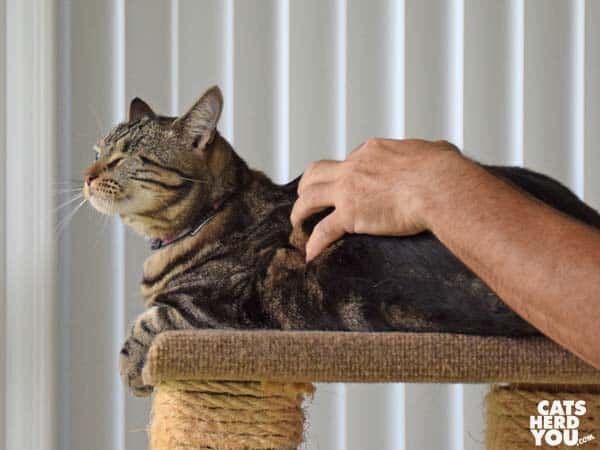
One-eyed brown cat is petted by a man's hand

There is no accident that the more a cat plays, the more confident she gets. Good play experiences where she can catch and conquer her prey make a cat feel confident, and they also serve as great bonding time for her and whoever is playing with her.

Ashton’s Confidence

I had no idea when Ashton was rescued as an injured kitten that she had never been handled before. She was an estimated 8 weeks old, so she was past the period where handling her would have had the best results for socializing her.

Since she was found in a downtown area, she probably had a feral father, so we will never know how friendly he was. We can guess that Ashton inherited some of his caution about humans.

one-eyed brown tabby cat exits white paper bag

Although Ashton isn’t a fan of wand toys that fly through the air where she can’t judge their distance, Ashton’s confidence grows when she plays and also when she discovers new objects that aren’t actually scary after all. We encourage play with lots of toys she finds interesting, and slowly Ashton has become more confident. No matter what her timid nature is, she has slowly become a more confident, less fearful cat, and that’s encouraging to see!


Research and Further Reading

Applied Animal Behavior Science, The impact of paternity and early socialisation on the development of cats’ behaviour to people and novel objects
Physiology & Behavior, Friendliness to humans and defensive aggression in cats: The influence of handling and paternity
Alley Cat Allies, Socializing Feral Kittens

Share Share on email
Email
Share on twitter
Twitter
Share on facebook
Facebook
Share on pinterest
Pinterest
Share on google
Google
Share on tumblr
Tumblr
Share on linkedin
Linkedin

August 29, 2016 Filed Under: Life With Cats Tagged With: Ashton 23 Comments

Eyes form a Cat’s Face Shape

One of the first things I noticed five years ago after the surgery to remove Ashton’s eye was how much it changed the shape of one side of her face. Even before the swelling from the surgery went away, that whole side of her face looked surprisingly smaller, almost deflated.

It’s something I see every day, so I don’t think about any more, and until now, I never took a photo that showed the difference in the shape of that side of her face and a normal cat’s. But the photo below happened to be at the exact right angle.

one-eyed brown tabby cat facing right

Do you see how you could practically put a ruler along her whole cheekbone, it’s so flat? (Pro tip: don’t stick a ruler in Ashton’s face. Her lack of depth perception means she really doesn’t like that kind of thing.)

Compare the shape of the left side of Ashton’s face to the shape of Pierre’s face, taken at a similar angle.

gray tabby cat semiprofile facing left

His face bows outward. It is especially noticeable in the area below his eye, known as the maxillary region. You can see it curves inward to meet the corner of his eye. Ashton’s face does not have that curve. While there is a bone in that part of a cat’s face, the maxilla (the namesake of the maxillary region), it isn’t enough to give the face that characteristic shape. Your cat’s eye does a bit part of that, too.

Of course, the shape of Ashton’s face doesn’t make any difference in how she feels or behaves. Her permanent wink makes her that much more endearing.

Share Share on email
Email
Share on twitter
Twitter
Share on facebook
Facebook
Share on pinterest
Pinterest
Share on google
Google
Share on tumblr
Tumblr
Share on linkedin
Linkedin

July 27, 2016 Filed Under: Life With Cats Tagged With: Ashton, Pierre 24 Comments

A Visit to the Cat Show

I often joke that everyone comes here eventually because it’s such a tourist town. Last weekend, it wasn’t humans who came to visit, it was cats, for the TICA Sandy Claws cat show, and I had to go the variety of cats being showed just a few miles from home.

colorpoint kitten

I heard a man entering the hotel ballroom where the show was held say, “It’s much smaller than I expected!” I had not been to a cat show since one at Madison Square Garden in 1999, so I have no idea whether it was an unusually small show or not. There were six rings, and they were nonstop busy, even at lunchtime.

havana brown being judged

I watched a few rings be judged. The judge in the longhair ring was here all the way from Oregon, and I wondered if she had met our friend Summer, who has been in shows up there. She was the most interesting of the judges, explaining as she went what she was looking at and looking for.

bocolor maine coon

She talked a lot about the confirmation of their bodies and heads and what she expected of each, and I learned how each type of cat had different standards she was looking for.

This kitty doesn’t have airplane ears. It’s a longhaired Scottish Fold, something I didn’t know existed!  Here, the judge is explaining that this kitty has a very sweet face and big eyes, which is part of the breed standard.

longair fold cat in judging ring

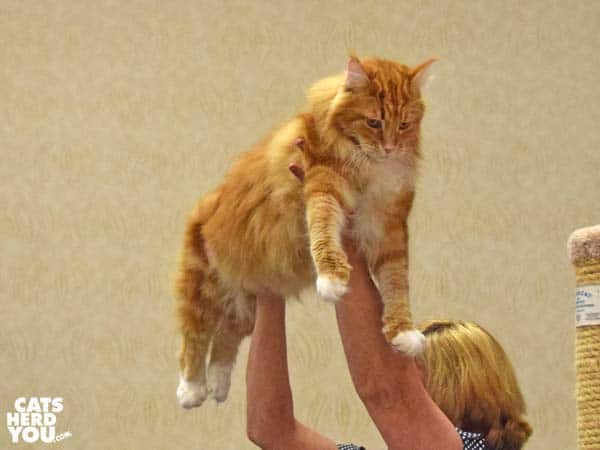
This massive Maine coon kitty was the winner in the ring for long haired cats. There’s not really any way to tell from this photo, but he was really enormous. He seemed to fill the whole judging ring cage while he was waiting to be judged. Quite an impressive cat!

Orange Maine Coon

When the adult longhaired cats were in their judging ring cages, they waited patiently for their turn with the judge. It was the complete opposite in the kitten ring. Those cages were just mayhem. There was a bengal kitten determined to climb the top of the cage.

bengal kitten in cage

There was also a bobtail kitten who apparently thought the cage tasted interesting.

bobtail kitten in show cage

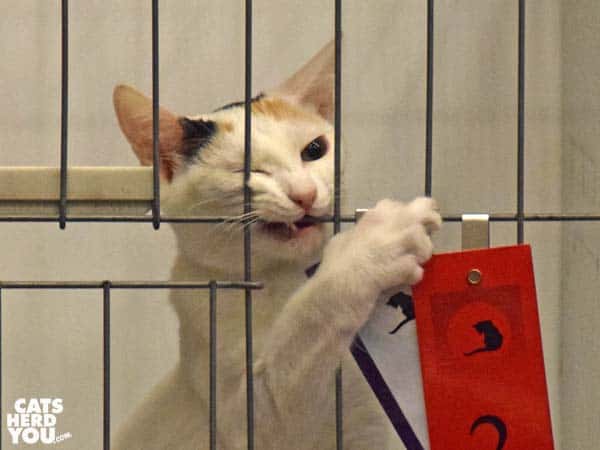
I noticed that the bottom part of the cage, where the cats sit, was sanitized between cats, but I didn’t see them actually cleaning every inch of the bars. This little guy was making sure he left his kitten cooties behind for the next kitty who sat in that cage.

bobtail kitten in show cage

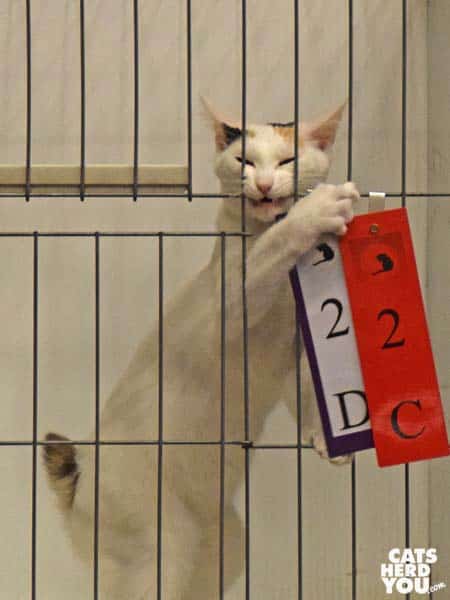
After he lost interest in eating the cage, the started in on the little flaps hanging from the cage. I never got an explanation of what those were. They weren’t cage numbers, though, and it’s a good thing, because this kitten was determined to do them in.

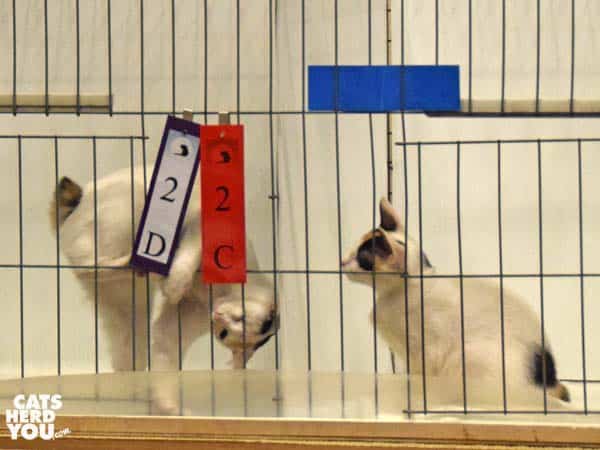
bobtail kittens in show cages

He even got his neighbor in on the act!

bobtail kittens in show cages

The judge for the kitten ring didn’t talk to the audience or explain anything, but she clearly had her hands full with that crowd.

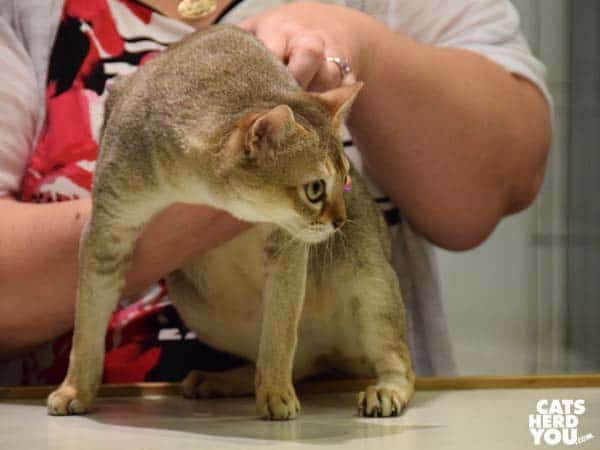
Do you recognize this cat? I thought at first glance it was an Abyssinian, but the head and face looked all wrong for the breed. I learned later it was a Singapura, a breed I had not heard of before.

Singapura cat in judging ring

I would have liked to have talked to the person showing the cat, but I never managed to catch her. Everyone showing cats was constantly rushing back and forth to show rings. A cat show is a busy place!

I only saw one Abyssinian at the whole show, but I didn’t get a photo of him because these little faces were in the next cage and they captivated me.

bengal kittens

They were for sale, too! I have no idea how I escaped without bringing one of them home.

The cat show was a lot of fun, and it’s quite an experience for anyone who has never been to one. If there’s ever one in your town, it’s totally worth a visit!

Share Share on email
Email
Share on twitter
Twitter
Share on facebook
Facebook
Share on pinterest
Pinterest
Share on google
Google
Share on tumblr
Tumblr
Share on linkedin
Linkedin

June 22, 2016 Filed Under: Life With Cats 17 Comments

Catnip: Why Your Cat Loves It

The image of a cat playing with a catnip toy is so common that people are often surprised to find that not all cats respond to catnip. Over half of adult cats do find it intoxicating, and you may have wondered why.

catnip - why is your kitty so crazy for it?

Catnip is a member of the mint family. There are over 250 members of the mint family, and some cats may respond to more than one of them. Some cats are attracted to peppermint or spearmint, which can means it’s a good idea to keep breath mints secured, just in case!

How Catnip Works

The ingredient in catnip that cats respond to is an essential oil, neptalactone, found in the leaves and stems of the catnip plant.

When your cat sniffs catnip, neptalactone particles travel into your cat’s nose and into her nasal tissue, where they bind to protein receptors that stimulate sensory neurons. Signals travel from there to the brain, where information is routed to the pituitary gland, creating a response that is similar to that seen when encountering the pheromones of another cat. That’s right: catnip actually functions like an artificial cat pheromone.

sat sittingin catnip plant. photo courtesty flickr creative commons/furphotos

Your household cat isn’t the only one who responds to catnip. Cats all the way up to lions respond neptalactone, too.

Your Cat on Catnip

Cats who encounter catnip will sniff it, and it’s not unusual to see them lick or chew on it as well as rub or roll on it. During your cat’s catnip high, which lasts about 10-15 minutes, your cat may respond sleepiness, or drooling. Some cats show aggression and will growl or even bite and scratch while under the influence of catnip.

orange cat playing with mouse toy. Photo credit depositphotos/c-foto

After your cat has recovered from a catnip high, she probably won’t be interested more catnip right away. It usually takes an hour of two for your cat’s brain to “reset” and be ready to respond to catnip again.

If your kitty has catnip too often, she may stop showing interest in it. Try putting it away for a couple weeks before offering it to her again.

Is Catnip Safe?

Catnip is safe for your cat. Although people will joke about their cat being “addicted” to catnip, it doesn’t actually have addictive properties, and your kitty will walk away when she has had enough.

If your cat eats a lot of catnip, she could vomit or get diarrhea, just as she might if she ate grass. Let the catnip pass through her system and she will be fine. Cats who eat catnip might do better with toys that keep the catnip enclosed so that they can smell but not ingest it.

Catnip is not for Every Cat

If your cat isn’t into catnip, she’s in good company! Somewhere between 25-50% of cats don’t respond to neptalactone. Attraction to catnip is a trait passed down between parents and offspring.

Kittens under eight weeks don’t respond to catnip either. Some scientific studies showed that kittens will actively avoid catnip, so the smell of it may actually be unpleasant to them.

cat licking catnip plant. photo courtesy flickr creative commons/jdickert

Humans and Catnip

Human brains don’t work like cat brains, so we don’t get high in response to exposure to neptalactone in catnip. It is, however, a mild sedative, and can be found in some herbal teas. Nepalactone is also a natural mosquito and insect repellent.

You can grow your own catnip for your kitty (and yourself!), and many garden centers have starter plants available. Doesn’t this sound like a fun weekend project to share with your cat?

cat rubbing in catnip plant in pot. photo courtesy flickr creative commons/katleb50


Research and further reading

Natural Products for Pest Management, Natural Insect Repellents: Activity against Mosquitoes and Cockroaches
Economic Botany, Catnip and the catnip response
The Canadian Veterinary Journal,  Catnip: Its uses and effects, past and present
Journal of Heredity: Inheritance of the Catnip Response in Domestic Cats

Photo credits

flickr creative commons/furphotos
depositphotos/c-foto
flickr creative commons/jdickert
flickr creative commons/katleb50

Share Share on email
Email
Share on twitter
Twitter
Share on facebook
Facebook
Share on pinterest
Pinterest
Share on google
Google
Share on tumblr
Tumblr
Share on linkedin
Linkedin

June 13, 2016 Filed Under: Life With Cats 23 Comments

  • « Previous Page
  • 1
  • 2
  • 3
  • 4
  • 5
  • 6
  • …
  • 9
  • Next Page »

Read Ashton’s Story in Rescued, Volume 2

These pawtographed books support Candy's Cats, who work tirelessly to find homes for cats in Florida.

Rescued, Volume 2: The Healing Stories of 12 Cats, Through Their Eyes. Proceeds from authographed copies benefit Candy's Cats.


Outside the US, contact us for shipping to your location.

Read Us by Email

Don't miss a thing! Cats delivered to your email.

Privacy Policy


Archives

All Rights Reserved

Articles and images on this site may not be reproduced in whole or in part without written consent. Please contact me if you are interested in reprinting or in having me write something unique for you.

Disclaimer

There are no veterinarians here. All health-related posts are the result of research and observation, but educational information is not a substitute for visiting your veterinarian. Do not self-diagnose your cat. For more information, see our disclaimer.

Policies

Disclosure Statement
Privacy Policy
Commenting Policy

Copyright © 2026 · Sometimes Cats Herd You · All Rights Reserved