Cats Herd You

Laugh. Learn. Love cats.

  • Home
  • Safety
  • Wellness
  • Rescue
  • Reviews
  • Life With Cats
  • About
  • Media Friendly
  • Contact
You are here: Home / Archives for Health

Why Cats Love Boxes

In case you missed it, Saturday was International Box Day. While your kitty was enjoying that cardboard box, did you wonder why cats enjoy boxes so much? Scientists have studied the answer for you!

What Scientists Saw about Cats in Boxes

A Dutch animal shelter studied cats to see what their stress levels looked like when they were provided either a boxlike kitty condo or simply an open cage. Cats on shelter intake were selected either to get a hiding box in their cage or not. Then the cats were observed for two weeks, and their stress levels were assessed using a standard stress scoring system.

cat in a box. photo credit: depositphotos/Meldes

Cats who were able to spend time in boxes chose to spend over half of their time in them, so they made lots of use of them. By the third day, cats who had access to hiding boxes on average had lower stress scores. Over time, the cats without boxes slowly became less stressed until after two weeks their stress levels were about the same as the cats who had been provided hiding boxes from the beginning.

Why  do Cats Feel Less Stressed in Boxes?

Cats get a feeling of safety from being inside that cardboard box. While it may look like your latest arrival in the post, to your kitty, that box’s enclosing sides represent a fortress.

cat in box. photo credit depositphotos/pannawat

As relatively small creatures, cats are wired to think of themselves as potential prey to many larger creatures. Curling up to sleep allows a cat to protect their most vulnerable parts, like their stomach, and curling up in an enclosed space like a bed with high sides or a cardboard box gives them an extra sense of being enclosed and protected.

How Boxes Can Help Cat Welfare

This is useful to know for your kitty at home, especially when bringing a cat home into a new environment like the cats brought into an unfamiliar shelter environment in the study. But it’s especially important information for cats in shelters.

For a shelter cat, acting less stressed-out can mean faster adoption. Faster adoptions by themselves can be lifesaving in overwhelmed shelters.

Stressed out cats, like stressed out humans, have elevated cortisol levels. Cortisol is an important hormone in your cat’s body involved in regulating blood pressure and immune function. This means that reducing the stress levels of shelter cats with boxes can help keep them healthier.

cat in box, photo credit depositphotos/cynoclub

Does your cat prefer enclosed spaces like boxes when resting?


Research and further reading

Applied Animal Behaviour Science, Will a hiding box provide stress reduction for shelter cats?

Photo credits: depositphotos/Meldes, pannawat, cynoclub

Save

Share Share on email
Email
Share on twitter
Twitter
Share on facebook
Facebook
Share on pinterest
Pinterest
Share on google
Google
Share on tumblr
Tumblr
Share on linkedin
Linkedin

June 20, 2016 Filed Under: Health 23 Comments

5 Tips for Keeping Cats Cool

Summer and its long, hot days are on their way. You may not think of your cats as being at risk of hyperthermia (heatstroke), but they are wearing a fur coat year round. Helping keep your cat cool on the hottest days of the year is important, especially in kittens and elderly cats.

Make Cool Spots Available

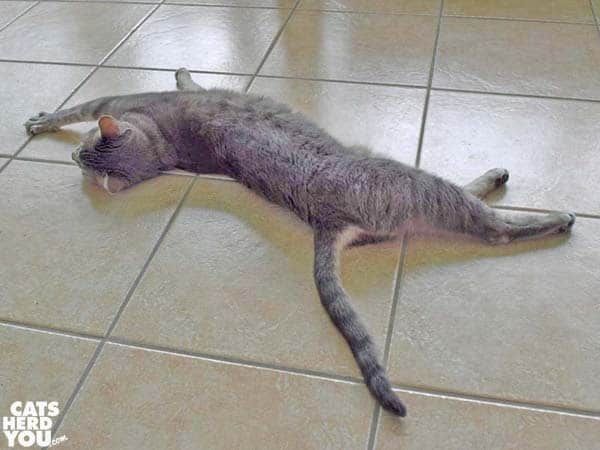
Give your cat access to rooms with cool things they can lay on. Tile floors, ceramic bathtubs, or even the back of your toilet are places that your cat can stretch out and enjoy the cool surface beneath them.

gray tabby cat sprawled on tile floor

In our house, we have a sunroom connected to the house by a sliding glass door, and the metal track of the door was a favorite spot for one of our previous cats, Rhett, many years ago. His white paws were often smudgy from the grease in the sliding door track where he would sprawl for comfort on hot days.

You can make an extra cool spot in your house by freezing water in a three-quarters full water bottle (leave room for expansion as the water freezes) and wrapping a towel around it. Use this kind of like you would a heating pad in the winter. Instead, think of it as a cool buddy that your cat can cuddle up to in order to cool off. Don’t forget that this is going to be damp due to condensation, so you will need to either put it somewhere that won’t be damaged by moisture or protect the surface beneath it from moisture.

Provide Plenty of Fresh Water

Make sure your cats have plenty of water, and check the water level often. Warm weather means it evaporates more quickly, and your cats will drink it faster, too, meaning it will need to be refreshed more often than in cooler months. You can add ice cubes to the water to cool it down temporarily. Just be aware that some cats will fish out ice cubes to play with them, so monitor the bowls the first time you do that, especially if your bowl is in an area that the floor could become slippery when wet from melting ice.

orange cat looks at ice cubes

Keep Out the Sun

Close curtains or blinds to prevent sun from further heating rooms in your house where your cat prefers to sleep during the day. This will also help with your air conditioning bill. This may mean less time for your cat to watch the birds and squirrels outside your window, but the birds and squirrels are probably resting in the heat of the day, too.

cats and window blind - creative commons image courtesy flickr/nauright

Southern and western exposure windows are the ones likely to heat up your house the most. Our sunroom has both south and west-facing windows, and we keep the blinds closed for most of the day in the summer to try to keep cool. In the late afternoon, opening the room’s west-facing blinds can make the temperature jump ten degrees in a few minutes, so keeping that sun out makes a big difference.

Use Fans to Maximize Circulation

Point a fan where your cat can enjoy the breeze it creates. A fan helps humans cool off by evaporating sweat from your skin, and cats don’t sweat all over the way that humans do, only on their paw pads. That means that a fan isn’t quite as efficient for helping cool your cat as it is to cool you, but moving air around your cat that is cooler than her body temperature still helps to draw heat away. If your cat is willing to let you wet her down with a damp washcloth, this effect works even better.

cat enjoying fan

Don’t forget that some fans are easier to tip over than others. If your cat is rambunctious or has climbing tendencies, a fan that sits on the floor is a safer choice than one on a tall pedestal that has a higher center of gravity and could be prone to toppling. Of course, always make sure the fan has a grill over it so that a cat can’t get close to turning blades.

Save Strenuous Exercise for the Cooler Hours

You probably go out for your daily jog in the early morning to avoid the sizzling summer heat, and it’s no different for your cat. Don’t encourage strenuous play in the heat of the day. Playtime is important, and it’s great bonding between cat and human, but it can wait until after the house cools down. Or set your alarm a little early in the morning and have extra play time then.

You may regularly play with your cat until he is panting, but panting is also a sign of heat stress.

panting cat - creative commons image courtesy flickr/barbourians

Don’t push your cat’s exercise when it’s hot so that you can’t tell one from the other. And if your cat begins to act unusual after summer exercise, with rapid pulse and breathing, redness in his tongue and mouth, lethargy, or if kitty is stumbling after a case of the midday zoomies, don’t assume he’ll be fine. Heat exhaustion signs like those need prompt veterinary followup.


References and further reading:

Heat Stroke in Cats, Pet MD.
How to Keep Your Pets Safe in the Summer Heat, American Humane Association

Creative commons images courtesy flickr/nauright and flickr/barbourians

Share Share on email
Email
Share on twitter
Twitter
Share on facebook
Facebook
Share on pinterest
Pinterest
Share on google
Google
Share on tumblr
Tumblr
Share on linkedin
Linkedin

May 23, 2016 Filed Under: Health 23 Comments

Lysine for Feline Herpesvirus: Does it Help?

Often when someone says their cat has an upper respiratory infection, they are advised by friends who have had cats for years that they should sprinkle some lysine on the sick kitty’s food. However, a look over the body of research available indicates that lysine supplementation does not help cats with Feline Herpesvirus (FHV-1).

What is Feline Herpesvirus?

Feline Herpesvirus (FHV-1) is one of the main causes of upper respiratory infections in cats, and it is directly or indirectly accounts for over 90% of feline eye diseases. The virus is very common, and many cats are exposed to it as kittens by an infected mother caring for them.

sick tortoiseshell kitten, cc image courtesy flickr/pmarkham

The virus transmits between cats through:

  • Direct contact through saliva or through nasal or eye secretions
  • Inhaling sneeze droplets of an infected cat
  • Sharing food bowls and litter boxes
  • Sharing contaminated bedding or grooming aids

FHV-1 Infection Symptoms

At the time the cat is infected, the main symptom of FHV-1 is an upper respiratory infection, including discharge from the eyes and nose, sneezing, fever, lethargy, and sometimes coughing.

sick siamese kitten, cc image courtesy flickr/kayveeinc

After the upper respiratory symptoms are gone, the virus remains in an inactive status in the nerve cells of most cats. A little under half of those cats will have the virus reactivate at some time later during their life. The FHV-1 virus reactivates when the cat is under stress, including emotional or physical stress. Additionally, some drugs like corticosteroids are likely to reactivate latent FHV-1 in a cat.

When the virus reactivates in a cat, the cat might show upper respiratory symptoms mentioned above, or the kitty might instead only shed the virus, becoming contagious to other cats without appearing sick.

Less commonly, cats with chronic FHV infections have inflamed corneas (the clear covering of the eye) that can lead to ulcers in the eye.

Why Do People Expect Lysine Would Help with FHV-1?

Dr. Andrew Weil, an integrative physician for humans, recommends that people with the viruses that cause herpes in humans, HSV-1 and HSV-2, reduce the amount of the amino acid arginine in the diet and increase their intake of the amino acid lysine to reduce symptoms. There is mixed evidence about this, practice, but it is frequently repeated advice both around the internet and through veterinarians.

lysine

The theory behind this is that lysine interferes with the replication of the virus by blocking the body’s uptake of arginine, which can worsen herpes outbreaks. Human bodies create arginine naturally but require dietary lysine, so dietary modifications and/or supplementation are suggested.

Cats, Lysine and Arginine

Cats and humans aren’t the same. An overview of all of the previous research done on lysine and FHV-1 showed that lysine does not inhibit arginine in cats. This means that there isn’t really a purpose behind supplementing cats with lysine.

cat holding beakers, image credit: depositphotos/funny_cats

Unlike with humans, cats don’t create arginine. Finding ways to reduce arginine in their diet isn’t necessarily beneficial because arginine deficiency can result in excess ammonia in the blood, a condition that can be fatal.

The evidence found that orally supplementing cats with lysine was not effective and in some cases can enhance FHV-1 viral replication, making infection worse.

Belief Perseverance

When this research first came out last year, internet discussions about it tended to say, “I have seen kittens get better when supplementing them with lysine, so I will continue to give it to sick kittens.” Comments on articles dismissed the research instead of looking more closely at it to see if maybe their perceptions of it had been flawed.

red tabby cat at computer keyboard, image credit: depositphotos/belchonock

Maintaining beliefs and theories against explicit conflicting evidence isn’t unusual. The psychological phenomenon actually has a name: belief perseverance. Behaviors we think are beneficial are especially hard to break, but over time, this may change in the face of the evidence that cat physiology doesn’t work like human physiology.

Do you think that one day, giving cats with upper respiratory infections lysine will be like feeding cats milk is today: a practice that used to be common and is now considered old-fashioned?


Research and further reading

Bio Med Central, Lysine supplementation is not effective for the prevention or treatment of feline herpesvirus 1 infection in cats: a systematic review
International Cat Care, Feline herpesvirus (FHV) infection
Michigan Veterinary Medical Association conference proceedings, FHV-1, Can One Virus Cause All Those Diseases?
Journal of Nutrition, Excess Dietary Lysine Does Not Cause Lysine-Arginine Antagonism in Adult Cats

Image credits

Creative commons images courtesy flickr/pmarkham, kayveein
depositphotos/designer491, funny_cats, belchonock

Share Share on email
Email
Share on twitter
Twitter
Share on facebook
Facebook
Share on pinterest
Pinterest
Share on google
Google
Share on tumblr
Tumblr
Share on linkedin
Linkedin

May 2, 2016 Filed Under: Health 32 Comments

Keeping your Cat Hydrated

Some of the same characteristics that make cats great at living alongside human in such a variety of situation so how adaptive they are. But that same adaptive nature means that they will live for extended periods of time at a chronic low level of dehydration.

Cats, just like you, get dehydrated when they don’t take in enough water. Since cats are descended from desert-dwellers, they are good at extracting moisture from their prey, and they don’t feel thirsty to go drink water until they are 3% dehydrated. Cats don’t show any obvious clinical signs of anything being wrong until they are more than 5% dehydrated.

Cat drinking from glass

How to Help Your Cat Stay Hydrated

There are a few simple things you can do that will help your cat stay more hydrated and more healthy.

Kick the Kibble Habit

A lot of cats are on a kibble-only diet. Many vets will even recommend kibble because they feel that it’s a convenience food that that families will comply with. What many people who carefully select kibble don’t realize is that it is very low in moisture. Kibble is 6-10% moisture, while canned food is 75-80% moisture. For a cat whose system is used to extracting moisture from her food, kibble can leave a cat in a chronic low-level dehydration.

Getting cats off of kibble and onto a diet with more moisture can be difficult, and many people give up. Like everything with cats, it can take a lot of patience on your part to overcome your cat’s attachment to the stuff they spray on the outside of the kibble to make it taste so good. It took a full six months to fully transition my three cats from kibble to canned food, and I admit there were times I wanted to give up.

Once your cats are on canned food, it may seem like they never visit the water bowl any more since they get so much of their moisture directly through their food. You can even mix a little bit of water into your cat’s dry food, as long as your kitty will tolerate the slightly soupy texture.

Water Everywhere

One of the tricks that Dr. Sherri Basso taught me over ten years ago was to put water bowls in many rooms of the house. As she put it, “Every time your cat walks into a room, he should see a bowl and think, ‘Huh, I should have a little to drink!'”

The cat drinks water from the aquarium with goldfishIt took some getting used to, and I tripped over a water bowl in the bedroom more than once, but it made a big difference for my cat Cyrano at the time who had chronic kidney disease. That lesson has stayed with me, and I have water available in multiple rooms of my house. The cats drink from all of them!

If you can’t have water in every room of the house, at least make sure there’s water available somewhere well away from your cat’s food dish. A lot of cats prefer not to drink near their food dish, possibly because they are hard-wired to think that a water source near their killed prey is polluted. You may be surprised how much more your cat drinks from the water bowl that Is far from their food bowl than the one near it.

Running Water

A lot of cats really like to drink from flowing water. That’s why there are so many goofy videos all around the Internet of cats drinking from faucets.

If your cat loves to drink from the tap and you are home all day to turn it off and on for your kitty, that might be a great solution. For some of us, a fountain is a great alternative to being on call at the water tap.

longhaired cat drinking water from tap

There are several different kinds of water fountains on the market. All of them use some kind of pump to recirculate water, and some feature falling water while others have water that flows over a surface. Some humans love the sound of falling water while others find it uncomfortable to listen to without extra trips to the restroom, so consider your cat’s preferences and those of the humans in your household.

The best fountain for your cat is one you can keep clean, so pay attention to the design and features, and make sure it’s a commitment you are willing to keep up before making it your cat’s sole source of available water.

The More Options, the Better

Helping your cat to stay hydrated is important to keeping your kitty’s health at its peak. Consider using a combination of high-moisture food, plentiful water bowls, and even flowing fountains to help keep your cat hydrated and happy.

keeping your cat hydrated

Research and Further Reading

Candyce Jack LVT and Patricia Watson LVT, Veterinary Technician’s Daily Reference Guide
Little Big Cat, Dr. Jean Hofve, DVM, Why Cats Need Canned Food

Photo credits

depositphotos/kozorog
depositphotos/Madhourses
depositphotos/bollwerk

Share Share on email
Email
Share on twitter
Twitter
Share on facebook
Facebook
Share on pinterest
Pinterest
Share on google
Google
Share on tumblr
Tumblr
Share on linkedin
Linkedin

April 25, 2016 Filed Under: Health 21 Comments

  • « Previous Page
  • 1
  • …
  • 6
  • 7
  • 8
  • 9
  • 10
  • …
  • 18
  • Next Page »

Read Ashton’s Story in Rescued, Volume 2

These pawtographed books support Candy's Cats, who work tirelessly to find homes for cats in Florida.

Rescued, Volume 2: The Healing Stories of 12 Cats, Through Their Eyes. Proceeds from authographed copies benefit Candy's Cats.


Outside the US, contact us for shipping to your location.

Read Us by Email

Don't miss a thing! Cats delivered to your email.

Privacy Policy


Archives

All Rights Reserved

Articles and images on this site may not be reproduced in whole or in part without written consent. Please contact me if you are interested in reprinting or in having me write something unique for you.

Disclaimer

There are no veterinarians here. All health-related posts are the result of research and observation, but educational information is not a substitute for visiting your veterinarian. Do not self-diagnose your cat. For more information, see our disclaimer.

Policies

Disclosure Statement
Privacy Policy
Commenting Policy

Copyright © 2026 · Sometimes Cats Herd You · All Rights Reserved