Cats Herd You

Laugh. Learn. Love cats.

  • Home
  • Safety
  • Wellness
  • Rescue
  • Reviews
  • Life With Cats
  • About
  • Media Friendly
  • Contact
You are here: Home / Archives for Health

The Newton Update

Several of you have asked for a Newton update after his urinalysis, and I was stalling on one until I could sound a little less frustrated with the situation. So here we are.

For three weeks, Newton ate his raw diet, and the only treats he had were some freeze-dried Bravo turkey treats (100% meat), and some pinches of unseasoned, grilled chicken breast (also 100% meat).

With the crunchy treats gone from his diet, his pH numbers should look better, right?

orange tabby cat reads test results

His pH was still stubbornly 8.5. That’s crazy high for a raw fed cat.

The vet blamed the raw food and insisted on a prescription diet for life.

The local company I have been buying prepared raw food from blamed the freeze-dried treats.

I was ready to pull my hair out in frustration at the blame game.

orange tabby cat pauses while bathing

I agreed to put Newton on a prescription diet for a while while I figured out what the best long-term dietary move would be. I put off writing an update here until I had a plan.

Newton hates the renal diet. I’m not impressed with the ingredients in it, but he’ll be all right on it for a few weeks.
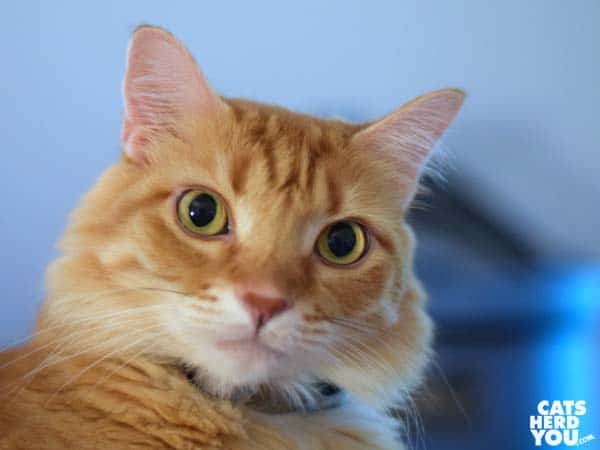
orange tabby cat

After some research, I took another hard look at the food Newton has been eating. Because life has been stressful, it has been easier for me to buy raw food rather than make it, and the local company who makes the raw food makes primarily raw for dogs, just like all pet food manufacturers do.

I sat down with the ingredient list and for some reason, I saw something I had questioned months ago and then put out of my mind: The food is made with chicken necks.

Newton tastes the wind-up chick

The USDA says that chicken necks are 27% bone.

Turkey thighs are 14% bone. The recipe I use to make my own raw food, from Dr. Lisa Pierson, uses poultry thigh with half of the bones removed, so that lowers the bone level to 10% or less.

Rodents are roughly 5% bone and rabbits are a little less than 10% bone.

There isn’t much way around it, Newton’s diet has too much bone in it.

orange tabby cat grabs the skeleton hand

Adding calcium to your diet can raise your urinary pH. Humans actually do this on purpose with calcium supplements to make their urine more alkaline.

Newton’s high urine pH may be the fault of my getting complacent and not making raw food at home and instead buying food that is too high in calcium.

So I think that’s the next step: We’ll leave Newton on the prescription food for a couple more weeks to get a new baseline on his urinary pH on that food, then I’m going to have to make time to make raw for him myself.

Then we’ll see if that allows him to eat high quality, species-appropriate ingredients and have his urine look the way it is supposed to.

orange tabby cat looks out of frame

In the meantime, Newton is feeling fine. He is still playing and making mischief. And he really doesn’t understand what all the fuss is about.


Research and Further Reading

USDA Agricultural Research Service, USDA Food Composition Database 
CatInfo, Making Cat Food
CatCentric, A Prey Model Raw (PMR)/Whole Prey Feeding Guide
Journal of the Medical Association of Thailand, The effects of potassium and magnesium supplementations on urinary risk factors of renal stone patients.

Share Share on email
Email
Share on twitter
Twitter
Share on facebook
Facebook
Share on pinterest
Pinterest
Share on google
Google
Share on tumblr
Tumblr
Share on linkedin
Linkedin

November 14, 2016 Filed Under: Health Tagged With: Newton 27 Comments

Newton’s Cystocentisis

Newton has been on a diet without any treats except freeze-dried meat for about a month now, so it was time for him to go back for a recheck on his urine pH.

orange tabby cat in sleepypod, buckled into car

He was welcomed to the vet’s office by their appointment sign.

Newton's name on Bay Hill Cat Hospital appointment sign

And of course, we were also greeted by Josie, the clinic cat. She doesn’t always pay much attention to the cats in carriers in the lobby, but she walked over and looked in at Newton, who meowed back to her.

Josie, the office cat at Bay Hill Cat Hospital

There was another cat in the lobby during our visit: a tuxedo kitten named Dale, who is up for adoption. The rest of his litter was adopted last weekend, and he has a lot to say any time he thinks someone might pay attention to him.

Dale, adoptable tuxedo kitten at Bay Hill Cat Hospital

Since a urine sample isn’t sterile when a cat uses the litterbox the usual way, the vet wanted a sample drawn from Newton by cystocentesis.

One of the things I really like about this vet’s office is that they will do procedures in exam rooms if they don’t require the big equipment in back, and that includes cystocentisis.

Newton: What’s going ON?

orange tabby cat restrained by vet tech

The vet tech performing the cystocentisis first tried to feel Newton’s bladder, but his mother apparently taught him to “go before you leave home.” The tech wasn’t confident she could find it with a needle without visualization, so they used a small ultrasound unit.

The tech wiped his abdomen with rubbing alcohol and moved the wand around the spot she had wiped, watching the ultrasound screen.

Newton: You aren’t going to publish photos of this on the internet, are you?

orange tabby cat undergoing cystocentisis

Once the vet tech located the his bladder, she inserted the needle into it.

orange tabby cat undergoing cystocentisis

When the tech drew back the plunger, you could see the urine drawn from Newton’s bladder filling the syringe, sterile and ready to test.

orange tabby cat undergoing cystocentisis

This is the kind of thing that goes on in the back of your vet’s office all the time, but it’s nice to get a glimpse of it.

We’re waiting for Newton’s test results and crossing our paws that his urinary pH will have come back down to an acceptable level so there aren’t more diet changes needed. We’ll let you know what we hear.

Share Share on email
Email
Share on twitter
Twitter
Share on facebook
Facebook
Share on pinterest
Pinterest
Share on google
Google
Share on tumblr
Tumblr
Share on linkedin
Linkedin

November 4, 2016 Filed Under: Health Tagged With: Newton 25 Comments

Newton and the No-Good pH

Recently, Newton had to take a trip to the vet. He hopped right into his  beloved Sleepypod carrier, but that’s where his enthusiasm ended for the adventure. He had expected he would get to snooze the morning away in it at home, not take a car ride.

Newton: This is not my happy face.

Newton buckledup in sleeypod carrier in car

It was really important for him to go, though, because he was having some litterbox issues, and we needed to know if they indicated a medical problem.

Lots of people think that when a cat goes outside the box, it is because they are “bad cats,” but it is often because something is wrong with their health. Since litterbox issues are the number one reason that cats get relinquished to shelters, it’s extra-important to check for medical reasons behind not using the litterbox.

Of course, Newton isn’t in any danger of being relinquished to a shelter, but that didn’t excuse him from getting checked out by the vet.

He was cheerfully greeted by name by our vet’s welcome sign in the lobby.

morning appointments at vet

But for some reason, that still didn’t impress him. The best part of visiting an all-cat vet is that everyone who comes in loves cats. Newton got lots of admiration while we waited for our exam room.

Newton: I would rather greet my admirers in the comfort of home, if you don’t mind.

orange tabby cat peers out of sleepypod carrier

After an exam and discussion with the vet, it was time for X-rays and some tests to see what was going on. While we waited for Newton’s turn at the X-ray machine, he stretched his legs. He was especially interested in the door to the back. Any time someone went through it, he wanted to follow them.

Newton: Let’s make a break for it out that door!

orange tabby cat loose in vet exam room

He got his wish when he went to get his X-rays and have his urine drawn.

The X-ray didn’t show any stones, so we had to look at urinalysis to see what was going on.

feline x-ray

It turns out Newton has struvite crystals in his urine, and the pH of his urine is 8.5

pH is a measurement of the molar of hydrogen ions in a solution, and it indicates how acidic or alkaline the solution is.  Lower pH values indicate more acidic materials. Battery acid has a pH of 1. Higher pH values indicate more alkaline materials. Lye has a pH of 13.

pH Chart, image credit: Wikimedia Commons

A cat’s urinary pH should be 6.0 to 6.5, or slightly acidic. This make sense when you think about which foods are acidic and which are alkaline. A cat’s diet is made of meats, which are acidic foods.

acidic vs alkaline foods, image credit: depositphotos/eleabs

Yet for some reason, Newton’s urine was more alkaline, even though he eats a raw diet.

But Newton also eats treats, and those were primarily the crunchy style that is made mostly of grains. He also steals the kibbles that Pierre gets as bedtime treats. So there was no way to say that Newton’s diet was really free of plant material that could be causing his urinary pH to climb.

Step one for Newton is going cold-turkey off of anything with plant material in it. He’ll have to wave goodbye to his crunchy treats as they go in the bin to be donated to a local rescue. We’re hoping that will get his urinary pH back where it needs to be so that he can can start dissolving the struvite crystals in his urine that were making him go outside the box.

Newton: Can we go home now? 

orange tabby cat on the floor of vet exam room

Hopefully he’ll be feeling better in no time. We’ll let you know what happens…


Image credits:

wikimedia commons/Hans Kirkendoll
depositphotos/eleabs

Share Share on email
Email
Share on twitter
Twitter
Share on facebook
Facebook
Share on pinterest
Pinterest
Share on google
Google
Share on tumblr
Tumblr
Share on linkedin
Linkedin

October 17, 2016 Filed Under: Health Tagged With: Newton 24 Comments

10 Signs it’s Time for Your Cat to Visit the Vet

Cats instinctively to hide illness. As such small creatures in a big animal world, they don’t want to show weakness and become prey for a larger creature. Unfortunately, this means that they also hide illness from their human companions who want to be sure they stay healthy. To help catch your cat’s illness early, watch for the 10 signs that your kitty needs a visit to the vet for a diagnosis.

10 signs your cat should visit the vet

1 . Going outside the litterbox

There are a lot of reasons that your cat might be going outside the litterbox. But adding litter boxes, changing litter, and scooping more often doesn’t help if your kitty is going elsewhere because she isn’t feeling well.

Keep in mind that the ailment may not have anything to do with being “sick.” Cats with arthritis may find it difficult to “assume the position” do do their business on the shifting material of cat litter and choose to go on firm flooring instead.

2 . Changes in activity

Is your senior cat suddenly playing with toys like a kitten for the first time in years? A senior experiencing what seems like a second kittenhood can be so delightful it is hard to look past it to realize it might be due to a metabolic problem.

tabby cat playing. Photo credit: depositphotos/darzyhanna

If your kitty is less active than before, this could be a sign that something is wrong, too. For example, refusing to jump up onto furniture to look out a favorite window can be a sign of arthritis.

3.  Changes in social interactions

Most of us are familiar with cats who become withdrawn when they don’t feel well. This makes it easier to overlook ailments that can make formerly-timid cats suddenly seem more outgoing.  If your kitty who never spent time in the living room with the family is suddenly climbing onto everyone’s lap when you sit down in front of the TV, it’s easy to think she has had a breakthrough, and maybe she has! She could also have hyperthyroidism making her seem more outgoing than before.

4  Changes in sleeping habits

Maybe your cat is sleeping all the time, not just her usual 18 hours or so. There’s a reason that kitty is “slowing down” that’s worth looking into.

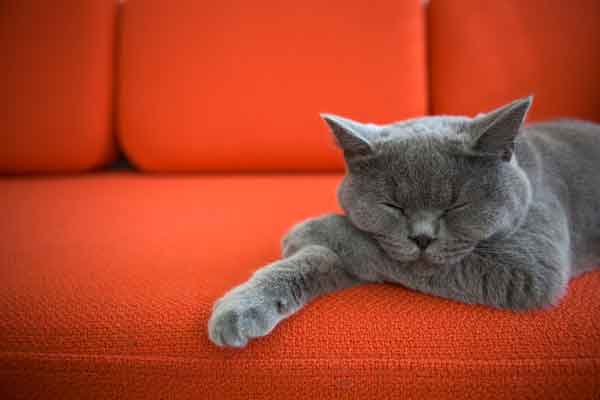
gray cat sleeps on sofa. Photo credit: depositphotos/acmanley

If your kitty who used to sleep with you every night now restlessly roams the house during the wee hours, something has changed. It might be a new neighbor cat, or it could be the onset of an illness that is making her seem restless at night.

5.  Changes in food or water intake

A cat who was a moderate eater and is now always hungry probably has something going on that needs attention. So does a cat whose formerly healthy appetite vanishes and now picks at her food.

If your kitty suddenly stops at the water bowl to drink much more frequently, that should also get your attention. Get her checked out so that you can intervene early in case it is diabetes or kidney disease.

6.  Weight loss or gain

A cat who eats just as much as before but now loses weight has had some kind of a metabolic change that requires attention. Don’t think, “Thank goodness that diet finally worked!” if the exact same diet didn’t work for the last six months. Something is going on!

fat cat. Photo credit: Flickr creative commons/Pamela B

Similarly, a cat who is eating the same amount but seems to be suddenly gaining weight can be a sign that something is going on that needs attention. Your vet can help identify what is happening.

7.  Changes in grooming

Does your kitty look unkempt? Maybe she isn’t bathing as often as she used to or isn’t bathing certain areas like further down her back. There could be lots of reasons for this, including arthritis making it painful to bend around into those catlike pretzel shapes needed for complete grooming.

On the other end of the grooming scale, cats can overgroom to the point of causing bare spots. This can be be a sign of anxiety, pain, or even allergy.

8.  Vocalization changes

Some cats, like Siamese, are just talkative, but be on the lookout for changes from your kitty’s normal behavior. If a talkative kitty suddenly doesn’t meow, something is going on.

cat yawning. photo credit: Gratisography/Ryan McGuire

Does your cat’s meow sound different? Maybe the pitch is different, or she meows much more frequently or sounds hoarse. Any of these changes are a sign that something is going on with your kitty’s health.

9.  Bad breath

Your cat isn’t likely to have that just-brushed fresh breath unless you brush her teeth yourself, but bad breath can be a sign of a variety of issues as obvious as dental disease or as not-so-obvious as kitty having anal gland problems and grooming herself.

10.  Behavior changes

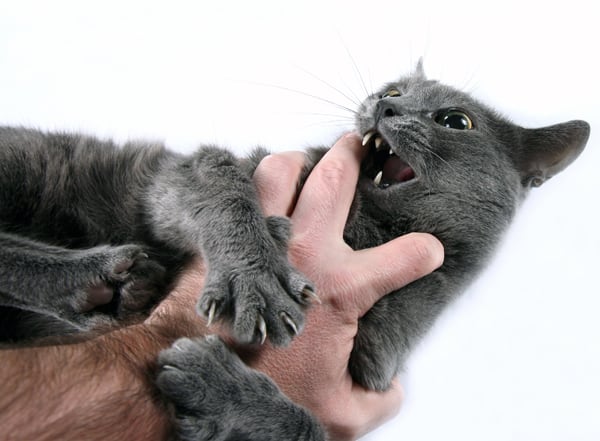
Other behavior changes not already covered above, like sudden signs of fear or aggression may be neurological but are easy to mistake for behavior issues. Keep in mind that all behavior issues have a cause, and the cause could be medical rather than your kitty being a “bad cat.”

gray cat bites a human hand. Photo credit: depositphotos/OlegTroino


Research and further reading:

Cat Healthy, When is it Time to Go to the Vet?

Photo credits

depositphotos/darzyhanna
depositphotos/acmanley
flickr creative commons/Pamela B
Gratisography/Ryan McGuire
depositphotos/OlegTroino

Share Share on email
Email
Share on twitter
Twitter
Share on facebook
Facebook
Share on pinterest
Pinterest
Share on google
Google
Share on tumblr
Tumblr
Share on linkedin
Linkedin

October 3, 2016 Filed Under: Health 27 Comments

  • « Previous Page
  • 1
  • …
  • 4
  • 5
  • 6
  • 7
  • 8
  • …
  • 18
  • Next Page »

Read Ashton’s Story in Rescued, Volume 2

These pawtographed books support Candy's Cats, who work tirelessly to find homes for cats in Florida.

Rescued, Volume 2: The Healing Stories of 12 Cats, Through Their Eyes. Proceeds from authographed copies benefit Candy's Cats.


Outside the US, contact us for shipping to your location.

Read Us by Email

Don't miss a thing! Cats delivered to your email.

Privacy Policy


Archives

All Rights Reserved

Articles and images on this site may not be reproduced in whole or in part without written consent. Please contact me if you are interested in reprinting or in having me write something unique for you.

Disclaimer

There are no veterinarians here. All health-related posts are the result of research and observation, but educational information is not a substitute for visiting your veterinarian. Do not self-diagnose your cat. For more information, see our disclaimer.

Policies

Disclosure Statement
Privacy Policy
Commenting Policy

Copyright © 2026 · Sometimes Cats Herd You · All Rights Reserved