Cats Herd You

Laugh. Learn. Love cats.

  • Home
  • Safety
  • Wellness
  • Rescue
  • Reviews
  • Life With Cats
  • About
  • Media Friendly
  • Contact
You are here: Home / Archives for Health

Cat Writers in New York City for BlogPurr

Last week, I went to New York City for an event called BlogPurr. Merck brought together veterinarians, a cat behavior expert, and a small panel of cat writers to discuss issues specific to feline wellness and advocacy.

blogpurr_01_wm

You’ll be reading more about topics the sessions touched on in the future, but today I wanted to share a little overview of the event itself.

The morning’s lineup of speakers began with author Amy Shojai, who writes about feline behavior. She turned the tables a little bit and instead of just discussing feline behavior, she led a discussion of human behavior, especially how we all interact online.

Amy Shojai speaks at BlogPurr

We discussed how there are so many different personality types among cats, and among humans, too, and how that is reflected in the way we interact online. It was great to be reminded that there are people reading who are too intimidated to comment and join the conversation, and that we need to make sure everyone has a voice in the discussion so that everybody is heard.

The second speaker was Dr. Margie Scherk, who founded the first ever feline-only veterinary practice and is now an international speaker and writer on veterinary topics. I was blown away by her amazing of energy and passion about cats and their care!

Dr. Margie Scherk speaks at BlogPurr

She opened by talking about how there are so millions more cats than dogs here in the US. I had no idea that there are nearly twice the number of cats as there are dogs in Canada. Our friends north of the border love cats more than we do! Yet with so many more cats than dogs living in our homes, cats get to the vet much less frequently, and the number is decreasing.

She shared some really interesting numbers about some of the excuses people give for why their cats don’t make it in to see the vet, including 60% saying their cat “hates” the vet visit, and 39% only willing to visit if their cat is sick. Cats are great at hiding illnesses, and humans aren’t very good at seeing the subtle signs of a sick cat. That makes preventative care even more important so that the cat doesn’t get sick in the first place or the illness is caught early during a routine visit.

One of my favorite things about the sessions at BlogPurr is that they didn’t talk down to us as non-veterinarians about veterinary topics. Hearing a vet say to a non-veterinary audience that  veterinarians and their team members are often less comfortable working with cats than dogs was really refreshing, since it took me years of trying to convince myself I was imagining exactly that.

Veterinarians are now learning how to make their practices more cat friendly, including less-threatening exam rooms and helping cats be less fearful when they are at the vet. Since so much of what is perceived as “bad” behavior at the vet comes from a cat being afraid, this can make a big difference in your cat’s experience at the vet… which means it is a better experience for you, too.

During Dr. Scherk’s talk, she spotted a cat watching her from a window across the street. I hope that kitty learned something from her talk about why going to the vet was important!

Tuxedo cat looks out window, New York City

A third talk was by Dr. Cathy Lund, who has an all-feline practice, City Kitty, in Providence, Rhode Island. I had no idea how much people can be in denial about fleas and ticks. Sure, fleas are embarrassing, but Dr. Lund has had clients tell her that their cat can’t have fleas because they live in a nice neighborhood. Some people really don’t understand that it can happen to anyone.

Cathy Lund and Amy Shojai at BlogPurr

Dr. Lund also explained what a huge fear of tick-borne illness there is in her part of the country. It’s bad enough that people surrender their cats to shelters out of fear of catching diseases from ticks! Obviously, there has to be some solution that helps keep these cats in their homes by calming the fears of the humans they live with.

She told us about how successful the field study was at her clinic for Merck’s new Bravecto for cats and shared quotes from grateful people whose cats were part of the trial and used it to get their flea infestations under control at least. Never having heard a firsthand explanation of participating in a field study, that was really fascinating, and I can only imagine how good it must have felt to help the itchy cats and their frustrated families.

This was followed by a talk from Dr. Robert Armstrong, a veterinarian with Merck, who shared more information about the studies leading up to the new flea and tick prevention product. I laughed when one of the slides said, “People do not want to see disgusting photos.” But it’s true! How many gross photos or diagrams are used at a vet’s office to try to explain things to you and end up squicking you out instead?

Dr. Robert Armstrong speaks at BlogPurr

I thought it was interesting when he talked about formulating a parasite preventative that lasts three months, so it lasts through the time that flea eggs in the household environment hatch and could re-colonize your cat. My first thought was of how long it took us to get fleas under control after my mother brought her cats and dog to live with my sister. A topical treatment you don’t have to remember to apply every month like Bravecto would have been a great solution for those itchy cats.

After the talk, we broke for lunch, and then it was time to go visit the cats.

New York Public Library lion statue

No, not the New York Public Library lions! I took that photo the previous day.

The whole group went to a cat cafe. I’ll have more about that on Wednesday, so come back to see part 2 about our visit to Koneko. 


Disclosure: My travel costs to this event were paid by Merck Animal Health.

Share Share on email
Email
Share on twitter
Twitter
Share on facebook
Facebook
Share on pinterest
Pinterest
Share on google
Google
Share on tumblr
Tumblr
Share on linkedin
Linkedin

September 19, 2016 Filed Under: Health 29 Comments

How Long Has it Been Since Kitty Visited the Vet?

Okay, kitties and humans, this is serious business. We know the vet is probably not either one of your favorite places to go. So why are we talking about Take Your Cat to the Vet Day today?

The truth is that cats don’t get the kind of veterinary care that dogs do. Vets report seeing five dogs for every cat who comes through their door for care, even though there are 85.8 million pet cats and only 77.8 million pet dogs.

Cats see 5 Dogs for Every 1 Cat - #TakeYourCatToTheVetDay

Cats overall aren’t getting seen by vets as often as they should, especially older cats who are more likely to be hiding chronic illnesses. A recent survey found that the older cats are, the less likely they are to go to the vet unless they show signs of illness. This is an alarming trend, since cats are really good at hiding illness in its early stages. Less frequent vet visits as a cat reaches an age where ailments are actually more likely mean those issues will go undiscovered and untreated longer.

You may not notice that your cat doesn’t jump up onto your counters as frequently, or maybe she has stopped entirely. You might even be glad she stopped. But what if the reason she stopped is that she has painful arthritis? Vets can help diagnose ailments during a wellness visit that are easy for even sharp-eyed humans to miss, so an annual exam is an important part of your cat’s preventative care.

Making Carriers Less Frightening

Does your carrier only show up from storage when it’s time to go to the vet? Of course kitty gets suspicious and hides under the sofa when she catches sight of it! She has already learned that thing is a sure signal that she is headed to the vet.

gray cat in green and gray carrier. photo credit: depositphotos/eAlisa

A lot of people avoid taking their cats to the vet because it’s hard to even get kitty into her carrier, but it doesn’t have to be that way. A carrier that only shows up when it’s time to go to the vet is frightening, but a carrier that is part of the usual living room landscape and serves as a place to nap on a regular basis isn’t scary at all. Any carrier can tuck under an end table and have a cozy blanket to make an everyday retreat for a cat so that it’s a familiar place when it’s time to go to the vet or anywhere else.

Cat Friendly Vets

Just thinking about going to the vet is stressful, isn’t it? Would it be less stressful if you thought your vet was a “cat person”? It turns out among surveyed vets, 48% prefer dogs and only 17% prefer cats. Many vets said that dogs were easier to work with during exams, and that they found cats more challenging to diagnose than dogs. If you have noticed your vet obviously prefers dogs, there really are vets out there who are more cat oriented, and not just at cat-only practices!

orange cat with stethescope. photo credit: depositphotos/photo-deti

More veterinarians are realizing they need to meet the needs of their cat clients and are becoming cat friendly. Cat friendly practices understand cat behavior and have more cat-friendly handling guidelines. The American Association of Feline Practitioners certifies cat-friendly practices, and their web site can help you can find one near you if you decide your vet has “gone to the dogs.”

Whether your vet is officially a feline friendly practitioner or just a great veterinarian, let Take Your Cat To the Vet day be a great reminder that it’s time to think about a wellness exam, especially if your cat is a senior.

References and further reading

Banfield 2016 State of Pet Health Report
American Pet Products Association 2015-2016 National Pet Owners Survey
Royal Canin Survey of Dog and Cat Owners
Bayer Veterinary Usage Study III: Feline Findings

Photo credits

depositphotos/eAlisa
depositphotos/photo-deti

Share Share on email
Email
Share on twitter
Twitter
Share on facebook
Facebook
Share on pinterest
Pinterest
Share on google
Google
Share on tumblr
Tumblr
Share on linkedin
Linkedin

August 22, 2016 Filed Under: Health 30 Comments

Cats and Depth Perception

It’s common knowledge that it takes two eyes to see 3-dimensional images. So have you ever wondered how a one-eyed cat like Ashton gets around without bumping into things?

one-eyed brown tabby cat in loaf position

I know it was a concern I had when I realized she was going to lose her eye. But it’s surprising how well she compensates!

Let’s start with how most cats see.

Binocular Vision

The concept of binocular vision brings to mind a cat using a pair of field glasses. But the term binocular actually just means to see through two eyes, the way a normal cat does.

cat looking through binoculars. image credit: depositphotos/RasulovS

Each of your cat’s eyes sees a slightly different image because they are next to each other, and the image projected on the retina of each eye is slightly offset. Your cat’s brain puts the two slightly different images together into a single three-dimensional image.

cat wearing 3D glasses. photo credit: depositphotos/RasulovS

Perceiving the three-dimensional image is called stereopsis. This three-dimensional sight helps your cat catch fast-moving prey, since they can more accurately judge distances when it’s time to pounce.

The side-to-side displacement of your cat’s eyes is easier to gauge using vertical lines and contours, which is why cats, as predators, have pupils with vertical slits.

Vertical pupils that can open wide when hunting also help maximize the contrast between the sharpness of the object your cat is focusing on and the blur of the out-of-focus objects in the foreground and background. Those also help your cat measure distance so that every pounce, whether it’s on a mouse or on a wand toy, is accurate.

orange cat face. photo credit: depositphotos/c-foto

Monocular Vision

Seeing with only one eye, the way Ashton does, is called monocular vision. Hearing “monocular vision” may bring to mind a cat wearing a monocle, but both monocular and monocle use the same word prefix, “mono” meaning singular.

cat with monocle. Photo credit: deposipthotos/kuban_girl

When a cat can only see out of one eye, three-dimensional sight isn’t available to help judge how far away objects are, but there are plenty of other cues a cat can use instead:

  • Focusing – Whether focusing on an object makes the eye work to focus near or far.
  • Detail in objects – The texture detail of an object is more visible as an object is closer. Father objects show less detail and are more indistinct.
  • Relative size – An object looks larger when it is nearer. Objects moving toward the cat look like they are growing larger.

mouse cat toys, near and far.

  • Light and shadow – Both light and shadow help judge the height and position of an object.
  • Brightness – Closer objects appear relatively brighter than further objects.
  • Motion – Nearby objects seem to move faster than farther objects when moving at the same speed. This is called as the parallax effect.
  • Linear Perspective – Parallel straight lines appear to meet in the distance. The further separated the two parallel lines are, the closer the object is. 

All of these are cues that a cat with two eyes uses to help judge distances to objects, too. In a sense, a cat using monocular vision only loses one of the many tools to help navigate the world.

one-eyed brown tabby cat dangles one paw


Research and Further Reading

Annual Review of Neuroscience, The Analysis of Stereopsis
Science Advances, Why do animal eyes have pupils of different shapes?
Unviersity of Calgary, Monocular Cues

Image credits: depositphotos/RasulovS, c-foto, kuban_girl

Save

Share Share on email
Email
Share on twitter
Twitter
Share on facebook
Facebook
Share on pinterest
Pinterest
Share on google
Google
Share on tumblr
Tumblr
Share on linkedin
Linkedin

August 1, 2016 Filed Under: Health Tagged With: Ashton 22 Comments

Anal Glands and Happy Cats

My beautiful, well-mannered cat expresses her anal glands when she is happy, and I thought I was the only one with a cat who did this until last week.

Why don’t we cat owners talk about these things? Are our cat’s rear ends just too delicate a subject and we don’t like to discuss them? Well, that ends today!

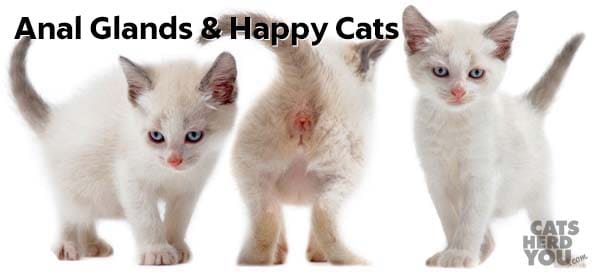
anal glands & happy cats

Feline Anal Glands

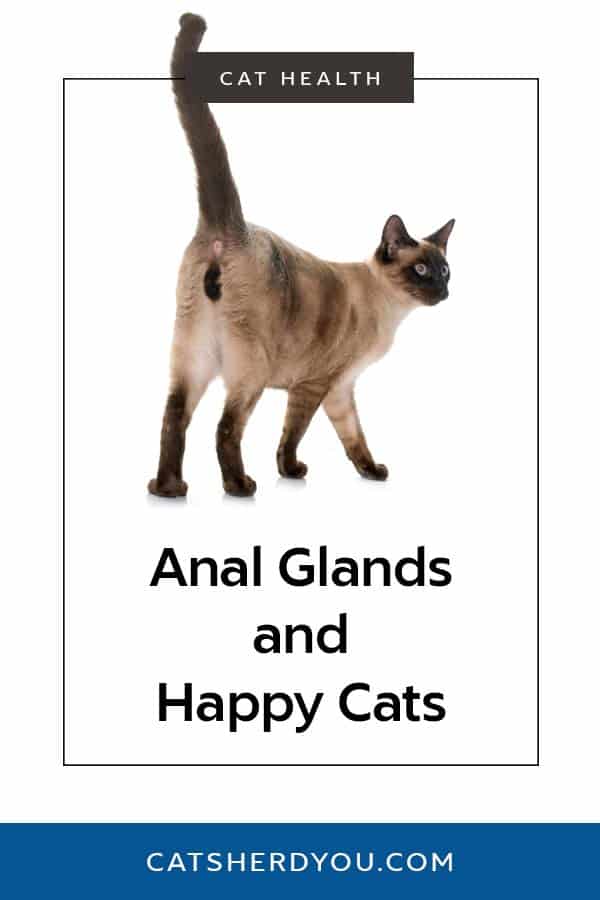
What we usually call anal glands are actually the anal sacs, small, pea-sized spaces on either side of your cat’s anus at about the 5 and 8 o’clock location. The anal glands are contained in the anal sacs, and they create a oily, unpleasant-smelling substance that collects within the sacs.

The contents of these sacs are then used for marking purposes. That’s why your cats sniff each other’s rear ends: they are checking out the calling cards from their anal sacs. When your cat defecates, the anal sacs are squeezed, and their contents are deposited onto the waste. You may have heard of wild cats leaving feces unburied around the perimeter of their territory to mark it; this is done because the feces has the identifying scent from the cat’s anal sacs.

siamese cat from behind. image credit: depositphotos/cynoclub

Most people don’t realize their cats have anal glands or anal sacs until something goes wrong.  When the sacs aren’t emptied during defecation, like when a cat has soft stools for an extended time, so nothing presses against the sacs during visits to the litterbox to empty them, the cat’s body can start to reabsorb the fluid from the contents of the anal sac, making it thicker and even harder to empty, until it becomes impacted or even infected. This requires veterinary attention.

Spontaneously Expressing Feline Anal Sacs

Cats don’t just express their anal sacs when visiting the litterbox. A big scare can be enough for a cat to leave behind an unpleasant-smelling surprise when he expresses his anal sacs spontaneously. This can be mistaken by humans who don’t know about anal glands and anal sacs as the cat “pooping a little” when scared, so this may happen  more often than people realize.

scared kitten. photo credit: depositphotos/Cherry-Merry

If you think expressing anal sacs in fear sounds like another animal you’ve heard of, you’re right. It’s similar to the defense mechanism used by skunks. We should be glad that cats don’t have the kind of aim with their anal sacs that skunks do!

Cats Expressing Anal Sacs when Happy

A happy cat often rubs his head against his favorite humans and objects. This activity deposits pheromones from the scents glands on the cat’s cheek and forehead, letting the kitty mark his territory with his scent.

So why is it surprising that some cats also spontaneously express their anal sacs when they’re in the middle of doing other things to happily mark territory? It is an extension of that same, happy behavior.

tabby cat rubs face on the floor. photo credit: depositphotos/darzyhanna

There’s no study of how widespread cats happily expressing their anal sacs actually is. An informal poll of cat lovers turned up a surprising number of people who had seen it, and all of them thought their cat was the only one.

Stop Making Feline Anal Glands a Polite Secret

Cats happily expressing their anal sacs can be mistaken as incontinence or even misbehavior by someone who doesn’t understand what is happening. That could lead to cats being surrendered to shelters.

The only way to solve this is to make it something that people have heard of and aren’t afraid to discuss. Can we agree not to be embarrassed to talk about this any more? It might save lives.


Research and further reading

Alleice Summers, Companion Animals
Gary Norsworthy, The Feline Patient, 4th Edition
Albone ES, Shirley SG, Mammalian semiochemistry: the investigation of chemical signals
between mammals

Photo credits: depositphotos/cynoclub, Cherry-Merry, darzyhanna

It's a well-kept secret that some cats can have anal gland leakage when they are really happy, similiar to the way that they drool with affection. #cats

Save

Save

Share Share on email
Email
Share on twitter
Twitter
Share on facebook
Facebook
Share on pinterest
Pinterest
Share on google
Google
Share on tumblr
Tumblr
Share on linkedin
Linkedin

July 18, 2016 Filed Under: Health 180 Comments

  • « Previous Page
  • 1
  • …
  • 5
  • 6
  • 7
  • 8
  • 9
  • …
  • 18
  • Next Page »

Read Ashton’s Story in Rescued, Volume 2

These pawtographed books support Candy's Cats, who work tirelessly to find homes for cats in Florida.

Rescued, Volume 2: The Healing Stories of 12 Cats, Through Their Eyes. Proceeds from authographed copies benefit Candy's Cats.


Outside the US, contact us for shipping to your location.

Read Us by Email

Don't miss a thing! Cats delivered to your email.

Privacy Policy


Archives

All Rights Reserved

Articles and images on this site may not be reproduced in whole or in part without written consent. Please contact me if you are interested in reprinting or in having me write something unique for you.

Disclaimer

There are no veterinarians here. All health-related posts are the result of research and observation, but educational information is not a substitute for visiting your veterinarian. Do not self-diagnose your cat. For more information, see our disclaimer.

Policies

Disclosure Statement
Privacy Policy
Commenting Policy

Copyright © 2026 · Sometimes Cats Herd You · All Rights Reserved