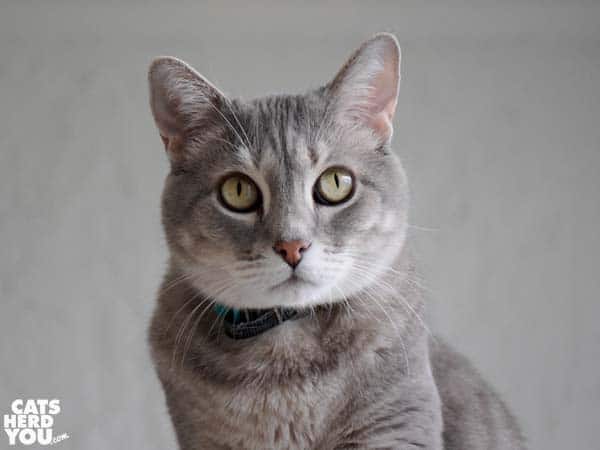
I don’t like to think about Pierre as a senior cat, but he is. He’s 11 now, and when he was at the vet this past week, the vet confirmed what I had suspected: he is slowly losing weight on the same diet where that had previously sustained him.
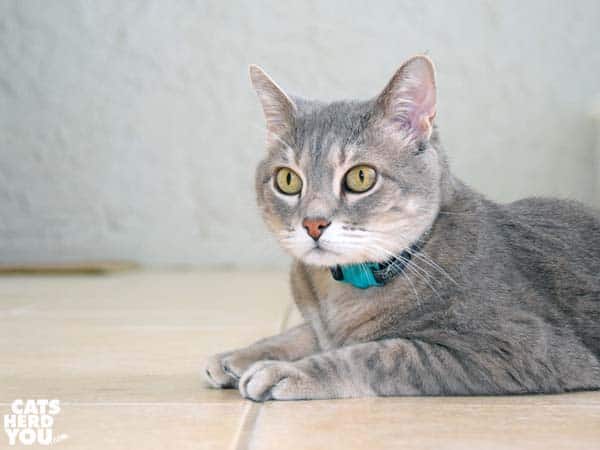
Why could this be? It’s good, high quality food, and that hasn’t changed. The thing that is changing is Pierre’s aging body.
Starting around age 10 or 12, a healthy cat’s aging body becomes less able to digest the protein in the food he eats. Pierre is eating the same food in the same amount he did, but he’s not getting as much of the protein he needs out of it.
Cats Need Protein for Energy
Animals eat food so they can convert it to energy to fuel their bodies. As obligate carnivores, cats need more protein in their diet compared to omnivores like humans. Cats don’t need carbohydrates, and their systems aren’t adapted to process carbs. They convert the digestible protein in their diet into energy to fuel their daily activities.
Not all protein is created equal. Although plant matter may contain protein, as carnivores, a cat’s system is designed to convert animal protein into energy. Even the wrong kind of animal protein isn’t digestible. For example, feathers are made of protein, but they aren’t digestible.
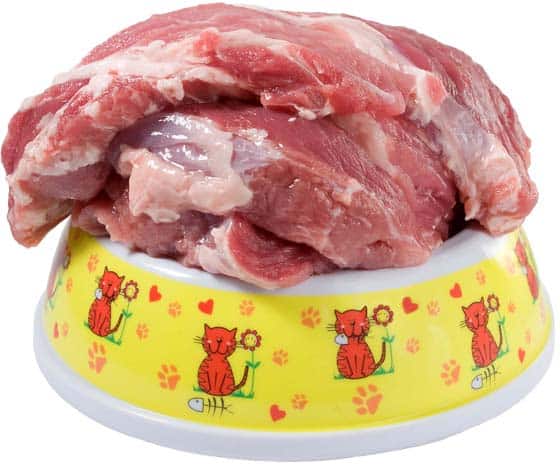
As carnivores, cats need digestible protien. Photo courtesy depositphotos/janzwolinski
An interesting study about middle-aged cats given a selection of foods and allowed to choose their own proportion of protein, fat, and carbohydrates to make up their daily energy requirements, the cats chose a diet 52% (26 grams) protein. The average body weight of cats in the study was 4.9 kg (10.8 lb for us Americans), which means the cats in this research colony chose to eat 5.3 grams of protein per kilogram of body weight a day.
Another study compared cats eating diets that were either low or high in proteins. Cats fed a 30% protein diet lost about 1.2% of their lean body mass while cats fed a 53% protein diet gained 4.2 lean body mass. The researches in this study concluded that cats needed to eat 5.28 grams of protein per kilogram of body weight a day. Those cats allowed to select the amount of protein they ate in their diet in the other study apparently had already figured that out!
Energy Requirements during Middle Age
We know from the epidemic of feline obesity that middle-aged cats can easily gain weight. This happens partly because their metabolism slows during middle age, a phenomenon that many humans can relate to. Both cats and humans can get “middle age spread” when their metabolism isn’t what it used to be when they were kittens.

When a cat reaches middle age, their metabolism slows, and they can’t burn off the calories like they used to. Image courtesy depositphotos/kuban_girl
There is a lot of attention currently being focused on the feline obesity epidemic, and it’s easy to breathe a sigh of relief when your older kitty starts to finally lose some of that weight that the vet has been telling you needs come off of him. But that could actually be a sign that your cat is leaving middle age and becoming a senior.
Energy Requirements beyond Middle Age
When cats get to 10 or 12 years old, their bodies start to change. Even healthy senior cats need more calories to convert into the energy their bodies need because they no longer absorb and metabolize the proteins they eat as efficiently as they used to.
A 12 year old cat only digests about 75% of the protein he eats, so he needs even more protein in his diet to make up for it, unless you can convince him to eat 25% more. This inability to digest the protein in the cat’s diet actually increases as he gets even more geriatric. At some point, you can’t keep feeding your kitty more and more of the same food to make up for his inability to absorb nutrients like he used to. Instead, your cat needs a higher amount of digestible protein in the food he eats.
When your cat doesn’t get enough protein to support his energy needs, he uses his body’s energy reserves. When the fat is gone, he begins to use the energy reserves in his own muscles. This is often referred to as called muscle wasting or sarcopenia. Muscle wasting is seen in a lot of elderly cats as well as elderly humans.
To prevent sarcopenia from aging, a cat needs additional calories and protein. After age 12, this need increases 10-60%, or at least 6.0 – 8.5 grams per kilogram of body weight a day.
How Much Protein is In My Cat’s Food?
Armed with this information, I went to look at Pierre’s cat food. He eats a quality food that has served him well for a long time, and since he’s a picky eater, I’m grateful that he likes the stuff.
It was time to bust out some math and figure out how many grams of protein Pierre is getting per kilogram every day to see if that might be an issue. You can follow along with your own cat food, if you want.
The Math
Pierre eats from a 6 oz can of food. 6 oz is the same as 170.097 grams.
To calculate things on a dry matter basis, I looked at the back of the can. 85% of the weight of his food is moisture. That means only 15% of the contents is dry matter.
If I multiply the 170.097 grams of food weight by the 15% dry matter percentage, I discover that the can contains 25.51 grams of food on a dry matter basis.
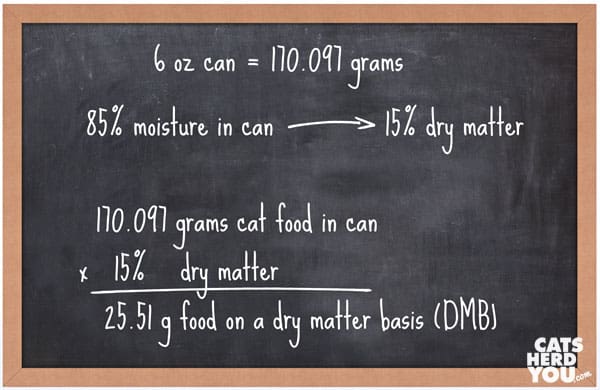
Next I went to the cat food manufacturer’s web site and looked up the percent of protein in the food by dry matter basis. Be sure you’re getting the dry matter basis number for this step! You are more likely to find an “as fed” percentage, and that isn’t the value you’re looking for. Pierre’s food is 57.1% protein on a dry matter basis. That sounded pretty promising.
I multiplied the number I calculated for grams of food in the can on a dry matter basis (25.51) by this protein percentage (57.1%) to find that there are 14.56 grams of protein in each can.
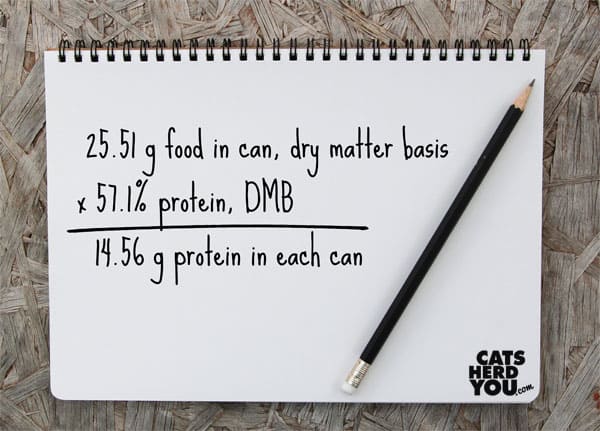
Now that I’ve calculated how much protein there is in a can, I need to figure out how much Pierre is eating per kilogram of his body weight. He eats one can a day, so we can use the protein value we already calculated for one can of his food. And at the vet last week, he weighed 10.1 lb, which converts to 4.56 kilograms.
If I divide his 14.56 grams of daily protein intake by his 4.56 kg weight, I find that he is eating 3.19 grams per kilogram per day of protein an average middle aged cat needs. It’s even further below the 6+ grams seniors who have started to have difficulty absorbing nutrients from protein need.
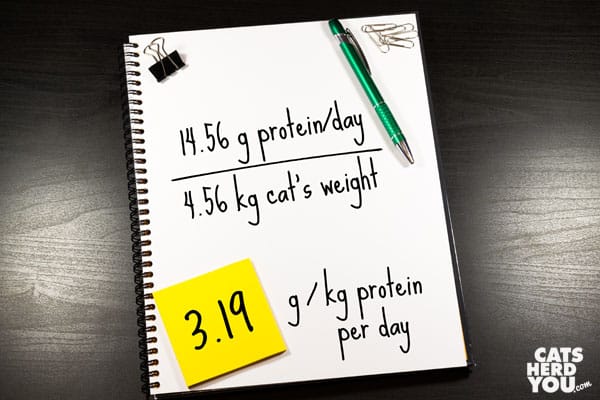
I just discovered I’m looking for a new cat food for Pierre!
(I originally figured this all out on a spreadsheet that calculated these numbers to a lot more decimal places, but I’m breaking them down here with only a few decimal places. If you check my math and it is off by a rounding error, that’s the reason.)
What About Your Skinny, Old Cat?
As you read above, Pierre is under a veterinarian’s care, and his vet and I will be discussing this information soon. There are other medical reasons that your cat could be losing weight in his senior years, such as hyperthyroidism, diabetes, or kidney disease, so it’s important that your vet make sure your kitty is healthy before making any changes to your cat’s diet, including increasing the protein in his food.
References and further reading
Journal of Experimental Biology, Geometric analysis of macronutrient selection in the adult domestic cat, Felis catus
Nestle Companion Animal Summit Proceedings, Focus on Gerontology 2010, Dietary Protein Consumption in the Healthy Aging Companion Animal
Journal of Nutrition, High Protein Intake Affects Lean Body Mass but Not Energy Expenditure in Nonobese Neutered Cats
Insights into Veterinary Endcrinology, Optimal Protein Requirements for Older Cats and Cats with Hyperthyroidism