Cats Herd You

Laugh. Learn. Love cats.

  • Home
  • Safety
  • Wellness
  • Rescue
  • Reviews
  • Life With Cats
  • About
  • Media Friendly
  • Contact

5 Things You Can Do on Earth Day and Every Day

It’s Earth Day, a day to think about how the health of the earth and its environment is in our paws.
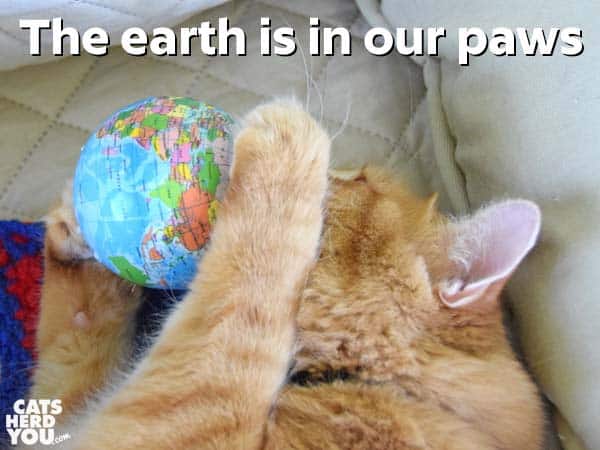
orange tabby cat with earth in his paws

At first glance, sharing your life with cats doesn’t seem like it has many opportunities to help out our environment, but there are actually lots of things you can do! Here are five ideas to get you started:

Use Non Toxic Cleaners

It’s easy to forget that everything you use to clean your house is likely to end up in your cat’s system in one way or another. They walk across your floors, lay on your furniture, and groom themselves, ingesting the chemicals you have chosen to use. Some of the cleaners available in your supermarket cleaning supplies aisle should never come into contact with humans, and humans are a lot larger — and can absorb more chemicals before showing signs of illness — than cats! Using alternative, natural cleaning agents such as vinegar, baking soda, and even steam can help. Our friends at The Cat in the Fridge have some great suggestions about ways to replace your cleaning chemicals with more natural alternatives.

Recycle

Many parts of the country and even parts of the world require recycling, but even if your community makes recycling optional, it’s good for the environment to recycle whatever you can. Did you know that over 65% of aluminum recycling cans are recycled, but pet food cans are recycled at a much lower rate? You can make a difference by making sure your cat food cans make it into the recycling bin instead of the trash can. Since it takes 95% less energy to make a can from recycled aluminum than it does from raw materials, recycling your cans from pet food is a big win for the environment.
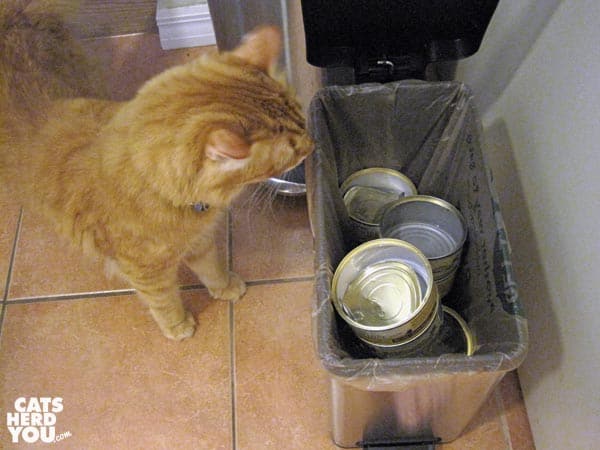
orange tabby cat looks into bin full of cans to recycle

Use Earth-Friendly Cat Litter

Clay and silica for cat litter is gathered through strip-mining, which is very destructive. Mining with a strip-mine is much more cost-effective than making holes in the ground and it takes less labor, but it requires huge amounts of reclamation on the part of the mining company to try to make the land usable again All of your used litter has to go somewhere, and, it takes decades for materials in clay litters to break down in landfills. Consider cat litters made of more eco-friendly materials such as corn, wheat, pine, and recycled newsprint.

Play with Toys Made of Recycled Materials

There are more and more cat toys entering the market with the environment behind. Many use post-consumer waste, including fabrics made of former soda bottles. These toys are generally competitively priced with their counterparts that use less eco-friendly materials, but you can know that you’re doing your part for the environment while you still get your playtime in.

Gray tabby cat plays with Freddie the Fish from Beco

Donate Old Toys

You know that stuffed mouse your Aunt Effie brought you and you never played with? Your humans may think that it’s a lost cause for you to play with — and if you have ignored it this long, they’re probably right. Instead of throwing it in the trash where it will add to the bulk of waste in the landfills, donate it to a shelter or rescue who accepts gently-used toys. That way, it can bring joy to lots of other cats, and you’re off the hook for not playing with it. Win-win!

Share Share on email
Email
Share on twitter
Twitter
Share on facebook
Facebook
Share on pinterest
Pinterest
Share on google
Google
Share on tumblr
Tumblr
Share on linkedin
Linkedin

April 22, 2016 Filed Under: Conservation Tagged With: Newton, Pierre 17 Comments

Cautionary Tale

When you live in Florida this is the time of year that the days that you can leave the door open for the cats to go out onto the porch are coming to an end. It’s getting too warm and humid for that. So last weekend may have been the last chance for the cats to enjoy the porch for a while.

Ashton decided to make the most of it and caught a lizard.

one-eyed brown tabby cat eating lizard

Being a blogger, the first thing I thought to do was document the incident, so I grabbed my camera, turned on the flash since she was backlit by the outdoors, and started snapping photos.

one-eyed brown tabby cat eating lizard

I expected her to let the lizard go and then catch it again. That would have given me plenty of time to come to the lizard’s rescue.

Ashton had other ideas. She skipped directly to second breakfast.

one-eyed brown tabby cat eating lizard

Ashton: Did I miss any?

one-eyed brown tabby cat eating lizard

The moral of this little story is that when your cat catches something in the house, if you don’t want your cat to eat it, don’t grab a camera. Grab the cat and get the prey away immediately.

Ashton is none the worse for her little snack, and she has been hanging around the front door a little more ever since, just in case another lizard happens to run in. She’ll be right on it.

Share Share on email
Email
Share on twitter
Twitter
Share on facebook
Facebook
Share on pinterest
Pinterest
Share on google
Google
Share on tumblr
Tumblr
Share on linkedin
Linkedin

April 20, 2016 Filed Under: Life With Cats Tagged With: Ashton 28 Comments

Don’t Forget ID for Your Cat

It’s National Pet Identification week. Do you know if your kitty has the right ID for your cat necessary to find her way home to you?

Your cat doesn’t have pockets to carry a wallet, so ID for cats takes the form of a microchip and tag. Only two percent of cats who end up in shelters have some form of ID, and until your cat learns to talk, that’s the only way your cat can tell people where she lives.

“A pet’s looks and fur can change drastically in only a few days or weeks on their own,” says Kim Freeman, pet detective and owner of Lost Cat Finder. Cats covered in dirt or wet can look surprisingly different than a nearby lost cat sign that has their photo on it, so ID is the best way for someone to tell it really is your cat.

Can you Identify this Cat?

Microchips

A microchip is a small transponder about the size of a grain of rice that is has with a unique identification number. The chip is implanted by a simple procedure at your vet or even at a local shelter. Reduced-cost and sometimes even free microchips are available at events in your community at various times during the year.

Be sure to register your chip so that if someone finds your kitty, they can get your contact information. Your chip isn’t registered automatically!

If You Move to a New Home

Update your contact information with the microchip registry so that if someone finds your cat, they will be able to contact you. Animal shelters run into heartbreaking dead ends when they scan a cat for a chip but the phone number on the chip is disconnected. Don’t let this happen to your cat!

british shorthair cat using computer

After moving, access your cat’s microchip registry to update the information. Photo: depositphotos/ots-photo

Collars

If your cat will wear a collar, make sure you use a breakaway collar that will come off if your cat gets it caught on something. Safety first!

Include daytime and evening contact information on your cat’s tag, since you never know when someone might have to try to call you. If your cat has a medical condition like diabetes, you can include that on the tag, too, so that if your kitty is lost, he can get the appropriate care until you are reunited.

safety collar with ID tag helps your kitty get home safely

If the noise of a metal tag bothers you or your cat, there are lots of options available, including silent silicon tags and metal tags that slide onto a collar so they don’t dangle.

If You Move to a New Home

Make sure your cat’s tag includes a cell phone number or the number of someone who knows how to reach you.

Microchip Plus Collar

The ASPCA recommends your cat have a registered microchip and also wear a collar with personalized ID tag. Anyone who finds your cat can read an ID tag, while the microchip reader requires the good Samaritan to go to a veterinarian or shelter where they can read the chip.

Collars with tags make it easy for anyone to get your cat home to you. A microchip, hidden beneath your cat’s fur, won’t be lost like a collar can, so it’s a great way to be sure your cat won’t “lose her wallet” and not have any ID when lost.

We all hope our cat never gets lost, but make sure your kitty has the best chance to get back home to you as quickly as possible by chipping and collaring your cat with ID for your cat.

woman holding kitten wearing collar

A cat with both microchip and collar has the best chance of getting home and back into your arms again. Photo: depositphotos/elwynn


This post contains affiliate links, which means we receive a small percentage if you make a purchase using the link on this page.

Share Share on email
Email
Share on twitter
Twitter
Share on facebook
Facebook
Share on pinterest
Pinterest
Share on google
Google
Share on tumblr
Tumblr
Share on linkedin
Linkedin

April 18, 2016 Filed Under: Rescue 17 Comments

Catnip Capers

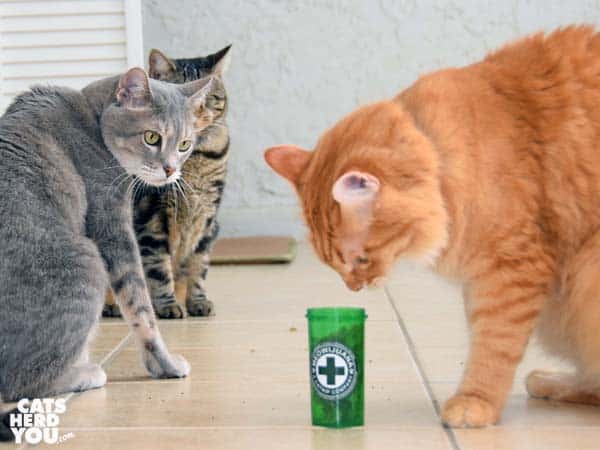
Pierre: Whatcha got, Newton?

Newton: * SNIFF * Oh…. nothing.

orange tabby cat sniffs catnip while gray tabby cat and one-eyed brown tabby cat look on

Pierre: That doesn’t look like nothing to me. Do you mind if I take a closer look?

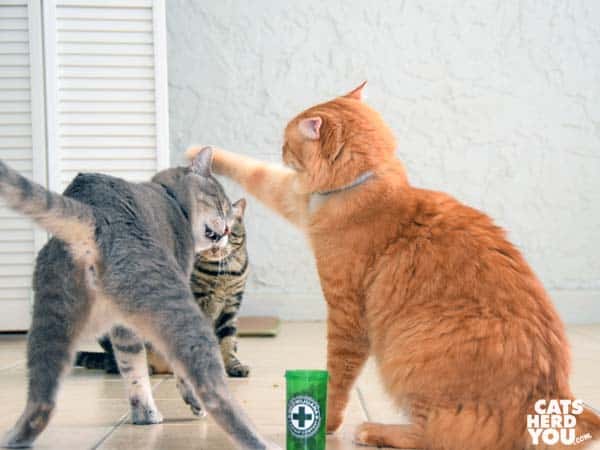
Newton: Stay away from my nip stash!

Pierre: OW!

oranget tabby cat bashes gray tabby caton the head while brown tabby cat looks on

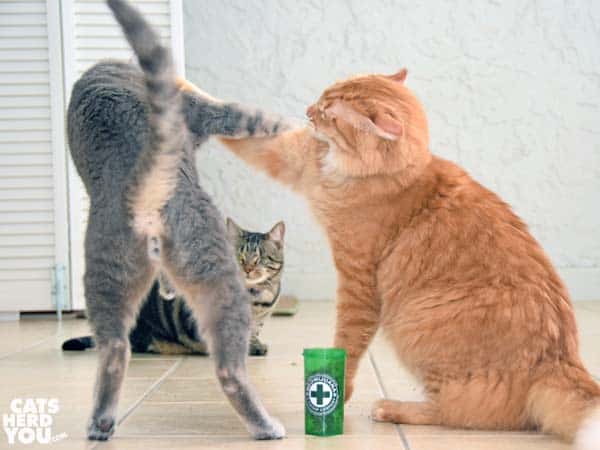
Pierre: Don’t mess up my hairdo. I just finished getting it just right for all the ladycats.

Newton: I’ll show you what the ladycats like. Big, orange mancats who have their own catnip.

Ashton: I am SO out of here. You two are scaring me.

Orange tabby cat and gray tabby cat spar while one-eyed brown tabby cat looks on

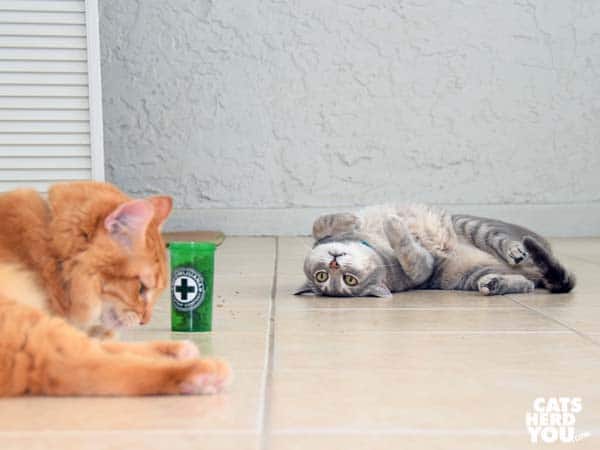
Pierre: Are you going to share that nip? Just a little? Please?

Newton: Stop looking at me upside down like that. That’s kind of scary.

gray tabby cat looks cute while orange tabby cat hoards catnip

Newton: What do all of you think? Should I share my catnip with Pierre?

orange tabby cat, gray tabby cat, and catnip

Share Share on email
Email
Share on twitter
Twitter
Share on facebook
Facebook
Share on pinterest
Pinterest
Share on google
Google
Share on tumblr
Tumblr
Share on linkedin
Linkedin

April 15, 2016 Filed Under: Cats Tagged With: Ashton, Newton, Pierre 22 Comments

  • « Previous Page
  • 1
  • …
  • 109
  • 110
  • 111
  • 112
  • 113
  • …
  • 494
  • Next Page »

Read Ashton’s Story in Rescued, Volume 2

These pawtographed books support Candy's Cats, who work tirelessly to find homes for cats in Florida.

Rescued, Volume 2: The Healing Stories of 12 Cats, Through Their Eyes. Proceeds from authographed copies benefit Candy's Cats.


Outside the US, contact us for shipping to your location.

Read Us by Email

Don't miss a thing! Cats delivered to your email.

Privacy Policy


Archives

All Rights Reserved

Articles and images on this site may not be reproduced in whole or in part without written consent. Please contact me if you are interested in reprinting or in having me write something unique for you.

Disclaimer

There are no veterinarians here. All health-related posts are the result of research and observation, but educational information is not a substitute for visiting your veterinarian. Do not self-diagnose your cat. For more information, see our disclaimer.

Policies

Disclosure Statement
Privacy Policy
Commenting Policy

Copyright © 2026 · Sometimes Cats Herd You · All Rights Reserved