Cats Herd You

Laugh. Learn. Love cats.

  • Home
  • Safety
  • Wellness
  • Rescue
  • Reviews
  • Life With Cats
  • About
  • Media Friendly
  • Contact

Anal Glands and Happy Cats

My beautiful, well-mannered cat expresses her anal glands when she is happy, and I thought I was the only one with a cat who did this until last week.

Why don’t we cat owners talk about these things? Are our cat’s rear ends just too delicate a subject and we don’t like to discuss them? Well, that ends today!
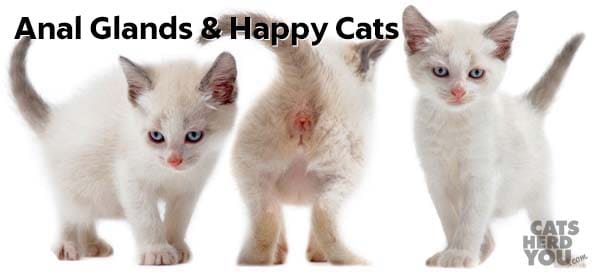
anal glands & happy cats

Feline Anal Glands

What we usually call anal glands are actually the anal sacs, small, pea-sized spaces on either side of your cat’s anus at about the 5 and 8 o’clock location. The anal glands are contained in the anal sacs, and they create a oily, unpleasant-smelling substance that collects within the sacs.

The contents of these sacs are then used for marking purposes. That’s why your cats sniff each other’s rear ends: they are checking out the calling cards from their anal sacs. When your cat defecates, the anal sacs are squeezed, and their contents are deposited onto the waste. You may have heard of wild cats leaving feces unburied around the perimeter of their territory to mark it; this is done because the feces has the identifying scent from the cat’s anal sacs.

siamese cat from behind. image credit: depositphotos/cynoclub

Most people don’t realize their cats have anal glands or anal sacs until something goes wrong.  When the sacs aren’t emptied during defecation, like when a cat has soft stools for an extended time, so nothing presses against the sacs during visits to the litterbox to empty them, the cat’s body can start to reabsorb the fluid from the contents of the anal sac, making it thicker and even harder to empty, until it becomes impacted or even infected. This requires veterinary attention.

Spontaneously Expressing Feline Anal Sacs

Cats don’t just express their anal sacs when visiting the litterbox. A big scare can be enough for a cat to leave behind an unpleasant-smelling surprise when he expresses his anal sacs spontaneously. This can be mistaken by humans who don’t know about anal glands and anal sacs as the cat “pooping a little” when scared, so this may happen  more often than people realize.

scared kitten. photo credit: depositphotos/Cherry-Merry

If you think expressing anal sacs in fear sounds like another animal you’ve heard of, you’re right. It’s similar to the defense mechanism used by skunks. We should be glad that cats don’t have the kind of aim with their anal sacs that skunks do!

Cats Expressing Anal Sacs when Happy

A happy cat often rubs his head against his favorite humans and objects. This activity deposits pheromones from the scents glands on the cat’s cheek and forehead, letting the kitty mark his territory with his scent.

So why is it surprising that some cats also spontaneously express their anal sacs when they’re in the middle of doing other things to happily mark territory? It is an extension of that same, happy behavior.

tabby cat rubs face on the floor. photo credit: depositphotos/darzyhanna

There’s no study of how widespread cats happily expressing their anal sacs actually is. An informal poll of cat lovers turned up a surprising number of people who had seen it, and all of them thought their cat was the only one.

Stop Making Feline Anal Glands a Polite Secret

Cats happily expressing their anal sacs can be mistaken as incontinence or even misbehavior by someone who doesn’t understand what is happening. That could lead to cats being surrendered to shelters.

The only way to solve this is to make it something that people have heard of and aren’t afraid to discuss. Can we agree not to be embarrassed to talk about this any more? It might save lives.


Research and further reading

Alleice Summers, Companion Animals
Gary Norsworthy, The Feline Patient, 4th Edition
Albone ES, Shirley SG, Mammalian semiochemistry: the investigation of chemical signals
between mammals

Photo credits: depositphotos/cynoclub, Cherry-Merry, darzyhanna

It's a well-kept secret that some cats can have anal gland leakage when they are really happy, similiar to the way that they drool with affection. #cats

Save

Save

Share Share on email
Email
Share on twitter
Twitter
Share on facebook
Facebook
Share on pinterest
Pinterest
Share on google
Google
Share on tumblr
Tumblr
Share on linkedin
Linkedin

July 18, 2016 Filed Under: Health 180 Comments

Newton on Pet Fire Safety

Newton: I’m not supposed to get on the counters, but I’m here to tell you a story today for National Pet Fire Safety Day. Once upon a time, I jumped up on the counter to see if anyone had left any good stuff up there.

Well, okay, maybe it was while the head peep was making my dinner on the counter and I wanted to get a head start on it.

orange tabby cat walks on stove


Well, okay, maybe I try to get a head start on dinner every night. But that’s not what the story is about. The story is that one night, I jumped up to help prepare dinner and the head peep started tell me that I was naughty because I had turned on the knob.

  orange tabby cat stands on stove

You kitties might wonder what a knob is. Apparently, these are knobs. Ours are under special protection so I can’t play with them any more.

orange tabby cat sniffs stove knob

Sometimes humans take all of the fun out of my adventures.

About Newton and the Stove Knobs

It’s a true story: Newton used the stove knob as his personal stepping stone to the promised land of the countertop. We have a gas stove, so it was frightening to see him turn on the stove like that. Thankfully, he did it while a human was standing right there preparing food, so the gas was turned off before anything dangerous happened.

We now have stove knob covers as if we had toddlers in the house, because the last thing we want is for Newton to pull this stunt while no one is home to turn off the gas!

stove knob covers

That doesn’t mean that Newton won’t think of another way to be a little bit naughty, but hopefully his next idea will be a little safer for all of us.

orange tabby cat wears fire helmet

Do you take fire safety precautions at your house because of your cat?


Disclosure: This post contains affiliate links, which means we get a small commission for our cat treat fund if you purchase after clicking the link on this page.

Save

Share Share on email
Email
Share on twitter
Twitter
Share on facebook
Facebook
Share on pinterest
Pinterest
Share on google
Google
Share on tumblr
Tumblr
Share on linkedin
Linkedin

July 15, 2016 Filed Under: Safety Tagged With: Newton 27 Comments

Speedbump

Newton: I have always loved my ess scratcher. It’s the best seat in the house! 

orange tabby cat in ess scratcher

Newton: I’m kind of rough on them, though. I went through several of them over the past few years. 

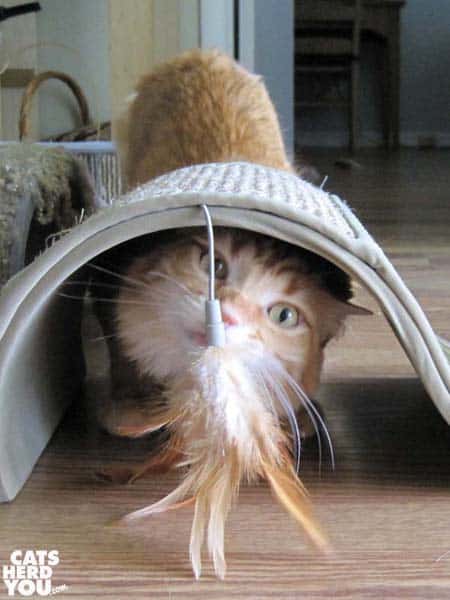
orange tabby cat sniffs feather under the new ess scratcher

Newton: The humans said they don’t make esses like they used to. One day, this speedbump showed up in place of my beloved ess. 

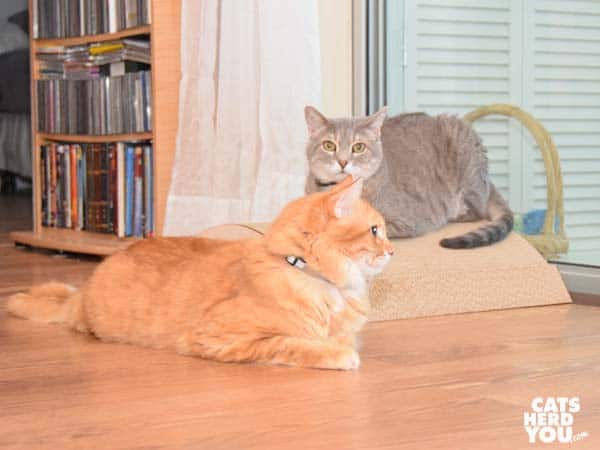
orange tabby cat ignores gray tabby cat on speedbump scratcher

Pierre: Whose best seat in the house is it now? 

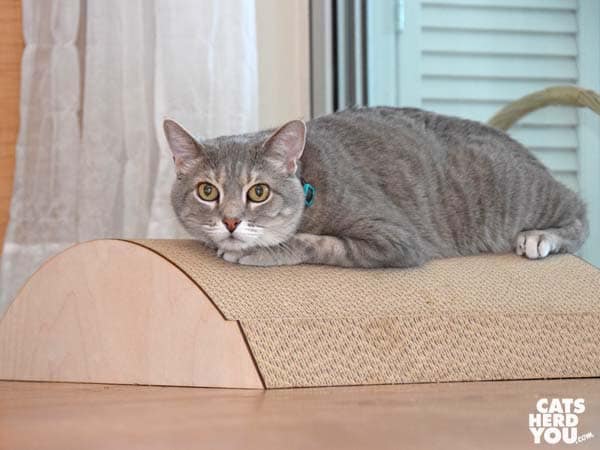
gray tabby cat on speedbump-looking scratcher


Disclosure: This post contains an affiliate link to where the humans got our speedbump scratcher. That means we get a small commission for our cat treat fund if you purchase after clicking the link on this page.

Share Share on email
Email
Share on twitter
Twitter
Share on facebook
Facebook
Share on pinterest
Pinterest
Share on google
Google
Share on tumblr
Tumblr
Share on linkedin
Linkedin

July 13, 2016 Filed Under: Cats Tagged With: Newton, Pierre 21 Comments

Lost Cat Prevention

July is Lost Pet Prevention Month. The things you can do for your cat fall into two categories: prevention and preparedness.

Lost Pet Prevention

The best way to keep your cat safe is to avoid your cat becoming lost.

Keep Your Cats Inside

Indoor cats are less likely to be lost because they aren’t as likely to fall victim to misfortune outdoors. If a kitty is indoors, he isn’t going to be hit by a car, attacked by a predator like a coyote, or exposed to disease from other cats.

The indoors is a safer place to be, and the average lifespan of a cat who lives indoors is ten years longer.

kitten looks out window. photo credit: depositphotos/ysbrand

Many people find that it’s difficult to keep a determined cat indoors, but spaying or neutering can help with a cat’s drive to get out any open door and reproduce. Spaying and neutering can also help with other behaviors that make some people hesitate to keep their cat indoors, like spraying.

Tell Guests Cats Aren’t Allowed Out

It may sound obvious that you need to let guests who come into your house know that your cats aren’t allowed outside, but everyone who comes into your house may not keep their own cats indoors. They also may not have cats and not be accustomed to closing the door when they go outdoors for just a moment or two.

In the chaos of a holiday visit from your family, it helps to enlist everybody’s help to make sure there aren’t any feline escape artists at work!

cats rule premises - keep door closed. photo credits: flickr creative commons/ari

If you are having work done on your house, like plumbing repair or other trades, it is safest to close your cat in a separate room with litter, water, and other necessities so that he doesn’t make a run for the door while the plumber goes back and forth to the truck a dozen times an hour. Even with kitty safely locked up, letting the plumber know that any cat asking to go out should be kept in is safest in case your kitty makes an escape from the safe room.

Make Safe Places for Indoor Cats to Look Outside

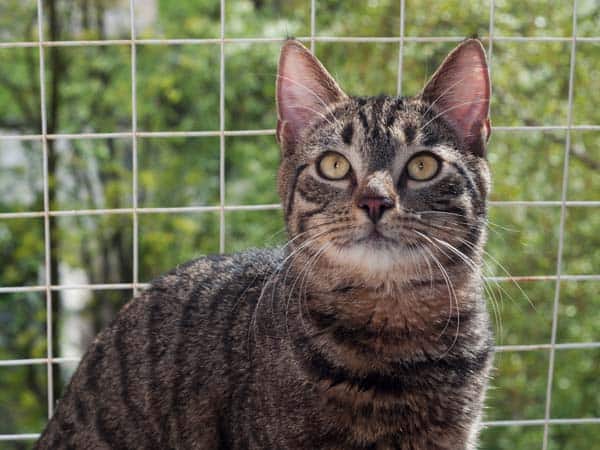
You can make it safe for your cat to enjoy the sights, sounds, and smells of the outdoors without the danger by providing access to windows with secure screens. Even better, cats enjoy spending time on a screened porch or other catio enclosure where they can be somewhat outdoors but are still kept secure from outdoor hazards.

tabby cat with grid separating him from outdoors. photo credit: depositphotos/darzyhanna

A small screened porch in your entryway can also serve as a safety measure for keeping especially determined cats inside. If you treat it like an airlock where the door to the house is never opened until the screened door is closed, even determined door dashers can’t get outside.

Be Safe While Transporting Pets

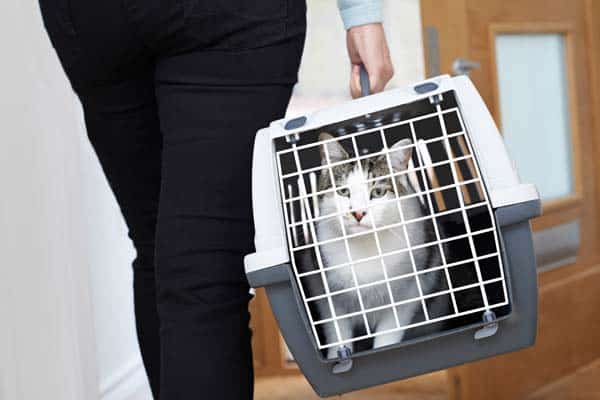
One of the times that indoor cats can become lost is while being transported outside the house, such as to veterinarian appointments. Always transport your cat in a secure carrier, and in the car, don’t open the carrier unless all windows and doors are closed.

Check cat carriers carefully before each use. On hard plastic carriers, screws or clasps that hold the top and bottom halves together can loosen. You can use zip ties as a backup security measure to help keep the top and bottom portions of a carrier together in case a screw works loose during transport.

Also, the plastic on many carriers can age and become brittle, especially if you store them in an attic, garage, or basement where they are subject to extreme temperatures. Look carefully at the plastic near the carrying handle, by where the door fastens, and where the main parts of the carrier come together to be sure that there are no signs of fatigue in the plastic, and don’t trust them to bear weight if you see damage.

cat carrier being carried by woman. photo credit depositphotos/HighwayStarz

Lost Pet Preparedness

No one wants to think that their cat could get lost, but the best way for your cat to get home safely is to be prepared.

Have Proof of Ownership on Hand

If your kitty is lost, the person or organization who finds your cat may ask for proof of ownership. This can be frustrating when it happens, but you wouldn’t want just anyone to be able to say they own your cat and take him away. Be ready by having photos of your pet. Photos of you with your pet are even better! Copies of vet records can also serve as proof of ownership, and they are also useful in case your cat is lost and is in the hands of a veterinarian who wants to know his history. Your cat’s ID is also part of your proof of ownership.

Make Sure Your Cat Has Identification

Without pockets, your cat can’t carry a wallet with an ID card. The two main kinds of identification your cat can carry are a collar and microchip, and they work together to help your cat get home to you.

Collar with ID

A safety collar with ID is a way for your cat to be identified on sight as being an owned cat. There are many  collars available with breakaway clasps that will release if your cat gets the collar caught on an object or in a fight with another cat.

cat wearing collar and ID. photo credit: depositphotos/markhayes

ID on the collar with current contact information allows anyone who finds your cat to quickly find you and reunite the two of you. If you or your cat don’t like the traditional, dangling tags, there are many other options, including tags that slide onto the collar and even collars that include your cat’s information stitched on.

Microchip

Identification in the form of a microchip implanted under your cat’s skin that you update with a registry when your contact information changes is a great, permanent way to identify cats, especially since safety collars can be lost. Animal shelters and veterinarians can scan a lost cat and read the chip, then get the information from the registry to help reunite you to bring your lost cat home again.


Research and further reading

American Animal Hospital Association Pets Matter, Keeping Cats (The #1 pet in America) Healthy
Journal of Feline Medicine and Surgery, Longevity and mortality of cats attending primary care veterinary practices in England

Image credits

depositphotos/ysbrand
depositphotos/darzyhanna
flickr creative commons/ari
depositphotos/HighwayStarz
depositphotos/markhayes

Save

Share Share on email
Email
Share on twitter
Twitter
Share on facebook
Facebook
Share on pinterest
Pinterest
Share on google
Google
Share on tumblr
Tumblr
Share on linkedin
Linkedin

July 11, 2016 Filed Under: Safety 20 Comments

  • « Previous Page
  • 1
  • …
  • 100
  • 101
  • 102
  • 103
  • 104
  • …
  • 494
  • Next Page »

Read Ashton’s Story in Rescued, Volume 2

These pawtographed books support Candy's Cats, who work tirelessly to find homes for cats in Florida.

Rescued, Volume 2: The Healing Stories of 12 Cats, Through Their Eyes. Proceeds from authographed copies benefit Candy's Cats.


Outside the US, contact us for shipping to your location.

Read Us by Email

Don't miss a thing! Cats delivered to your email.

Privacy Policy


Archives

All Rights Reserved

Articles and images on this site may not be reproduced in whole or in part without written consent. Please contact me if you are interested in reprinting or in having me write something unique for you.

Disclaimer

There are no veterinarians here. All health-related posts are the result of research and observation, but educational information is not a substitute for visiting your veterinarian. Do not self-diagnose your cat. For more information, see our disclaimer.

Policies

Disclosure Statement
Privacy Policy
Commenting Policy

Copyright © 2026 · Sometimes Cats Herd You · All Rights Reserved