
July is Lost Pet Prevention Month. The things you can do for your cat fall into two categories: prevention and preparedness.
Lost Pet Prevention
The best way to keep your cat safe is to avoid your cat becoming lost.
Keep Your Cats Inside
Indoor cats are less likely to be lost because they aren’t as likely to fall victim to misfortune outdoors. If a kitty is indoors, he isn’t going to be hit by a car, attacked by a predator like a coyote, or exposed to disease from other cats.
The indoors is a safer place to be, and the average lifespan of a cat who lives indoors is ten years longer.

Many people find that it’s difficult to keep a determined cat indoors, but spaying or neutering can help with a cat’s drive to get out any open door and reproduce. Spaying and neutering can also help with other behaviors that make some people hesitate to keep their cat indoors, like spraying.
Tell Guests Cats Aren’t Allowed Out
It may sound obvious that you need to let guests who come into your house know that your cats aren’t allowed outside, but everyone who comes into your house may not keep their own cats indoors. They also may not have cats and not be accustomed to closing the door when they go outdoors for just a moment or two.
In the chaos of a holiday visit from your family, it helps to enlist everybody’s help to make sure there aren’t any feline escape artists at work!

If you are having work done on your house, like plumbing repair or other trades, it is safest to close your cat in a separate room with litter, water, and other necessities so that he doesn’t make a run for the door while the plumber goes back and forth to the truck a dozen times an hour. Even with kitty safely locked up, letting the plumber know that any cat asking to go out should be kept in is safest in case your kitty makes an escape from the safe room.
Make Safe Places for Indoor Cats to Look Outside
You can make it safe for your cat to enjoy the sights, sounds, and smells of the outdoors without the danger by providing access to windows with secure screens. Even better, cats enjoy spending time on a screened porch or other catio enclosure where they can be somewhat outdoors but are still kept secure from outdoor hazards.
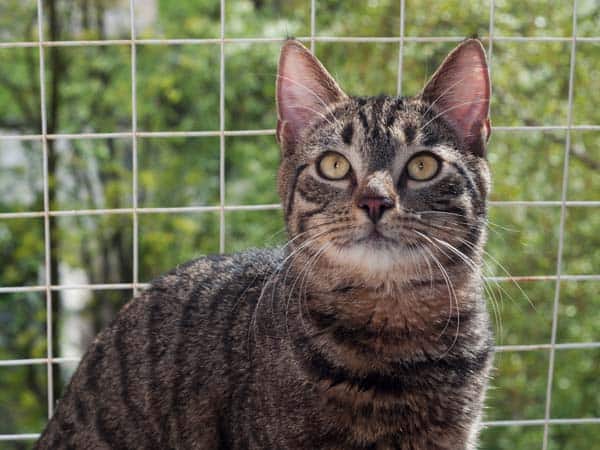
A small screened porch in your entryway can also serve as a safety measure for keeping especially determined cats inside. If you treat it like an airlock where the door to the house is never opened until the screened door is closed, even determined door dashers can’t get outside.
Be Safe While Transporting Pets
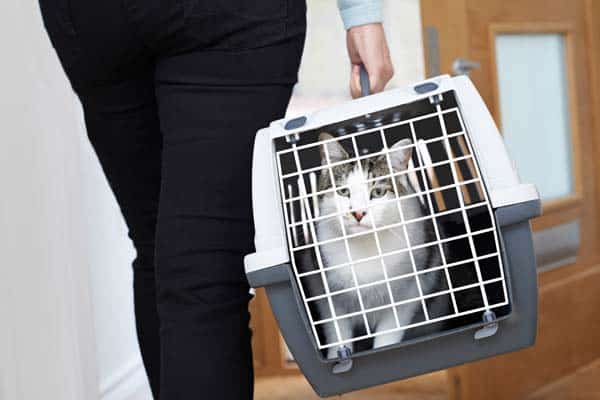
One of the times that indoor cats can become lost is while being transported outside the house, such as to veterinarian appointments. Always transport your cat in a secure carrier, and in the car, don’t open the carrier unless all windows and doors are closed.
Check cat carriers carefully before each use. On hard plastic carriers, screws or clasps that hold the top and bottom halves together can loosen. You can use zip ties as a backup security measure to help keep the top and bottom portions of a carrier together in case a screw works loose during transport.
Also, the plastic on many carriers can age and become brittle, especially if you store them in an attic, garage, or basement where they are subject to extreme temperatures. Look carefully at the plastic near the carrying handle, by where the door fastens, and where the main parts of the carrier come together to be sure that there are no signs of fatigue in the plastic, and don’t trust them to bear weight if you see damage.
Lost Pet Preparedness
No one wants to think that their cat could get lost, but the best way for your cat to get home safely is to be prepared.
Have Proof of Ownership on Hand
If your kitty is lost, the person or organization who finds your cat may ask for proof of ownership. This can be frustrating when it happens, but you wouldn’t want just anyone to be able to say they own your cat and take him away. Be ready by having photos of your pet. Photos of you with your pet are even better! Copies of vet records can also serve as proof of ownership, and they are also useful in case your cat is lost and is in the hands of a veterinarian who wants to know his history. Your cat’s ID is also part of your proof of ownership.
Make Sure Your Cat Has Identification
Without pockets, your cat can’t carry a wallet with an ID card. The two main kinds of identification your cat can carry are a collar and microchip, and they work together to help your cat get home to you.
Collar with ID
A safety collar with ID is a way for your cat to be identified on sight as being an owned cat. There are many collars available with breakaway clasps that will release if your cat gets the collar caught on an object or in a fight with another cat.

ID on the collar with current contact information allows anyone who finds your cat to quickly find you and reunite the two of you. If you or your cat don’t like the traditional, dangling tags, there are many other options, including tags that slide onto the collar and even collars that include your cat’s information stitched on.
Microchip
Identification in the form of a microchip implanted under your cat’s skin that you update with a registry when your contact information changes is a great, permanent way to identify cats, especially since safety collars can be lost. Animal shelters and veterinarians can scan a lost cat and read the chip, then get the information from the registry to help reunite you to bring your lost cat home again.
Research and further reading
American Animal Hospital Association Pets Matter, Keeping Cats (The #1 pet in America) Healthy
Journal of Feline Medicine and Surgery, Longevity and mortality of cats attending primary care veterinary practices in England
Image credits
depositphotos/ysbrand
depositphotos/darzyhanna
flickr creative commons/ari
depositphotos/HighwayStarz
depositphotos/markhayes


Thanks for all these tips! My human is especially paranoid about keeping the doors shut when people come over.
Great tips! Our three cats are indoors only and all are chipped. We always put them in the bedroom (and Ruby, too) when we have repair people over. Also, when my daughter has friends over, I usually put the cats upstairs or keep a very close eye on them. Kids who aren’t used to having cats and closing the doors behind them can be a disaster waiting to happen.
What a timely post!! Mom and I are sequestered in the blog office for that very reason.
Mom said some of these workers must’ve been raised in a barn they NEVER no NEVER close doors thoroughly. Mom has signs on all the doors keep Doors CLOSED at all times and on my blog door DO NOT OPEN THIS DOOR CAT ROOM!!
Hugs madi your bfff
OH our Mom is super paranoid about even opening the front door when someone knocks! She dashes outside and closes it quickly so we stay inside, although we all tend to hide when the door bells rings! Good post!!
Oh our humans are paranoid about letting every visitor knows we are not allowed outside. Even though sometimes the door is wide open (the humans are around) we never ever go near the door anyway. We don’t want to go outside. Scary there, no noms either.
grate post guys…..thanx for sharin….therz a lot oh grate info
in thiz post two day; several points we can ree late two round
trout towne way ~~~~~~ ☺☺☺♥♥♥
Yippee for awesome info and tips! Thanks for the reminder to look closely at our PTDs. Even though we don’t like them, we like knowing our humans are checking them for age-related problems. Maybe we’ll even get a couple of new ones!
Very good tips. The mom is paranoid every time she answers the door for fear that one of us will run out. It doesn’t help that Wally has done it a few times.
Great tips! There is nothing much scarier than the thoughts of losing a precious pet.
Collar, microchip or some form of on-cat ID is so important, since sometimes natural disasters and the unexpected can occur (thinking of Amy’s apartment fire!).
Pawesome tips!!
Terrific post and AMEN to all of that, especially crazy working humans at the house!
Great info! I’m working on a similar article this week. With the age of my PTU, it’s a wonder it hasn’t biodegraded. TW has bought others but she likes this one best.
Great tips, thank you! We have indoor kitties and I am super paranoid about them getting out. I also got soft-sided carriers because I was always nervous that the plastic one would break.
Those are some mighty good suggestions. Great post.
All good advice. We all wear collars 24/7, and some of us have a microchip as well, but not every vet and rescue in our area has a reader. And the collar is the best way to recognize an owned cat should we escape. A collar is put on each of us the moment we are adopted and a tag ordered immediately. We have a missing cat in our neighborhood right now with no form of I.D. other than fur color. Not much to go on! XOCK, Lily Olivia, Mauricio, Misty May, Giulietta, Fiona, Astrid, Lisbeth and Calista Jo
Most people think microchipping is enough, but I’ve seen several stories about shelters not scanning (because they don’t have the equipment or don’t use it properly) before euthanizing cats found on the street. I’m trying to remember where I read this, but some organization is pressing for mandatory scanning before euthanization (this seems like common sense to me). I’m lucky in that I don’t have a lot of people going in and out (really no one besides me) so I have more control than most – but I still have nightmares about Kitty getting outside (she died 10 years ago) and not being able to find her (at the time I lived with my family and not everyone cared or paid attention to the dangers).
Those are all great tips ! We enjoyed reading tips about prevention to avoid pet loss. Purrs
SUCH important tips!
Did you know that Nicki, the cat that came before us, was once lost in downtown Minneapolis? Glogirly used to bring him to work with her when she was an assistant at a photo studio. And one day someone (who didn’t realize the front door needed to be kept shut because of Nicki and the resident cat Digger) left the door ajar. Nicky was lost for 5 days until the photographer, who decided to spend the night at the studio in case Nicky came back, heard his cries from the building next door. It was a heart wrenching few days…but fortunately a very happy ending.
So, YES!!! Tell everyone who comes into your house that you have cats and they do not go outside and to be VERY careful when opening and shutting the door!
Our mom tells every new visitor about us being indoor only, mainly service people who have to do something in and out. Even though we’re famous for hiding with aliens in the house, it’s good just in case.
Excellent post. A collar and ID is so important because so many places don’t check for microchips even though it is so simple. I am working with my state rep. for a mandatory scan law.