Cats Herd You

Laugh. Learn. Love cats.

  • Home
  • Safety
  • Wellness
  • Rescue
  • Reviews
  • Life With Cats
  • About
  • Media Friendly
  • Contact
You are here: Home / Archives for Health

Less Stress Getting to the Vet

Timid cats like Ashton can suffer from a lot of stress and anxiety when they go to the vet. Ashton regularly pants during the car ride and even at the vet’s office, a sure sign of fear. For Ashton’s recent recheck appointment, the vet suggested we try giving her a drug to make the visit less stressful.

one-eyed brown tabby cat and veterinarian's hands - less stress during vet visits

I’m not a big believer in giving drugs for everything, but Ashton gets so frightened by being taken out of her routine that I thought was worth trying. If her heart is racing and her blood pressure is way up from fear, there is no way to examine her to tell whether she is truly healthy. If it worked, having her calm and being able to get a better assessment of her health sounded worth a try.

Ashton’s Less Stressful Trip to the Vet

Her veterinarian prescribed Gabapentin, which is sometimes used for pain relief in cats, to be given in a teaspoon of food two hours before her appointment. A friend whose cat took Gabapentin for chronic pain warned me that the medication was bitter, so instead of her usual food, it went into a teaspoon of pungent cat food with a thick sauce to help mask the flavor.

one-eyed brown tabby cat eating

About 40 minutes after Ashton ate the food with the gabapentin, I looked up and discovered that she was nowhere to be found. When it was time to go to the vet, I found her in one of her usual hiding places in the closet. I picked her up, anticipating her usual struggle against being held, but she didn’t resist being held at all. That was unexpected!

It’s much easier to put a cat who isn’t resisting being held into her carrier, and I zipped the lid right onto her Sleepypod. She immediately let out one of her usual “For real?” meows, and I realized that although the gabapentin made her more sedate, she was still alert and able to talk all the way to the vet.

one-eyed brown tabby cat in sleeypod carrier

I always start early when I’m gathering Ashton up for a vet trip, not knowing if it is going to take a while to locate a hiding place or get her out from under some piece of furniture. That meant we were so early for her first-in-the-morning vet appointment that they weren’t even open yet.

I climbed into the back seat of the car, and with the doors and windows closed, I unzipped the Sleepypod. I expected to find her cowering in the bottom of the carrier, panting and drooling. Instead, Ashton sat up, looking alert but not afraid. This was a real difference from her usual attitude when she was in the car.

one-eyed brown tabby cat sits up from open Sleepypod cat carrier in back of car

Ashton’s Less Stressful Vet Exam

When the office opened, we went inside for her appointment. In the exam room, the vet was able to reach into the pod and pull Ashton out with no resistance. She placed Ashton on the scale in the exam room, and Ashton made no attempt to crawl off of the scale like she usually would. Instead, Ashton curiously looked up into her face while she listened with the stethoscope.

one-eyed brown tabby cat looks up at veterinarian during exam

Every once in a while, Ashton would register a verbal protest, but she seemed calm otherwise. At the end of the exam, her vet picked Ashton up and said, “This is one of my favorite parts of gapapentin. I get a cuddle.” And she did! Ashton doesn’t even let me cuddle her like that.

veterinarian cuddles one-eyed brown tabby cat

Overall, there were signs of stress during the experience, but they were diminished from the usual vet trip. Ashton stress-shed some fur, but not as much as usual. She also never reached the point of panting out of fear in the car like she usually does. When we got home, she didn’t hide for hours, which seems like a sign that it was a less scary experience for her. She was back to completely normal within a few hours, sooner than Pierre stopped telling her she smelled like the vet.

I’d call gabapentin a success for reducing Ashton’s stress level for a vet visit. There’s no way to know what was going on inside her head, of course, but outwardly, she didn’t exhibit signs of stress the same way, and we will be using it for her again when it is necessary for her to visit the vet again to make the experience less traumatic for her.


Research and further reading:

Veterinary Anesthesia Specialists, Serenity Now: Practical Sedation Options for Cats

Share Share on email
Email
Share on twitter
Twitter
Share on facebook
Facebook
Share on pinterest
Pinterest
Share on google
Google
Share on tumblr
Tumblr
Share on linkedin
Linkedin

May 17, 2017 Filed Under: Health Tagged With: Ashton 12 Comments

Why Cats Shouldn’t Eat before Anesthesia

There’s a reason they tell you it’s important not to let your cat eat the night before a surgery or other procedure where kitty is being put under anesthesia. I found out the hard way with Ashton last month during her tooth extraction due to tooth resorption, and it has taken me a while to be ready to talk about it.

One-eyed brown tabby cat - why cats shouldn't eat before anesthesia

The anesthesia guidelines from the American Animal Hospital Association (AAHA) are clear. Cats over 16 weeks of age should not eat or drink overnight if they have morning procedures. This is to reduce risks of vomiting up stomach contents and potentially breathing some of it in while under anesthetic.

Mistake #1

My vet, like nearly every other vet on the planet, has withholding food the night before part of their preoperative instructions.

I like to think of myself as a pretty good vet client. Ashton’s Sleepypod was ready 24 hours beforehand. Her dental was the last thought on my mind as I drifted off to sleep the night before, curled up with her in bed. But I forgot to pick up the water bowls, and I didn’t think to tell my husband that she should not eat the next morning.

I didn’t remember until it was nearly time to leave for the vet. So instead of leaving, I waited anxiously for the vet’s office to start answering their phone so I could confess and reschedule the dental procedure.

Mistake #2

The tech on the phone from the vet’s office asked how much she had eaten. “1.25 ounces.” That’s the regular amount for her raw food breakfast. The tech said that they would do her dental last instead of first to give extra time for her stomach to empty, and it would be fine.

Mistake #3

I could have insisted on rescheduling, but I didn’t. Instead, I took Ashton to the vet for her dental.

Welcome sign at Bay Hill Cat Hospital for Ashton

Ashton’s Anesthesia

Time drags when you’re waiting, and I spent the morning waiting for a status update on Ashton. When Newton had his dental, a tech at my vet’s office phoned to tell me he was under anesthesia, and she phoned again when he was awake. Not hearing anything made me anxious, so at nearly noon, I called to check on her.

The dental before hers had run long, the tech told me, but they had actually just put her under. I didn’t realize until looking back that there had probably already been problems.

Much more time passed before I got the second call that she was awake again than I expected. I told myself that when Newton has his dental, he only had a tiny tooth removed, and Ashton was having a premolar out and maybe more. That could account for the delay.

When the phone finally rang, I jumped to answer it. The tech told me that Ashton was awake, then gave the phone to the vet, something that didn’t happen after Newton’s dental.

“So we had a little bit of trouble…” Ashton’s vet began.

Trouble Under Anesthesia

If a cat has any stomach contents, they usually lose it when they are premedicated for anaesthesia. Ashton didn’t, so they felt confident to insert the tube into her airway for ventilation. But when they did, fluid unexpectedly came up from her stomach and was visible around the tube.

“She didn’t want to stay breathing when she was under,” Ashton’s veterinarian told me. After they woke her, it appeared that the lower right lobe of her lung had not gotten a lot of oxygen during the procedure. “You’ll want to watch her for coughing for a few days in case she aspirated.”

Coughing after an incident like this could be a sign of pneumonia. Cats, like humans, have an airway to the lungs (trachea) and a  tube that carries food to the stomach (esophagus). Those two tubes intersect in the cat’s throat (pharynx) in a way similar how they do in yours.

Feline upper airway and trachea anatomy diagram

Feline anatomy. Photo credit: depositphotos/Anviczo

When a cat is awake, her swallowing reflex causes her to cover the opening of the trachea with her larynx when he eats or drinks, preventing breathing in food or water. But when a cat is under anesthesia, that reflex doesn’t kick in, leaving them vulnerable if they regurgitate stomach contents or have reflux of stomach acids.

One of the things that helps prevent this during anesthesia is your vet’s staff using an endotracheal tube. The tube goes down into the trachea and the cuff near the end inflates like a balloon. The inflated cuff creates a seal to prevent your cat from inhaling anything she shouldn’t, like stomach contents.

endotracheal tube

Endotracheal tube. Photo credit: flickr creative commons/augschburger

Stomach contents making their way down the trachea ends up as a foreign substance in the lungs, and it causes an inflammatory reaction. That reaction is called aspiration pneumonia, and it was my vet warned me I would need to watch Ashton for.

Ashton’s Outcome

Having to wait over four hours to pick up Ashton gave me lots of time to worry. I probably had the world record in worrying by the time I was able to get there and see her again.

When I went to pick her up, the veterinarian walked me through what happened during Ashton’s anesthesia. “We looked, and her trachea was closed up tight.” She assured me they did extra radiographs of her lungs just in case to be sure there weren’t signs of Ashton having aspirated any of that reflux into her airway. The x-rays showed her lungs looking clear.

Finally, the vet tech brought Ashton out. She looked glassy-eyed and was awkwardly affectionate to everything familiar.

While I got her discharge instructions, she kneaded the inside of her Sleepypod. I was so relieved to see her breathing well and feeling all right.

Ashton was on antibiotics for her dental surgery anyhow, but they did double-duty as preventatives for pneumonia. Still, I was on pins and needles for a week, watching Ashton for the slightest cough. I felt fortunate that she was fine.

Lessons Learned

This was a big lesson to me. I don’t care what my vet’s office suggests, if I forget to fast a cat in the future, they aren’t going under anesthesia. I’m going to err on the side of caution and reschedule. It’s the safe thing to do.

Update: Before there are any misunderstandings, I should add that I don’t blame my vet’s office for my decision to bring Ashton in for her dental after she ate. That decision was mine, and it’s why I feel so strongly that people who love cats need to understand the risks so they are sure to do the right thing if they make the mistake of feeding their cat before scheduled anesthesia.


Research and Further Reading

Journal of the American Animal Hospital Association, AAHA Anesthesia Guidelines for Dogs and Cats
Veterinary Anesthesia Specialists, Options for Anesthesia Airway Control in Cats
Cornell University College of Veterinary Medicine, Pneumonia

Share Share on email
Email
Share on twitter
Twitter
Share on facebook
Facebook
Share on pinterest
Pinterest
Share on google
Google
Share on tumblr
Tumblr
Share on linkedin
Linkedin

May 10, 2017 Filed Under: Health Tagged With: Ashton 27 Comments

Pilling a Difficult Cat

Ashton just finished fourteen straight days of medication, and she may be the most difficult cat to administer pills ever in the family. I have given literally thousands of pills to all of my hyperthyroid cats over the years, but medicating Ashton without traumatizing her is nearly impossible.

one-eyed brown tabby cat, the difficult-to-pill cat

The problem with Ashton is she doesn’t like to be restrained or held in any way. After her recent dental, I brought home liquid medications for her, and wrestling her into taking them traumatized not just her, but the other cats, too. When both Pierre and Ashton hid and didn’t come out for dinner, I knew something had to change.

Ashton needed to take her medication willingly, and that meant hiding from her that she was taking it at all.

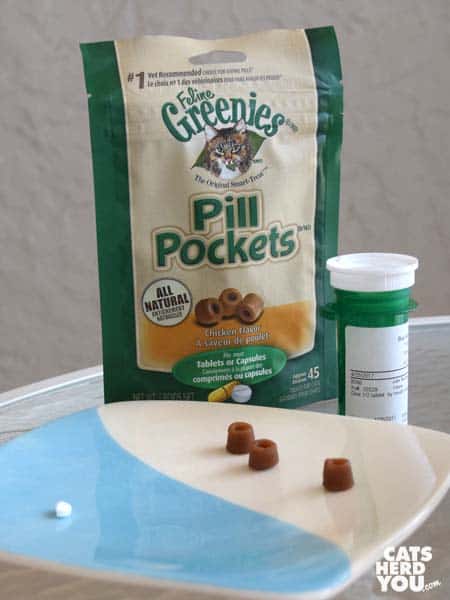
The first step was to switch from liquid medication to pills, which are easier to disguise for a food-driven cat like Ashton. Then I had to find something to hide the pill in. There are several products on the market specifically meant to hide pills. For Ashton, I chose chicken flavored Pill Pockets, because Ashton loves chicken, but you can’t hide a pill in actual chicken. If your cat is partial to a flavor that they don’t offer, there are other pill pastes and wraps. They important thing is to find a flavor your cat likes.

Pill and disguise

The key to successfully pilling a cat while hiding food inside anything is not using too much stuff around the pill. If there is, cats seem to chew it off and spit the pill right out, So for this pill, I broke the pill pocket in half and knead that around the pill so that it wasn’t too thick. Every time I do this, it doesn’t look like it’s going to be enough treat to cover the whole pill, but it is.

Combining pills into treat

Next, I give the empty half of the pill pocket as a treat. Ashton can smell the chicken flavor and waves her paw to ask for it. Since she is eating raw and only gets freeze-dried treats most of the time, this is pretty exciting for her.

one-eyedbrown tabby cat waves paw

After that, I offer the treat wit the pill hidden inside. Can you tell Ashton is right-pawed by the way it’s nearly always her right paw she waves when asking for her treat?

She eats the treat without ever realizing there was a pill in it. I sometimes worry that my sigh of relief will give me away to her when she does eat it!

one-eyed tabby cat takes pill hidden in treat

Once she has eaten her pill, Ashton gets another treat. This is important to make sure she isn’t hiding that pill somewhere in her mouth. Ideally, after you give a cat a pill, you should syringe some water into her mouth to get her to swallow, but  since syringing anything into Ashton is so difficult, we make do with additional treats to ensure she swallows.

By this time, Pierre has figured out that Ashton is getting something he isn’t, and he wants treats, too. That’s part of the reason I usually have extra pill pockets on hand for this process!

one-eyed tabby cat takes pill hidden in treat as gray tabby cat looks on

Does this look like the face of a cat who knows she just got medicine? Not a bit, and that’s exactly the way we want it to stay.

one-eyed brown tabby cat licks lips with tongue


This post contains affiliate links, which means we receive a small percentage if you make a purchase using the link on this page.

Share Share on email
Email
Share on twitter
Twitter
Share on facebook
Facebook
Share on pinterest
Pinterest
Share on google
Google
Share on tumblr
Tumblr
Share on linkedin
Linkedin

May 5, 2017 Filed Under: Health Tagged With: Ashton 25 Comments

Feline Tooth Resorption

When I shared that Ashton was going to have a tooth pulled, it was surprising how many friends commented about cats having teeth removed, too. What’s up with all these cats losing teeth? Feline tooth resorption.

Tooth resorption, where the cat’s own body begins to break down a tooth, happens more often than you would expect. It is one of the most common diseases in domestic cats, with about 29% of cats having at least one resorptive lesion.

What is feline tooth resorption?

Tooth resorption happens when odontoclasts, cells in the cat’s mouth, gradually destroy the tooth by digesting it at a cellular level.

Holes – or lesions – form in the outermost layer of the tooth, sometimes starting in the root, and other times in the visible of the tooth, called the crown. Because tooth resorption can be hidden beneath the gums, you may not be able to see when tooth resorption begins.

The only way to detect below-the-gumline lesions on teeth is with x-rays. Your veterinarian can only see this kind of resorptive lesion after it spreads upward into the crown. Sometimes the holes in the crown of the tooth are visible on examination, and other times, a cat’s gums become inflamed and will cover the area of the tooth with the lesion.

Ashton’s gums were inflamed around her damaged tooth, and the gum seemed to be stretching up to try to cover her tooth, as soon below.

Resorptive lesion on feline tooth

Resorptive lesion on tooth. Photo courtesy Bay Hill Cat Hospital.

What her inflamed gums were hiding was a tooth that had a huge hole in the side. Look at the x-ray image that shows what was hiding under the gum. Doesn’t that look like it must have been painful?

Radiograph showing tooth resorption courtesy Bay Hill Cat Hospital

If left long enough, tooth resorption will destroy the tooth entirely, until nothing remains above the gumline. Ashton’s same premolar on the other side of her mouth was completely gone, as seen in this image.

X-ray of tooth completely destroyed by tooth resorption

X-ray of tooth completely destroyed by tooth resorption courtesy Bay Hill Cat Hospital

Signs of Tooth Resorption

Once the lesions above the gumline can be painful to your cat. Cats are good at hiding pain, so it may not be obvious. Signs that could mean tooth resorption include:

  • Difficulty eating or dropping food outside the bowl
  • Chewing with only one side of the mouth
  • Bleeding from the mouth
  • Excessive salivation
  • Overall withdrawal or change in mood
  • Bad breath

Ashton never misses a meal, so the only clue we had at home there could be a problem was her terrible breath. It’s a good thing we knew what her regular breath smelled like so we could tell when there was a change. It meant the vet needed to take a look at her teeth!

one-eyed brown tabby cat with mouth open wide

What causes tooth resorption?

The exact cause of tooth resorption isn’t understood. Researchers have a list of conditions that happen around teeth with resorption, but they have not been able to establish whether these conditions cause resorption or whether they are an effect of it, including an acid pH  and the fact that there are more vitamin D receptors in the tissue around the teeth.

Some cats, especially purebreds like Siamese and Persian, are more prone to tooth resorption, so there is a genetic component to the tendency for the condition. Plenty of mixed-breed cats, like Ashton, get tooth resorption, too, so genetics isn’t the only factor at work.

How do you treat tooth resorption?

Tooth resorption is progressive. You can’t stop or reverse it. Once it is detected, the only treatment is to extract the tooth.

Veterinarians don’t yet have an adequate way to prevent tooth resorption. Brushing your cat’s teeth at home with toothpaste meant for cats is a good way to detect issues with your cat’s teeth and gums early so you can bring them to your vet’s attention.

Cat with toothbrush

Cat with toothbrush. Photo credit depositphotos/RasulovS


Research and further reading:

DVM 360, Dental Corner: How to detect and treat feline odontoclastic resorptive lesions
DentalVets, Feline Tooth Resorption Lesions

Vetbook, Tooth resorption
Banfield Applied Research & Knowledge Team, Literature Review – Feline Tooth Resorption
American Veterinary Dental College, Tooth Resorption
Tooth resorption and vitamin d3 status in cats fed premium dry diets
Merck Veterinary Manual, Nutritional Requirements and Related Diseases of Small Animals

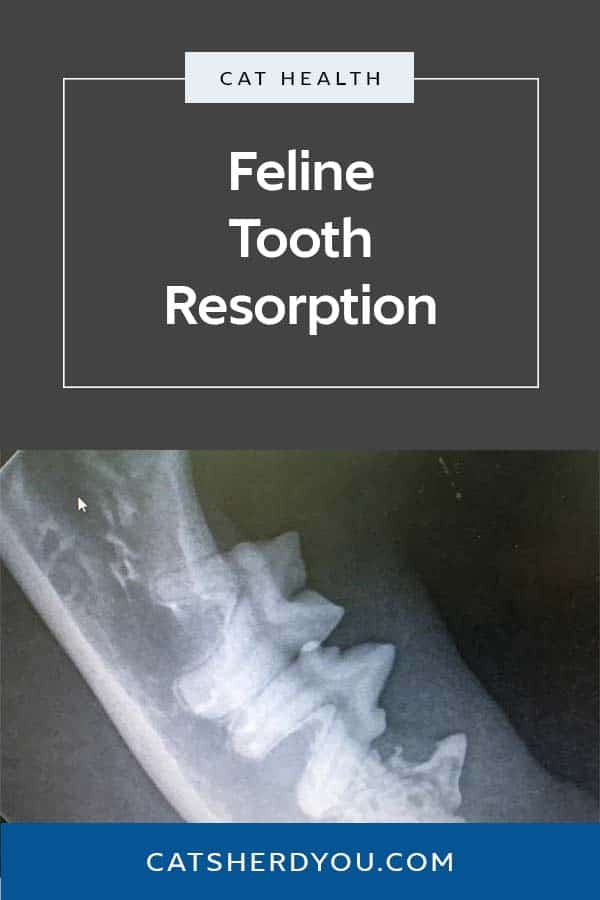
Feline Tooth Resorption -- What you need to know about your cat's teeth. #cats #dentalhealth
Share Share on email
Email
Share on twitter
Twitter
Share on facebook
Facebook
Share on pinterest
Pinterest
Share on google
Google
Share on tumblr
Tumblr
Share on linkedin
Linkedin

April 21, 2017 Filed Under: Health Tagged With: Ashton 21 Comments

  • « Previous Page
  • 1
  • 2
  • 3
  • 4
  • 5
  • 6
  • …
  • 18
  • Next Page »

Read Ashton’s Story in Rescued, Volume 2

These pawtographed books support Candy's Cats, who work tirelessly to find homes for cats in Florida.

Rescued, Volume 2: The Healing Stories of 12 Cats, Through Their Eyes. Proceeds from authographed copies benefit Candy's Cats.


Outside the US, contact us for shipping to your location.

Read Us by Email

Don't miss a thing! Cats delivered to your email.

Privacy Policy


Archives

All Rights Reserved

Articles and images on this site may not be reproduced in whole or in part without written consent. Please contact me if you are interested in reprinting or in having me write something unique for you.

Disclaimer

There are no veterinarians here. All health-related posts are the result of research and observation, but educational information is not a substitute for visiting your veterinarian. Do not self-diagnose your cat. For more information, see our disclaimer.

Policies

Disclosure Statement
Privacy Policy
Commenting Policy

Copyright © 2026 · Sometimes Cats Herd You · All Rights Reserved