Cats Herd You

Laugh. Learn. Love cats.

  • Home
  • Safety
  • Wellness
  • Rescue
  • Reviews
  • Life With Cats
  • About
  • Media Friendly
  • Contact
You are here: Home / Archives for Newton

Ten Myths and Misconceptions about Cats

There are a lot of urban myths and misconceptions about cats. Today, I’m going to talk about ten of the most common ones, and why they aren’t true.

1. Cats always land on their feet

Cats have a righting reflex, and in many cases, they will land on their feet. If a cat can fall far enough, he can usually right himself by twisting in midair. Shorter falls may not give a cat time to perform the necessary acrobatics to land paws-first, and older, arthritic cats who are less supple are less likely to be able to make the necessary moves in time. Additionally, kittens do not have a fully-developed righting reflex until between three and seven weeks of age.

Newton looks skeptical

2. All tortoiseshell cats are female

99.96% of tortoiseshell cats are female. The extremely rare tortoiseshell male cat, considered a genetic mutation, is usually sterile, and finding one is often a newsworthy event, such as a kitten who ended up in a shelter last year.

3. If you’re pregnant, you need to get rid of your cat

Cats are a host for the parasitic disease toxoplasmosis, which can be dangerous for an unborn baby if a woman who has never been exposed becomes infected during pregnancy. Avoiding direct contact with feces in the litter box either by getting someone else to clean the box or by wearing gloves and then washing hands thoroughly afterwards are recommended. The Center for Disease Control (CDC) lists more likely sources of toxplasmosis as undercooked meats and gardening, so be sure to clean all kitchen prep surfaces thoroughly and wear goves while gardening, as well.

4. All cats hate water

Most cats do hate water, but some like it and even seek it out. The Turkish Van breed is nicknamed the “swimming cat” for their love of water.’

5. If a cat scratches your furniture, just get her declawed

Declawing is a painful surgery in which the last bone in each toe is amputated. Cats can have permanent nerve damage, leaving a cat unable to walk on uneven surfaces without pain. This leads to declawed cats refusing to use litterboxes, which is usually even more undesirable than the original furniture scratching. Instead, offer convenient and appropriate alaternative scratching surfaces for your cat and trim her nails if necessary.

6. Cats should have a dish of milk every day

Most cats are lactose intolerant, and cow’s milk contains more lactose and casein than most cats can digest. Feeding milk often results in an upset stomach.
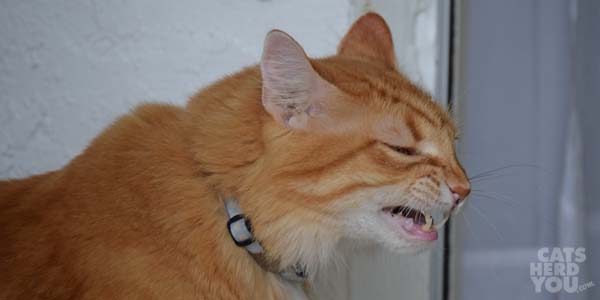
Newton Laughs

Newton laughs and says, “If feed me milk, I’ll make you sorry for it!”

7. A cat eat a diet of fish

Occasional fish may be all right, but fish isn’t a safe primary food source for cats. Some fish contain thaminase, an enzyme that destroys thiamine (vitamin B1), necessary for healthy neurological function in cats. Additionally, a fish-based diet can cause vitamin K deficiency. Many commercially-processed fish-based foods contain a syhtnetic form of vitamin K, menadione, which is banned by the FDA for use in human supplements.

8. Cats are nocturnal

Cats may knock over things in the middle of the night, but so do you when you’re wandering around in the dark! Cats internal clocks tell them to hunt at dusk and just after dawn, the times when they are most likely to find prey.

9. Cats will kill your baby

This urban myth usually takes the form of a jealous cat smothering the baby or sucking the baby’s breath. Cats love to snuggle in warm, cozy places, and people like to put their babies in cozy cribs. Is there any wonder cats try to join the baby in the best napping spot in the house? The myths about cats killing babies have been around for hundreds of years, long before Sudden Infant Death Syndrome (SIDS)  was a recognized cause of death for babies, usually occurring to babies in their cribs. Cats were probably blamed for some of those deaths.

10. Cats are so close to their wild ancestors they can survive in the wild

After being raised in a household and never being taught to hunt for her own meals, your cat can’t provide for herself. Cats left to fend for themselves when their family moves on are at high risk of starvation or being killed by predators. Your cat is part of your family, so include her in your moving plans!

Share Share on email
Email
Share on twitter
Twitter
Share on facebook
Facebook
Share on pinterest
Pinterest
Share on google
Google
Share on tumblr
Tumblr
Share on linkedin
Linkedin

May 14, 2015 Filed Under: Health Tagged With: Newton 26 Comments

Catnip Chicken

Pierre: Look what came in the mail to Ashton from our friends at 15 and Meowing…. chicken legs for Ashton’s Chicken Emporium.

Knit chicken legsThe best part is that Ashton doesn’t know about this because I intercepted her mail, so this delicious chicken is all mine to taste!

Pierre bites knit chicken legThere’s nothing like having some alone time with your favorite white meat…

PIerre attacks the chicken lg while Newton looks onPierre: Oops, so much for that alone time thing. Oh, hi, Newton!

Newton: This is a stick up. Hand over the chicken and nokitty has to get hurt.

Pierre realizes Newton wants his chickenPierre: If you leave me and my chicken leg alone, nobody has to get hurt, either.

Newton and Pierre - Cartoon Fight

Newton: Now who has the chicken? He’s big and orange and has four paws.

Newton attacks the knit chickenNewton: Yum! 

Newton loves the knit chicken

These handmade chicken legs are clearly a big hit. Don’t worry, Ashton will get her turn for her chicken emporium, too. She just prefers to play with toys when nokitty is watching. Thanks, Ellen and the kitties of 15 and Meowing for the amazing chicken legs!


Chicken Leg IconDid you miss some of our chicken capers? You can catch up any time!

Share Share on email
Email
Share on twitter
Twitter
Share on facebook
Facebook
Share on pinterest
Pinterest
Share on google
Google
Share on tumblr
Tumblr
Share on linkedin
Linkedin

May 13, 2015 Filed Under: Cats Tagged With: chicken, Newton, Pierre 28 Comments

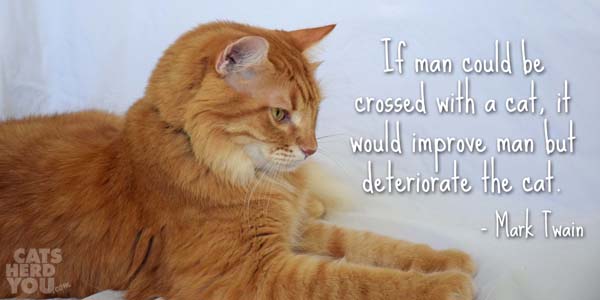
Literary Newton

Newton looks at quote

Share Share on email
Email
Share on twitter
Twitter
Share on facebook
Facebook
Share on pinterest
Pinterest
Share on google
Google
Share on tumblr
Tumblr
Share on linkedin
Linkedin

May 11, 2015 Filed Under: Cats Tagged With: Newton 27 Comments

National Animal Disaster Preparedness Day

This Saturday is National Animal Disaster Preparedness Day. Today we’re sharing an updated version of the information we previously published about disaster preparedness.
Are you prepared? Do you have a disaster plan for your pets? With hurricane season just around the corner in our part of the country, National Pet Disaster Preparedness Day is a good time to check and see if you’re prepared in case of emergency.

Newton looks seriousDo you have ID? Collar with tag and registered microchip both give the maximum ability to get pets back who go astray during a disaster. If you have changed telephone numbers recently, verify that you have updated the number on tags and with the chip registry.

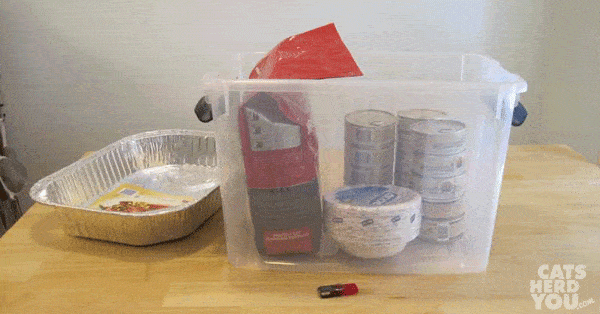
Do you have a disaster kit handy? Disaster kits are good to have on hand if you need to evacuate, and they are also filled with handy things in case disaster strikes and you are at home with local stores or delivery services not operating. A disaster kit should be in some kind of a durable bin or bag and contain:

  • Food for at least five days. If you use dry food, package it in something airtight and rotate it every six months so it doesn’t go bad. Don’t forget to include bowls. Paper bowls are a good idea since they are lightweight and you don’t have to worry about cleaning them.
  • Water for at least five days. You probably have this for yourself, but don’t forget your pets!
  • Litterbox with litter, scoop, and trash bags to dispose of used litter. There are disposable litterboxes on the market. Disposable foil pans like you would use for making a turkey can work for this, too. If you plan ahead, you can sometimes find those on sale after the holidays when everyone is done turkey for the year.
  • Medications and written instructions on how you give them, especially if your routine varies at all from what is on the prescription label. (If you cut pills in half and dose twice a day, for example)
  • A copy of medical records, especially proof of recent vaccines. If you have to board your pet during an evacuation, you’ll need that documentation.
  • Written information about feeding schedules and medical conditions that could be left with a boarding facility if necessary. You may have compiled this already for a pet sitter. If so, you can use a copy of the same information here.
  • Current photos and descriptions of pets to use in case you are separated from them during a disaster. It’s a good idea to also have a photo of yourself with your pets for a quick proof of ownership. Tip: You can put all of the photos and other documentation on a thumb drive to make it compact rather than carrying it all on paper.

Disaster peparedness kit

Do you have cat carriers for everyone? You may only take one or two cats to the vet at a time, but if you have more cats than that, make sure you have enough carriers to go around in case of evacuation. If you aren’t going to use the additional carriers for anything other than emergencies, less-expensive plastic carriers have the advantage of being stackable if you’re in tight quarters, and most of them break down for compact, nested storage.

Newton looks at carriersDo you know where to go in case of evacuation? Not everyone is pet friendly, so it’s a good idea to ask around before you need to find a place to go in an emergency. Places you might go include:

  • Local evacuation centers. Do the ones in your area make provisions for pets? More of them are including this in their contingency planning, but you should check before assuming that they do. Contact your local emergency management agency well ahead of a disaster — not after — to ask how to research this for your locality.
  • A family member or friend in a nearby region or state who might accommodate you. It’s always better to ask now rather than showing up in their driveway in an emergency!
  • Pet friendly hotels. Do you know where to find pet-friendly hotels? Several internet sites include listings, such as:
    • Go Pet Friendly
    • Bring Fido
    • Dog Friendly
    • Marriott Dog-Friendly Hotels
    • Pets Welcome

Keep in mind that when there is a disaster that causes an evacuation, lodging fills up fast.

What if you are away from home when disaster strikes? Talk to a trusted friend or neighbor in advance about helping evacuate and meet you with your pets in a safe location away from the disaster.

We all hope that disaster won’t strike us, but it’s best to be prepared and not need the plan than need a plan and have no idea what to do!

Share Share on email
Email
Share on twitter
Twitter
Share on facebook
Facebook
Share on pinterest
Pinterest
Share on google
Google
Share on tumblr
Tumblr
Share on linkedin
Linkedin

May 7, 2015 Filed Under: Safety Tagged With: Newton 23 Comments

  • « Previous Page
  • 1
  • …
  • 67
  • 68
  • 69
  • 70
  • 71
  • …
  • 138
  • Next Page »

Read Ashton’s Story in Rescued, Volume 2

These pawtographed books support Candy's Cats, who work tirelessly to find homes for cats in Florida.

Rescued, Volume 2: The Healing Stories of 12 Cats, Through Their Eyes. Proceeds from authographed copies benefit Candy's Cats.


Outside the US, contact us for shipping to your location.

Read Us by Email

Don't miss a thing! Cats delivered to your email.

Privacy Policy


Archives

All Rights Reserved

Articles and images on this site may not be reproduced in whole or in part without written consent. Please contact me if you are interested in reprinting or in having me write something unique for you.

Disclaimer

There are no veterinarians here. All health-related posts are the result of research and observation, but educational information is not a substitute for visiting your veterinarian. Do not self-diagnose your cat. For more information, see our disclaimer.

Policies

Disclosure Statement
Privacy Policy
Commenting Policy

Copyright © 2026 · Sometimes Cats Herd You · All Rights Reserved