Newton is so chilled out, he doesn’t quite fit into the cat bed.

He’s hanging onto the side of the bed so he doesn’t ooze over the side!

From that top view, it looks like there’s a little extra room, if any ladycats want to squeeze in and join him.


Laugh. Learn. Love cats.
Back around the holidays, we remembered Sparkle mentioning in someone’s comments that catnip pawbreakers were the right size to replace the ball inside a turbo track, and we decided to combine some of our toys to give it a try.
Pierre: It goes around just as fast as the usual ball in the track!

Ashton: Whatcha doin’?
Pierre: Nothing. You wouldn’t be interested. You don’t like catnip.
Ashton: Well fiiiine. I’ll just go and write a love note to Mr. Jinx, then.

Newton: But I do! I love catnip! And balls!

Newton: And romping with the turbo track!

Pierre: I’m going to get you!
Newton: Hey, give that back!

Newton: Now watch Pierre try to play with the pawbreaker. I’m goaltending it.

Newton: It’s all mine!


When Chewy.com reached out and asked us if we would be interested in sampling the new Orijen freeze-dried cat treats, we couldn’t say “yes” fast enough.
When we were kibble eaters, we ate Orijen kibbles because the head peep likes the company’s philosophy of cats eating biologically-appropriate ingredients sourced from regional ingredients. Now that the head peep insists that we eat canned food instead, we miss that kibble, and we were excited at the idea of trying their treats.
The treats arrived in some sample packaging that probably isn’t the way they will be sold in stores. So we have no idea whether they will be in a durable container that keeps us from helping ourselves or not.

The treats themselves are a nice bite size, and they are long enough that a human can hold one end while we delicately take the treat from between their fingers. Well, okay, sometimes we aren’t quite delicate, but it’s easy to get carried away.
Newton: Hey, are you done talking so I can to open this?
In a minute. Can you please read the ingredients, since you’re in the way?
Newton: I’m illiterate, like all cats.
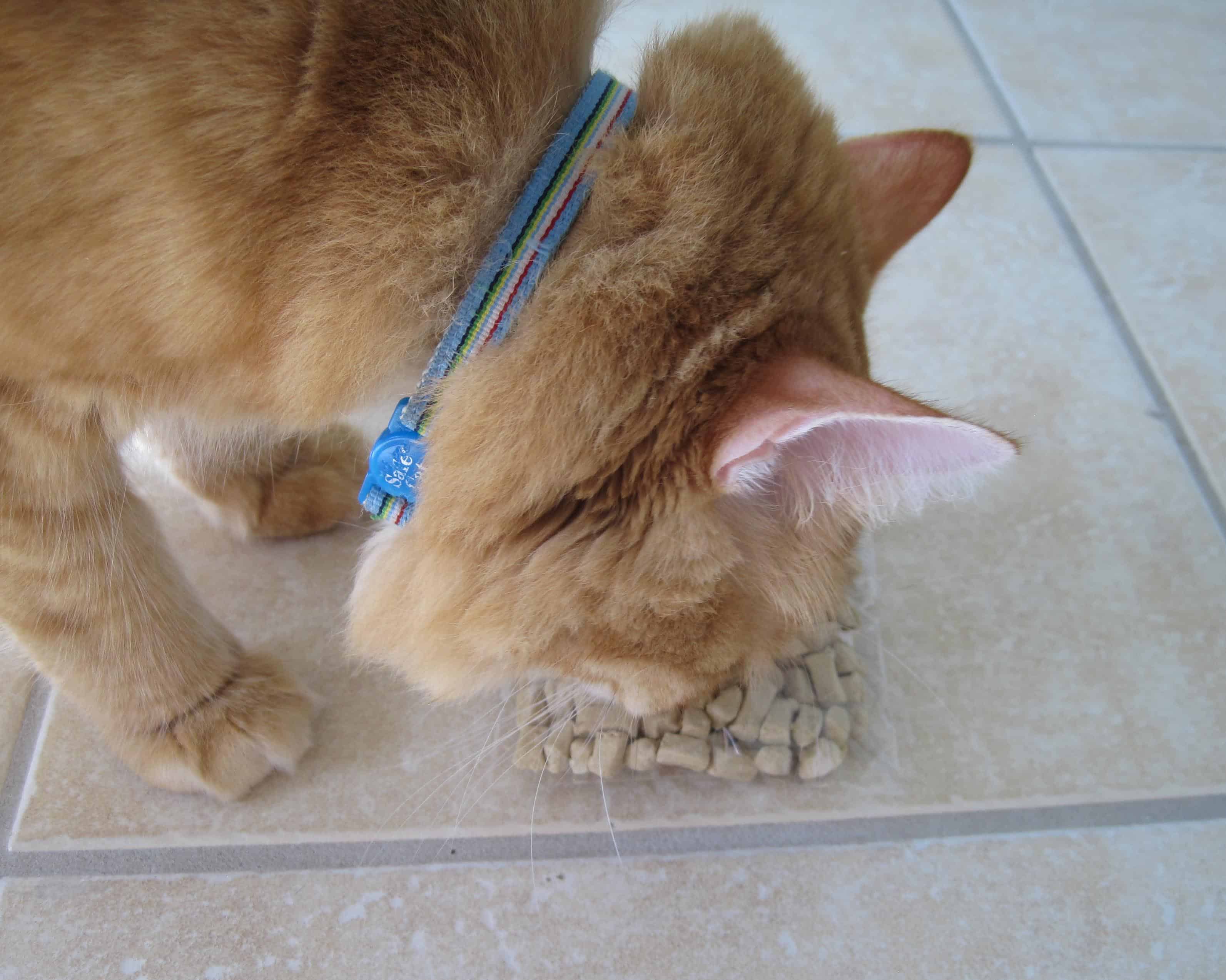
Hand those over, Newton, and we’ll take a look at the label. The ingredients are: chicken liver, turkey liver, boneless chicken, boneless turkey, boneless flounder. Just meats. That sounds like exactly what you should be eating.
Pierre: Ooh, this looks interesting…
Ashton: Hey, what do you have there, Pierre?

Pierre: *chomp* This is good!
Ashton: No fair! Pierre!

Ashton: Mine!

There wasn’t a way to show you how much we enjoyed the treats without a bit of video to show our real enthusiasm.
(If the video doesn’t load above, you can watch it on YouTube.)
We give very enthusiastic paws up to the new Orijen freeze dried cat treats, and we can’t wait until we can get into the rest of the bag!
Chewy.com sent the sample treats to us for free, but our opinions are our own.

At least in this part of the country, lots of houses are built with bifold doors in them, especially closet and pantry doors. Opinions about whether they are attractive or not aside, there is a more serious issue: they don’t latch, and cats can and do learn to open them.
Little paws fit right underneath the bifold doors, and a little tug will pull them ajar. If you store anything inside that your cats shouldn’t get into, this can make the kitties unsafe. It became a real issue in our house several years ago when our late cat, Louie, both diabetic and hyperthyroid, was so hungry that he was breaking into any food source he could find and indiscriminately eating it. Everything edible had to be locked up, which meant that the human food pantry had to be secured.
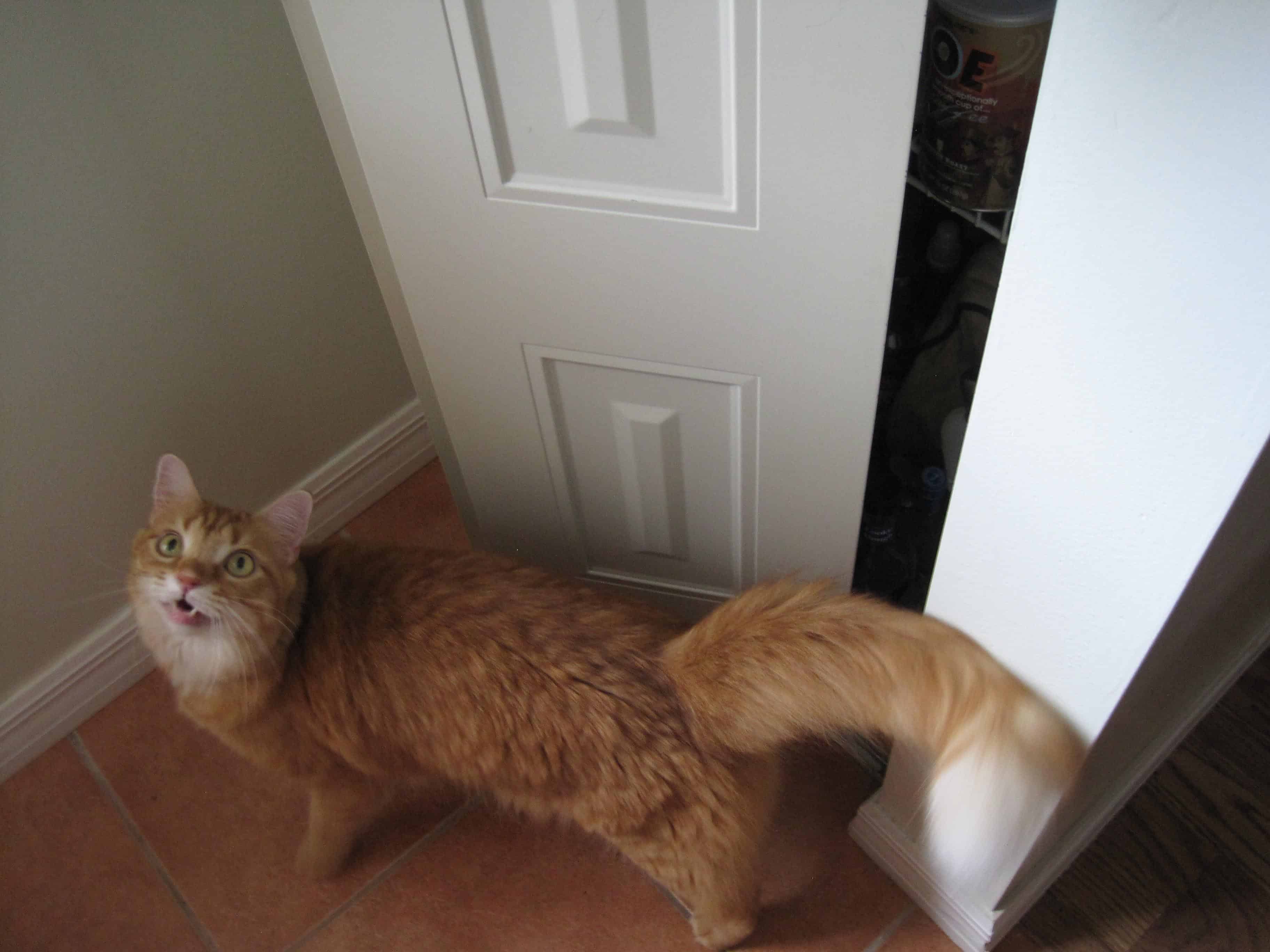
Newton will be happy to demonstrate that the pantry door isn’t safe from a determined cat who knows there are treats inside…

One way to latch a bifold door is to use commercially-available bifold door latches intended for childproofing a house. We found that these worked well for the standard wooden bifold doors, but our house has metal bifold doors for both the kitchen pantry and bedroom closet doors.
We could have replaced the doors, but instead, we came up with another solution. We barred the doors.The process was actually pretty simple, and didn’t take much in the way of needing handy-ness. It took a sturdy 1 1/2″ wooden dowel, cut to the width of the doorway, and a set of wooden curtain rod brackets per doorway. We painted them with some leftover trim paint to match the room trim, then used the included screws to attach them on either side of the pantry door.
Each set of brackets has a round bracket for one end.

This is the end that you will put the dowel into first to secure the door.

The other bracket is U-shaped.

The dowel slides down into this bracket to secure the door.
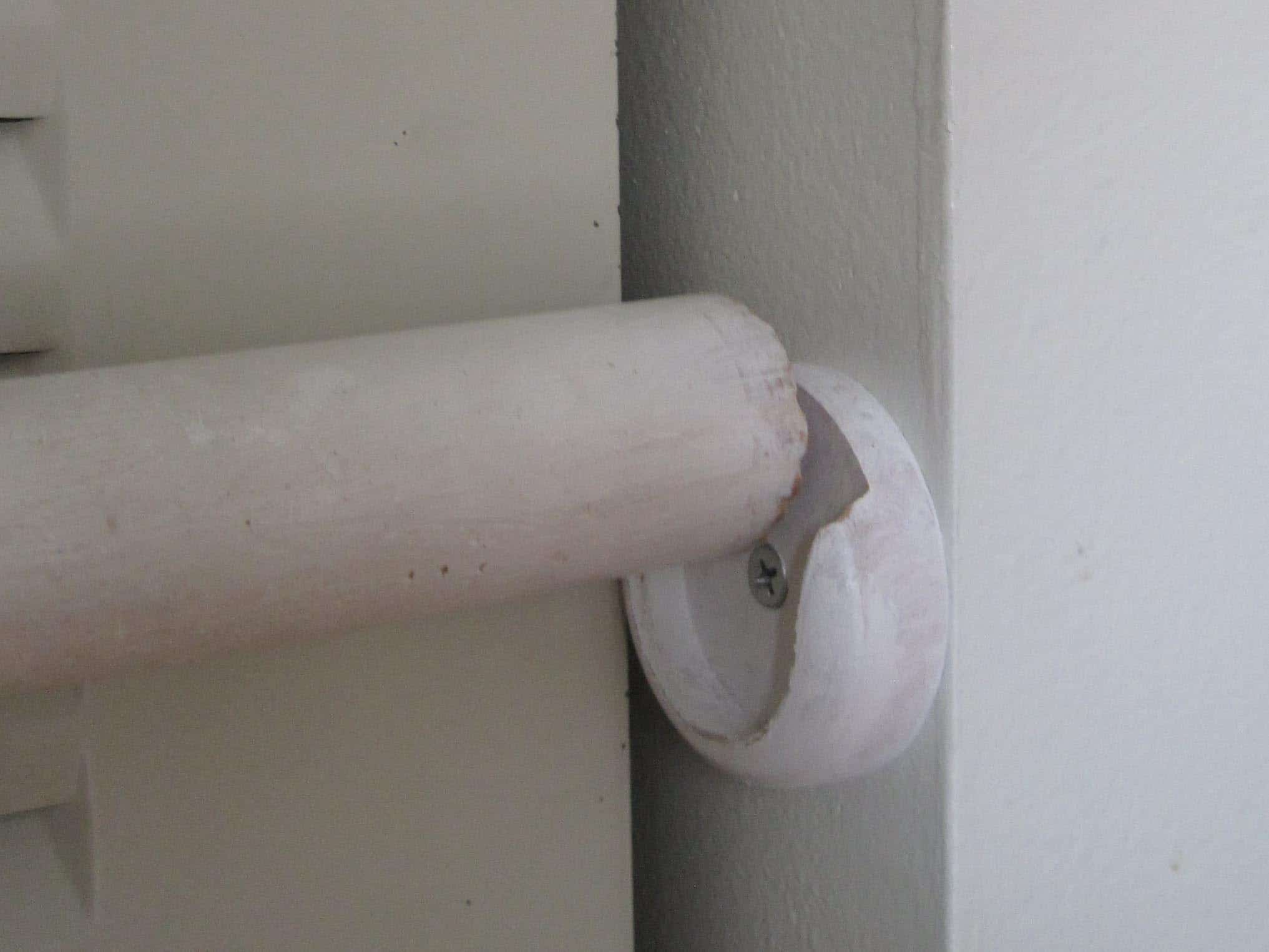
The result is a tidy barrier that sits so close to the door itself that the cats can’t pull it open.

When the dowel is removed from the brackets, they are unobtrusive, and the door operates as normal.

We used slightly different sized brackets for the kitchen pantry and for the bedroom closets. The bedroom closets were a challenge because the door jambs are narrower than the one in the kitchen. After some research, we realized that we were going to be unable to get a bracket that was quite narrow enough to allow the door to close and also not to protrrude into the room. We overcame this problem by trimming the sides of each bracket so that the decorative edge was no longer round, narrowing it to fit on the door jamb.

This project was done all with the materials available at the nearest home improvement store, so the wider array of brackets available online would have prevented us from needing to take this extra step.
This inexpensive, easy project has given us a lot of peace of mind. The cats can’t get into the food pantry and steal things they aren’t supposed to have, and they can’t get into the spare room closet where the extra dry food bins are stored, either.
Newton doesn’t approve of either of these things, but it’s for his own good.