Cats Herd You

Laugh. Learn. Love cats.

  • Home
  • Safety
  • Wellness
  • Rescue
  • Reviews
  • Life With Cats
  • About
  • Media Friendly
  • Contact
You are here: Home / Archives for kitten 101

Kitten 101: Gear for Your New Kitten

A friend of the head peep who never had cats before said her husband had fallen in love with the idea of two kittens… but she had no idea what to do for them. Our Kitten 101 posts are part of the process of gathering those thoughts together for our friend so that she has some ideas about things to do for her very first cats. Don’t miss our previous post in the series, Kitten 101: Kitten Proofing Your House.

Basic Kitten Gear

To survive, kittens have to eat, drink, and poop. To do that, they need these things:

Food

You should get quality food for your kitten. Dry is convenient, but we eat canned. Some information that helped make the choice for what our diet would look like is on Dr. Lisa Pierson’s CatInfo site  including some great nutritional analysis comparison information.

Water

  • Kitten Ashton sleepsYour kitten doesn’t need to drink Evian, just clean, wholesome water. If your tap water is something you would drink yourself, it’s fine for your kitten, too. We once lived somewhere that you could smell the sulfur in the water when the shower ran, and we always drank filtered water while we lived there.
  • Try to place the water bowl separate from the food location. We have observed that given water near and far from their food, cats consistently drink from the water source far from their food. Big cats don’t drink downstream from the gazelle they just ate, so that makes sense.

Bowls

Each kitten should have his own food bowl, though water bowls are often shared. You can use fancy or plain bowls, just make sure they are safe. Avoid plastic, since some cats have allergies to plastic and will develop acne from the close contact with the bowl during mealtimes. We use stainless steel bowls for our food, since it’s hypoallergenic. You can find them in the grocery store or pet stores. Our water is served in 1.5 quart anchor hocking mixing/storage bowls, available at the grocery store. Not only are they easy to clean and attractive, the clear color of the bowl helps monitor the water level in the bowl.

Litterbox

  • The usual rule of thumb is one litterbox for per cat plus a spare, but with kittens, you can probably combine for one litterbox for a while, as long as it is spacious. Many cats don’t care for covered litterboxes, so consider an open one for better compliance.
  • Make sure the litterbox has low enough sides for your small kitten who waited until the last minute to get to the box to scramble over the edge.
  • If possible, placing the litterbox on an easily-cleaned surface like tile rather than carpet is preferable so that any accidents are easier to clean up quickly and without a fuss.
  • Don’t put the litterbox so far out of the way that a kitten who waited until the last minute to go has to run a marathon to get there.
  • You may want to put something in front of the litterbox to collect litter off of litter paws as they exit. A washable mat or rug is an easy solution. If you have an IKEA nearby, their inexpensive bath mats make it possible to have a spare to rotate onto the floor while one is being washed.

Litter

  • When you adopt, ask what the kittens are accustomed to using. You may want to start with that and mix in whatever your preference to transition.
  • Major types of litter bases include clay, paper, corn, and wheat. Many clumping litters are not recommended for kittens. We use corn-based litter so that we don’t ingest clay or any of the clumping agents added to the litter.

Other Kitten Gear

A kitten has needs beyond input and output, and it’s important to take care of them, too. Rest, enrichment, safety for vet visits, and grooming are all important for your kitten.

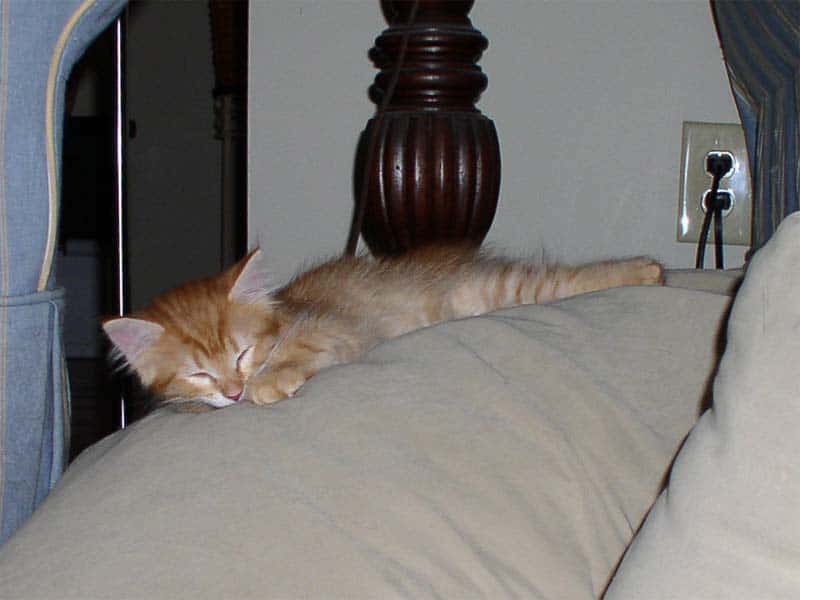
Newton as a kitten, sleepingBed

A kitten’s sleeping place should be a “safe spot” where the family agrees there’s no bothering her while she’s in the bed. That allows her to make it her haven.  A commercial cat bed isn’t necessary, but your kitten will appreciate a soft, draft-free place to sleep. We never had cat beds until we were adult cats, but always had places to sleep where we felt safe and comfortable.

Scratchers

  • Cats need to wear down their claws, and scratching is the natural way they do that. If all they have is your sofa, that’s what they will use. So offering attractive alternatives for scratching is a good idea.
  • Scratching posts tall enough for kitty to get a good stretch while scratching are a good idea. Also, some cats prefer scratching horizontal surfaces to scratching vertical ones. You can find scratchers to accommodate that, as well. You may need to try different substrates (sisal, cardboard, etc.) until you find which one your kitty prefers.
  • If kitty scratches the sofa arm, you can put a scratcher in a location that blocks access to the preferred location. After kitty transfers her attention to the cat tree, gradually move it back to wherever you would like it to be permanently.

Toys

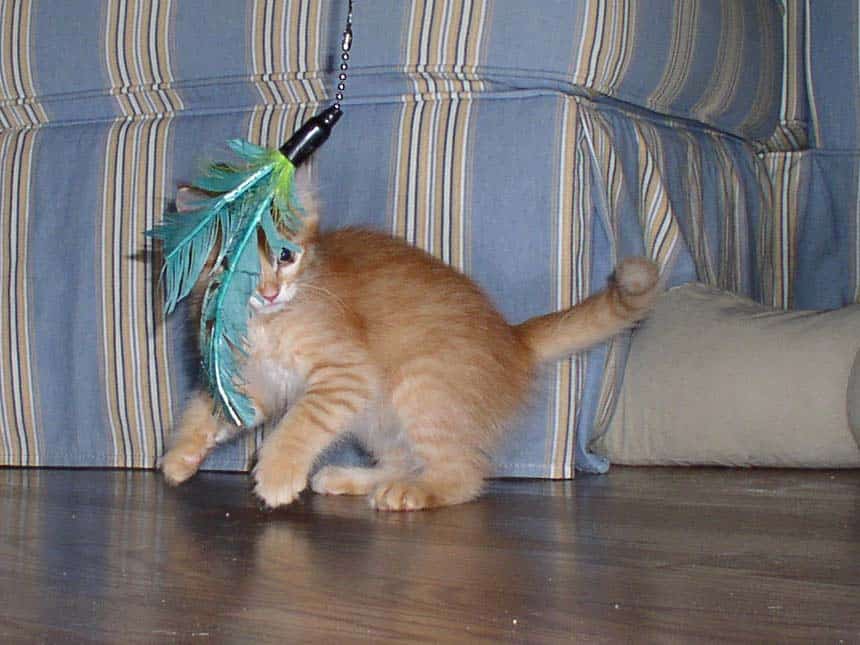
  • Newton_kitten_feather_toy_smLook for soft toys with no loose parts. Always examine toys for parts that might come off and be swallowed by a kitten.
  • Choose a variety of toys, both for independent and interactive play.
  • If you choose any toys with string attached, only let kittens have them for supervised play. Strings or yarn are dangerous if swallowed.
  • Kittens usually don’t respond to catnip but may grow into enjoying it after three to six months. Not all cats enjoy catnip, so it’s possible that your kitten never will, so don’t rely on catnip toys.
Cat Carrier

  • Always transport your kitten in a carrier when you take her to or from the veterinarian. You don’t want a loose kitten under your pedals in the car or getting wedged under the car seat out of fear.
  • It’s fairly easy to get a kitten into any kind of carrier, but as your kitten grows into a cat, you may find that a carrier with a top door is easier to get a reluctant cat into.

We hope this list helps you and your new kitten get off to a good start together!


Share Share on email
Email
Share on twitter
Twitter
Share on facebook
Facebook
Share on pinterest
Pinterest
Share on google
Google
Share on tumblr
Tumblr
Share on linkedin
Linkedin

June 12, 2014 Filed Under: Safety Tagged With: Ashton, kitten 101, Newton, Pierre 15 Comments

Kitten 101: Kitten-Proofing Your House

It all started with two adorable kittens in PetSmart. Not for us; we aren’t ready for new kitties around the house. A friend of the head peep who never had cats before said her husband had fallen in love with the idea of two kittens… but she had no idea what to do for them. Our Kitten 101 posts are part of the process of gathering those thoughts together for our friend so that she has some ideas about things to do for her very first cats.

If you don’t have kittens, your house probably isn’t kitten-proof. Even if you have grown cats, there are likely things that you haven’t thought about in years that a mischievous kitten can get into. Kitten-proofing your house before your new kitten comes home is an important way to help keep him or her safe.

The first thing you want to do is get down on your stomach on the floor. This isn’t so that your family members can take funny photos of you. Instead, it’s so that you have a kitten’s eye view of things. Wow, that refrigerator suddenly looks big, doesn’t it? But the kitchen towel you have hanging from the refrigerator door handle sure looks like it might be tempting for a little one to leap at. What else should you look for while you are taking a kitten’s eye view of your house?

  • Look for holes of all kinds. A cat can fit into nearly any space where her head will go, and a kitten’s head is really small.
    • Check to be sure that heat vents or registers are not loose. You don’t want a kitten in your ductwork!plumbing_drywalll_hole
    • Check for openings in the drywall around your plumbing, including under your sink cabinets. Our house was replumbed years ago and the drywall was never properly patched around where the pipe for one toilet passes through the wall. That’s the kind of thing that you’re accustomed to looking at and don’t pay attention to any more that can become a real hazard!
    • Check inside your cabinets to be sure that the interior is solid all the way to the top. A hole near the top leading to a void space where the corner of cabinets is otherwise inaccessible isn’t unusual in apartments, and one of the cats who came before us, Radcliffe, vanished into one of those as an adult cat right after we had moved into a new place. For several hours, we thought he had escaped outside. It’s better to be sure those spaces are kept off limits.
    • If your kitchen cabinets are set up so they don’t meet at 90 degrees (if you have a corner sink, for example), look underneath where the face frame for the cabinet overhangs the toe kick. There can be a triangular hole underneath if the cabinet edges are not mitered. Another of the cats who came before us, Talia, climbed into one of those holes as a tiny kitten and ended up behind the adjacent access panel at the bottom of a dishwasher. There was still duct tape covering that hole when the head peep moved out of that house years later, but no more kittens ended up under the dishwasher!
  • Living Room Furniture
    • If you have a recliner, take a look at how much clearance there is under there, and realize that it’s nowhere for a cat of any size to be when you recline or sit it up. Always make sure you know where your kitty is before operating the mechanism in a recliner.
    • What does the bottom of your sofa look like? Most of them have a gauzy-looking liner that is easy for cat claws to tear through, giving them access to the area between the coils on the underside of the sofa. Kittens can be injured if caught when the springs compress. It’s easy to replace the lining on the bottom of the sofa with more durable fabric. Any cheap fabric that seems durable will do, and all you have to do is turn over the sofa and use a staple gun to attach it around the sofa frame. Since it’s on the bottom of the sofa, no one but you knows about the Barney the dinosaur print fabric on the bottom of your sofa. Well, no one but you and your cat.
  • Your Bed
    • The box spring of your bed usually has a fabric lining underside similar to your sofa, with the same hazards. You can solve it the same way by replacing the fabric. At our house, we have boards under the box spring that were previously used with a platform bed. Anything that keeps kitty out of the underside of the box spring.
    • If you have a waterbed frame with drawers, you may think you’re safe from having to worry about the underside of the bed, but the head peep would like you to know from experience that motivated cats can learn to open drawers. And getting a cat out from behind an under-bed drawer is really hard. You might consider looking at child latches for your under-bed drawers if this becomes an issue.
  • Breakables
    • If you have lived in a cat-free home, you may have gotten used to keeping breakable knickknacks on shelves and tables. Kittens are the awkward teenager version of cats, and they’re more likely to knock down objects by accident, so you may want to move Newton_thinks_he_can_jump_smthem to inaccessible locations. We have just a few cat-inaccessible locations, though Newton dreams of getting up there to them.
    • For breakable art that you want to keep out in locations where kittens are likely to roam, consider using something like museum putty, designed to hold art objects during earthquakes.
  • Houseplants
    • You may not realize how many of the houseplants you have around your house may be dangerous to cats. Common plants you may bring into the house seasonally like mistletoe or Easter lily, or everyday plants like rhododendrons are all toxic.
    • Refer to the ASPCA Animal Poison Control list for a complete listing of plants toxic to cats.
  •  General
    • Make sure that string-like materials are locked safely out of a kitten’s reach. Although images of kittens and yarn are iconic, it can be deadly if swallowed, so make sure that yarn, string, needles and thread, fishing line, and any other string-like materials are only played with under supervision.
    • Make sure the fireplace screen has no gaps.
    • Check window screens to be sure they are secure. Excited kittens can leap at screens when they see something outside, so make sure they can’t be pushed out.  If you don’t have screens on windows, be sure the windows aren’t opened. Kittens are fast on four little legs, and you can’t necessarily get to the open window faster than they can.
    • Make sure the door to your utility rooms shuts, or be sure that you can securely close your washer and dryer. Warm places like those are attractive to cats, but they can be trapped inside.
    • If possible, restrict access from the garage. If your car leaks antifreeze, it takes as little as a teaspoon to poison a cat.

It may sound like a lot of work, but once you have done the work of kitten-proofing your house and made it a kitten-safe environment, maintaining it is easy.


If you enjoyed this post, don’t miss Kitten 101: Gear for your New Kitten.

Share Share on email
Email
Share on twitter
Twitter
Share on facebook
Facebook
Share on pinterest
Pinterest
Share on google
Google
Share on tumblr
Tumblr
Share on linkedin
Linkedin

June 5, 2014 Filed Under: Safety Tagged With: kitten 101, kitten-proofing, kittenproofing, Newton 14 Comments

Read Ashton’s Story in Rescued, Volume 2

These pawtographed books support Candy's Cats, who work tirelessly to find homes for cats in Florida.

Rescued, Volume 2: The Healing Stories of 12 Cats, Through Their Eyes. Proceeds from authographed copies benefit Candy's Cats.


Outside the US, contact us for shipping to your location.

Read Us by Email

Don't miss a thing! Cats delivered to your email.

Privacy Policy


Archives

All Rights Reserved

Articles and images on this site may not be reproduced in whole or in part without written consent. Please contact me if you are interested in reprinting or in having me write something unique for you.

Disclaimer

There are no veterinarians here. All health-related posts are the result of research and observation, but educational information is not a substitute for visiting your veterinarian. Do not self-diagnose your cat. For more information, see our disclaimer.

Policies

Disclosure Statement
Privacy Policy
Commenting Policy

Copyright © 2026 · Sometimes Cats Herd You · All Rights Reserved