Cats Herd You

Laugh. Learn. Love cats.

  • Home
  • Safety
  • Wellness
  • Rescue
  • Reviews
  • Life With Cats
  • About
  • Media Friendly
  • Contact
You are here: Home / Archives for Ashton

The Cat Days of Summer

You may have heard about the so-called dog days of summer. Merrriam-Webster defines the dog days as:

  1. the period between early July and early September when the hot sultry weather of summer usually occurs in the northern hemisphere
  2. a period of stagnation or inactivity

There aren’t any dogs around here, so we sure have cat days. They look like this.

one-eyed brown tabby cat sprawls on sofa

When it comes to inactivity, that’s what we cats do best.
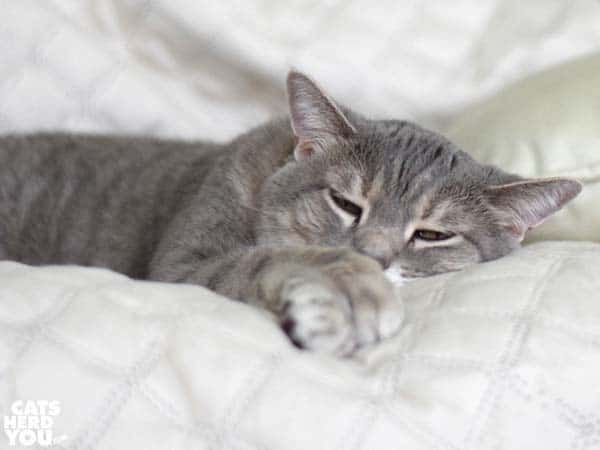
gray tabby cat snoozes on sofa

Newton: I’ll be with you in a few minutes. Or a few hours. Or maybe in autumn.

Sleepy orange tabby cat with splayed paw

How are you spending the cat days of summer?

Save

Save

Save

Save

Share Share on email
Email
Share on twitter
Twitter
Share on facebook
Facebook
Share on pinterest
Pinterest
Share on google
Google
Share on tumblr
Tumblr
Share on linkedin
Linkedin

August 17, 2016 Filed Under: Cats Tagged With: Ashton, Newton, Pierre 33 Comments

Chicken Nugget

Pierre: Wow, what’s that doing out there?

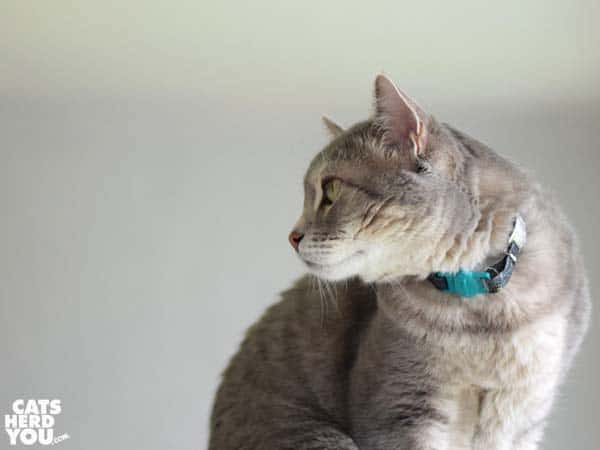
gray tabby cat looks out window

Pierre: Ashton, you might want to see this outside the window.

gray tabby cat looks away from window

Ashton: * YAWN * See what?

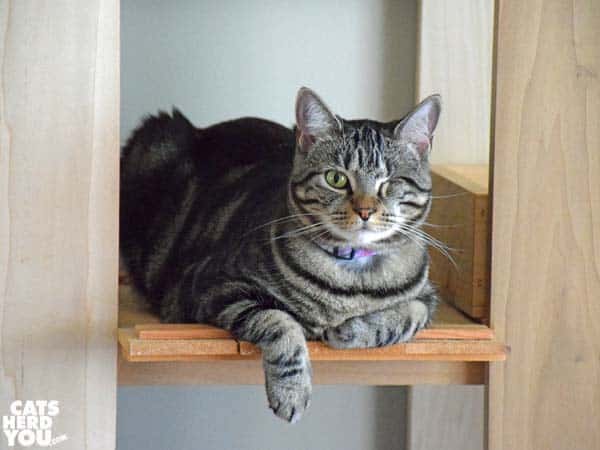
one-eyed brown tabby cat lounges on sofa back

Pierre: It’s a chicken nugget.

Ashton: A WHAT?

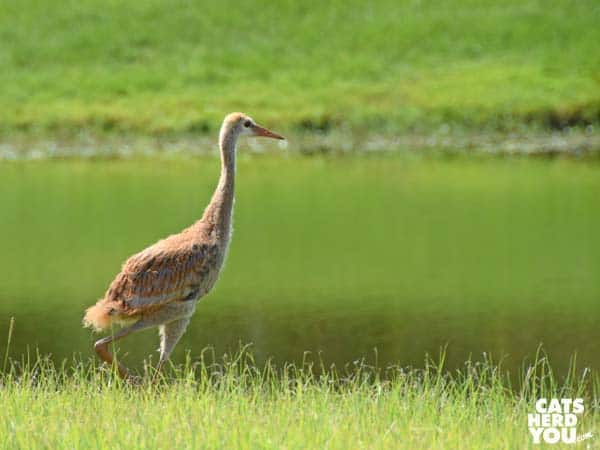
baby sandhill crane

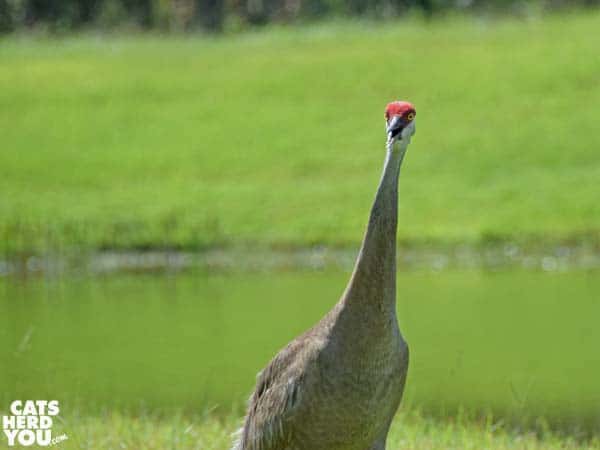
Mother Sandhill Crane: I heard you, cat! Junior, it’s time to go.

sandhill crane

Junior: I’m going. I’m going.

baby sandhill crane

Pierre: See you later, chicken nugget!

gray tabby cat licks his lips while looking out window

Junior: I don’t think so, kitty.

baby sandhill crane

Save

Share Share on email
Email
Share on twitter
Twitter
Share on facebook
Facebook
Share on pinterest
Pinterest
Share on google
Google
Share on tumblr
Tumblr
Share on linkedin
Linkedin

August 5, 2016 Filed Under: Cats Tagged With: Ashton, Pierre 24 Comments

Cats and Depth Perception

It’s common knowledge that it takes two eyes to see 3-dimensional images. So have you ever wondered how a one-eyed cat like Ashton gets around without bumping into things?

one-eyed brown tabby cat in loaf position

I know it was a concern I had when I realized she was going to lose her eye. But it’s surprising how well she compensates!

Let’s start with how most cats see.

Binocular Vision

The concept of binocular vision brings to mind a cat using a pair of field glasses. But the term binocular actually just means to see through two eyes, the way a normal cat does.

cat looking through binoculars. image credit: depositphotos/RasulovS

Each of your cat’s eyes sees a slightly different image because they are next to each other, and the image projected on the retina of each eye is slightly offset. Your cat’s brain puts the two slightly different images together into a single three-dimensional image.

cat wearing 3D glasses. photo credit: depositphotos/RasulovS

Perceiving the three-dimensional image is called stereopsis. This three-dimensional sight helps your cat catch fast-moving prey, since they can more accurately judge distances when it’s time to pounce.

The side-to-side displacement of your cat’s eyes is easier to gauge using vertical lines and contours, which is why cats, as predators, have pupils with vertical slits.

Vertical pupils that can open wide when hunting also help maximize the contrast between the sharpness of the object your cat is focusing on and the blur of the out-of-focus objects in the foreground and background. Those also help your cat measure distance so that every pounce, whether it’s on a mouse or on a wand toy, is accurate.

orange cat face. photo credit: depositphotos/c-foto

Monocular Vision

Seeing with only one eye, the way Ashton does, is called monocular vision. Hearing “monocular vision” may bring to mind a cat wearing a monocle, but both monocular and monocle use the same word prefix, “mono” meaning singular.

cat with monocle. Photo credit: deposipthotos/kuban_girl

When a cat can only see out of one eye, three-dimensional sight isn’t available to help judge how far away objects are, but there are plenty of other cues a cat can use instead:

  • Focusing – Whether focusing on an object makes the eye work to focus near or far.
  • Detail in objects – The texture detail of an object is more visible as an object is closer. Father objects show less detail and are more indistinct.
  • Relative size – An object looks larger when it is nearer. Objects moving toward the cat look like they are growing larger.

mouse cat toys, near and far.

  • Light and shadow – Both light and shadow help judge the height and position of an object.
  • Brightness – Closer objects appear relatively brighter than further objects.
  • Motion – Nearby objects seem to move faster than farther objects when moving at the same speed. This is called as the parallax effect.
  • Linear Perspective – Parallel straight lines appear to meet in the distance. The further separated the two parallel lines are, the closer the object is. 

All of these are cues that a cat with two eyes uses to help judge distances to objects, too. In a sense, a cat using monocular vision only loses one of the many tools to help navigate the world.

one-eyed brown tabby cat dangles one paw


Research and Further Reading

Annual Review of Neuroscience, The Analysis of Stereopsis
Science Advances, Why do animal eyes have pupils of different shapes?
Unviersity of Calgary, Monocular Cues

Image credits: depositphotos/RasulovS, c-foto, kuban_girl

Save

Share Share on email
Email
Share on twitter
Twitter
Share on facebook
Facebook
Share on pinterest
Pinterest
Share on google
Google
Share on tumblr
Tumblr
Share on linkedin
Linkedin

August 1, 2016 Filed Under: Health Tagged With: Ashton 22 Comments

Eyes form a Cat’s Face Shape

One of the first things I noticed five years ago after the surgery to remove Ashton’s eye was how much it changed the shape of one side of her face. Even before the swelling from the surgery went away, that whole side of her face looked surprisingly smaller, almost deflated.

It’s something I see every day, so I don’t think about any more, and until now, I never took a photo that showed the difference in the shape of that side of her face and a normal cat’s. But the photo below happened to be at the exact right angle.

one-eyed brown tabby cat facing right

Do you see how you could practically put a ruler along her whole cheekbone, it’s so flat? (Pro tip: don’t stick a ruler in Ashton’s face. Her lack of depth perception means she really doesn’t like that kind of thing.)

Compare the shape of the left side of Ashton’s face to the shape of Pierre’s face, taken at a similar angle.

gray tabby cat semiprofile facing left

His face bows outward. It is especially noticeable in the area below his eye, known as the maxillary region. You can see it curves inward to meet the corner of his eye. Ashton’s face does not have that curve. While there is a bone in that part of a cat’s face, the maxilla (the namesake of the maxillary region), it isn’t enough to give the face that characteristic shape. Your cat’s eye does a bit part of that, too.

Of course, the shape of Ashton’s face doesn’t make any difference in how she feels or behaves. Her permanent wink makes her that much more endearing.

Share Share on email
Email
Share on twitter
Twitter
Share on facebook
Facebook
Share on pinterest
Pinterest
Share on google
Google
Share on tumblr
Tumblr
Share on linkedin
Linkedin

July 27, 2016 Filed Under: Life With Cats Tagged With: Ashton, Pierre 24 Comments

  • « Previous Page
  • 1
  • …
  • 21
  • 22
  • 23
  • 24
  • 25
  • …
  • 90
  • Next Page »

Read Ashton’s Story in Rescued, Volume 2

These pawtographed books support Candy's Cats, who work tirelessly to find homes for cats in Florida.

Rescued, Volume 2: The Healing Stories of 12 Cats, Through Their Eyes. Proceeds from authographed copies benefit Candy's Cats.


Outside the US, contact us for shipping to your location.

Read Us by Email

Don't miss a thing! Cats delivered to your email.

Privacy Policy


Archives

All Rights Reserved

Articles and images on this site may not be reproduced in whole or in part without written consent. Please contact me if you are interested in reprinting or in having me write something unique for you.

Disclaimer

There are no veterinarians here. All health-related posts are the result of research and observation, but educational information is not a substitute for visiting your veterinarian. Do not self-diagnose your cat. For more information, see our disclaimer.

Policies

Disclosure Statement
Privacy Policy
Commenting Policy

Copyright © 2026 · Sometimes Cats Herd You · All Rights Reserved