

Laugh. Learn. Love cats.
Orlando has been waiting eagerly for a cat cafe for a long time, and it has been a long time since the original groundbreaking and open house party for the Orlando Cat Cafe. But the wait is over, and I was fortunate to visit the cat cafe near Walt Disney World less than a week after it opened.

The first confusing thing about the Orlando Cat Cafe is that you don’t enter through the cat cafe itself. That door on the front is sealed to prevent escaping cats.

Instead, you enter through Axum Coffee, next door. At first glance, Axum looks like a regular coffee shop inside.

But you quickly notice a large window into the storefront next door where the cats are.

After you pay for your entrance at the coffee bar, you get a sticker to wear that identifies your assigned time with the cats. When it is your assigned time, you enter a door into vestibule between the two storefronts. The door is so close to the front of the coffee shop that it is hard for the staff to control access to it while also tending the coffee bar. That probably wasn’t thought out as well as they hoped.
Once you enter the tiny room between the two storefronts, you get instructions from a staffer from South Lake Animal League about the cats: no chasing, no picking up, no flash photography.

After I entered the cat area, there was a nearly-immediate demonstration of why they used the vestibule for entry and exit as a Siamese-type cat who was in the cafe made a break for the door only to be caught by the staffer.

For anyone who wasn’t listening carefully, the rules of the cafe are posted on the wall inside, too.

The cafe serves as an off-site adoption center for the South Lake Animal League, so they provide a way to sign up for newsletters from the organization on site.

There is also a bulletin board that tells you more about the adoptable cats currently in the cafe. There were two cats who had just arrived, and their fliers weren’t up yet.

Cat litter is tidily kept out of sight in a staff-only area, and cats can access it through a cat door. I’m not sure why the symbol for the male cat has no eyes. Maybe he is mid-blink.

The place makes really good use of vertical space on the walls, with walkways, shelves, and cubbyholes mounted directly to the walls to make space for the cats to rest or observe.

There were also some very nice cat trees scattered around the room for the cats to climb. This little guy really wasn’t sure about making the leap down to the next level of the cat tree.

Since it was mid-afternoon, I caught a lot of cats during naps.

While I was visiting, a volunteer from the animal rescue league arrived to give the staffer on site a lunch break. The volunteer was a retiree, and I thought it was interesting that she was wearing a “Team Dog” t-shirt. Thankfully, the cats couldn’t read to be offended by it.

While I was taking a photo of this kitten, a retired woman with no sticker indicating she had paid to be in the cafe let herself in the door. As I mentioned above, the location of the entry door isn’t well-controlled in the coffeeshop, and that makes it fairly easy for someone to wander in. The retiree asked the volunteer if she had to pay if she just wanted to look around. “If you’re going to stay,” the volunteer replied.
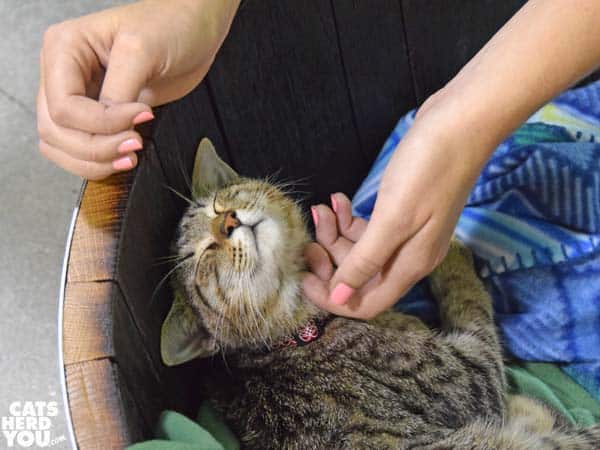
A moment later, the retired lady asked, “So are they all declawed and everything?” It’s a good thing my back was to the conversation, because I am sure my expression wasn’t neutral. The dog-shirted volunteer said something about only if they arrive declawed. What a missed opportunity for education!
The retired lady wandered out and I continued taking photos. A few minutes later, she was back, this time with her husband, who also didn’t have on a sticker indicating he had paid admission, either. They circulated around a few more minutes before leaving. I’m sure the newly-opened cafe will find a better way to monitor the entrance door, or work with the volunteers on how ask people to leave who haven’t paid their fee, but it was interesting to see the early growing pains of the place.
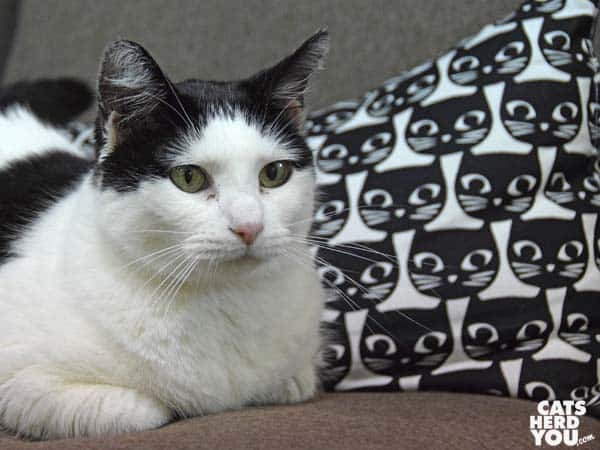
The original staffer emerged from the back room a little later, and I took the opportunity to ask her about whether they had seen adoptions from the cafe yet. “We’re still going through lots of applications,” she told me.

I think this could become a valuable adoption location for the rescue organization, and I recognize that when I was there, they had only been open 5 days. It takes longer than that to get everyone trained in the processes and procedures.
In the meantime, it’s a fun place to visit to say hello to the cats available for adoption. Who knows, maybe you’ll fall in love! I’m sure it will also be popular with Disney visitors who miss their cats back home, since it is the closest cat cafe to Walt Disney World.

Just be careful when you leave. They already have one escape artist cat, and you don’t want to be the one who lets her out!
Update: The Orlando Cat Cafe announced their first adoptions today, including one of the cats pictured in this article.
Although the Orlando Cat Cafe says they are “about 4 miles west of Disney’s Animal Kingdom,” that distance is only useful if you are a bird. The rest of us have to use streets!

The closest Disney resort to the Orlando Cat Cafe is Animal Kingdom Lodge, and the drive is 7.9 miles, so walking isn’t a realistic option to see the cats.
If you are staying somewhere else on Disney’s vast property, the distance could be much farther. The Contemporary Resort, close to Magic Kingdom, is a 14.5 mile drive.
Resorts around SeaWorld are about 16 miles and Universal-area resorts are around 19 miles away, so set aside travel time accordingly.
The easiest way to get to the Orlando Cat Cafe is to drive. If you arrived on vacation by air and didn’t rent a car, you’ll need ground transportation. Taxi service in Orlando tends to be expensive, and the biggest local transportation company’s fare estimator says that a trip from Disney’s Contemporary resort to the Orlando Cat Cafe will cost a $39.06 fare one-way.

A less-expensive option is Uber, which estimates $15-19 each way to get from Disney’s Contemporary Resort to the Orlando Cat Cafe. If you haven’t tried Uber before, you can sign up through this invitation link to get $10 free credit for your first ride with them (disclosure: I also get credit if you do).
The least expensive option is using the local Lynx bus system, at $2 each direction. Plan for up to two hours travel time due to transfers. You can use the Plan a Trip function on the Lynx site to see the bus schedules available for your visit.
Photo credit: depositphotos/funny_cats

Adoption of less-adoptable cats is a cause close to our hearts because Ashton is a less-adoptable cat. So for Flashback Friday, we are bringing back a reminder about Adopt a Less-Adoptable Pet Week.

According to a PetFinder survey, 99% of shelters and rescue organizations have pets they are having difficulty placing in good homes. These “less-adoptable” pets fall into several categories.
Many adopters decide against senior cats because they are adopting after losing a previous pet, and they don’t want to imagine that happening again for a very long time. The thought of losing a senior cat to old age in only a few years makes them choose to adopt younger cats. Adopters may also be afraid of senior cats developing expensive medical conditions with their advanced age.
 With the aging of the baby boom generation, a growing number of senior pets who lived their entire lives with a single human find themselves homeless when their human who becomes unable to take care of them due to their own age-related issues or even because of their human’s death. When the remaining family members are unable to care for the cat, frightened, disoriented senior pets don’t appear to be good potential companions and are harder to adopt.
Given time to settle into a new home, seniors can make wonderful, loving companions, great for adopters who want a cat to cuddle with but don’t want to have to wear a young cat out with a lot of exercise and play every day.
Like the frightened senior pets mentioned above, shy cats don’t warm up to potential adopters when they come to a shelter or rescue organization to look for a new companion. Shy cats don’t “show well,” and their shyness can look like aggression when they are especially afraid at adoption events. The same cat that hisses at a potential adopter when being pulled out of the safety of his cage at an adoption event will come out of his shell after being given more time to warm up to strange humans, but it’s hard for the shy cat to get the chance to let his personality shine.
Shy cats can blossom in foster homes, but it can be hard for a potential adopter to take a shelter’s word that the cat cowering in their litterbox will be friendly and outgoing in their home environment once they have time to adjust to new surroundings.
There are many types of special needs cats, like diabetic cats or cats that need special diets for ongoing conditions. Each of these may worry potential adopters because they aren’t sure if they understand what care the cat will need, even though the extra care is often minimal. Education is key to understanding how much or little care a special need cat will require.
 One of the most common conditions that causes cats to be considered special needs is Feline Immunodeficiency Virus (FIV), found commonly among stray cats. While there is a lot of lingering fear and misunderstanding about the transmission of this virus, studies have shown that friendly FIV-positive and negative cats live together without transmitting the disease. While FIV-positive cats should see their vet more promptly at any sign of illness, they can also live long, happy lives with their human and feline families. Still, lingering fear and misunderstanding make these cats harder to adopt.
Many cats are simply imperfect. Even though they need no extra care, they may be missing an eye like our Ashton or a leg like our Cousin Earl. Others might have tattered ears or visible scars. These imperfections are usually from a previous mishap, and the cats simply aren’t as appealing to potential adopters on sight.
These different-looking cats are just as wonderful companions as their two-eyed or four-legged companions, but they are often overlooked because they don’t have as much “curb appeal” as unblemished cats.
Cats who are relinquished to a shelter or rescue together sometimes turn to each other for comfort. It’s no wonder that the rescue organization decides that they must go to a home together so that they can continue to rely on each other for solace during stressful transitions and play together during joyful times. Not everyone wants to adopt two cats, or if they do, they may not want the particular combination of personalities, colors, or other characteristics that the bonded pair represents.

Bonded pairs of cats, with each other to help their confidence, may adapt more quickly to new situations then they would alone, but some adopters still hesitate.
At the other end of the spectrum, cats who must go to homes with no other cats can take longer to adopt because the most likely adopters already have one or more cats. Some only cats also need to be the only pet in the home so they can’t join a household with dogs or other pets, either. This limits their potential pool of adopters and keeps them at the shelter or rescue group longer.
These “only” cats bond closely to their human family members, especially since they have no other feline companions.
People who work in shelters and rescues continue to report that black cats with wonderful personalities take longer to adopt than their more colorful counterparts. Black cats may not show well in the muted light of cages in shelters or may be victims of superstitions about their being unlucky. Anyone who has lived with a black cat can report that they are anything but unlucky, but are great companions with winning personalities.

Most shelters work to get their less-adoptable pets extra attention, knowing that they are going to take more families considering them than average before one decides that they have found the perfect companion.
Some shelters and rescues offer programs that help defray the potential costs of medical care that might put people off of adopting seniors or special needs cats. Others offer foster-to-adopt arrangements so that shy cats have time to come out of their shell in a home environment and show their potential adopter what loving companions they can be.
A number of shelters are also working hard to find innovative ways to help seniors keep their less-adoptable pets, serve as long-term foster homes, and adopt senior pets of their own.
Shelter outreach and programs alone won’t help place all of their less-adoptable pets. The next time you’re looking for a new family member, think beyond a kitten to a less-adoptable cat who could be a perfect fit for your family!
References and further reading:
Petfinder, Adopt a Less Adoptable Pet Week
The Veterinary Journal, Transmission of feline immunodeficiency virus (FIV) among cohabiting cats in two cat rescue shelters
Photo credit: depositphotos/cynoclub
As I mentioned on Monday, my trip to New York City included visiting a cat cafe, Koneko. In fact, I ended up visiting it twice!

I scheduled my arrival to NYC to be early in the day so I could meet up with a local friend who is also a cat lover, and we went to Koneko together. That was my very first cat cafe visit. The next day, I went back with the rest of the BlogPurr event attendees. Photos on this page are from both visits.
Walking down Clinton Street on the lower east side of New York, a modest sign above one storefront hints that there are cats inside.
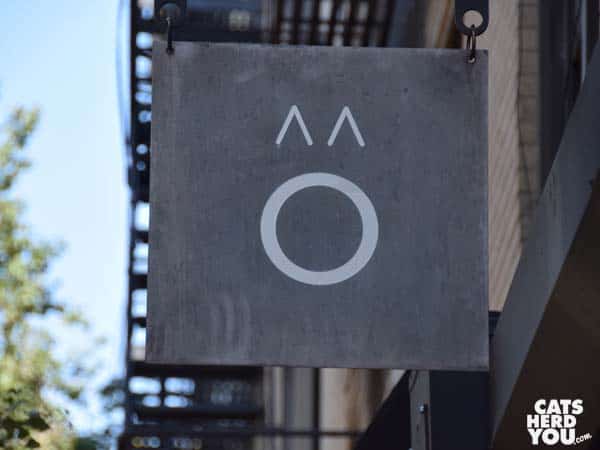
The overhead sign is so modest that when the cat cafe is open to the general public, a sidewalk sign beckons you inside with the magic words: adoptable kitties.

The cafe itself is a single storefront’s width, serving wonderful coffee and tasty, Japanese snacks. Try the green cheesecake… it isn’t wasabi pie, even though I joked that it might be.

All of the decor is themed around the real guests of honor at the cat cafe, like the sign on the restroom.

At the back of the cafe is a glass-fronted cattery. The glass separates the food-serving area from the area of the cafe reserved for the cats.

When you enter the vestibule for the cattery, you take off your shoes and just wear your socks. If you don’t have socks, the cafe supplies slippers. This prevents cross-contamination of the cattery area. You also learn about the important rules for visiting the cat cafe.

Inside the cattery, 20 adoptable cats from Angellicle Cats Rescue roam free in three different areas. Or instead of roaming, many of them sleep.

It’s amazing how relaxed some of the cats are with strangers wandering through. These adoptable cats will be remarkably well-socialized when they go home with new families.

Some people would think that having 20 cats in a confined space would be dirty or smelly, but the cattery is spotless. Cat litter boxes are tucked discreetly away behind cat doors labeled to identify what is on the other side. I doubt the cats actually read the signage, but it’s really cute.

There are two separate indoor areas of the cafe, connected by a stairway. The cats don’t have to take the stairway meant for the humans. They have their own, private opening between floors. Downstairs, they can use wall-mounted shelving to make their way down from their private catwalk.

There are plenty of places for cats to scratch, stretch, and engage with visitors.

There are also plenty of high shelves and places the cats can get away from visitors if they aren’t in the mood for being bothered.

This cat, Cello, had just arrived at Koneko that day and was already playing with visitors.

The cafe’s outdoor catio has an impressive mural, representing lots of cats from pop culture.

More cats seem to congregate on the catio than indoors, enjoying the fresh air.

Outside, they do some of the same things they do indoors, like sleep.

But the real attraction is the falling leaves and pigeons that land on the fire escapes above.

The catio keeps the cats safe while they enjoy the fresh air and the sights.

What better way to fall in love with an adoptable cat then watching her chatter at birds?

While cat cafes started as ways for people without cats to spend time with cats, being able to meet cats in the cafe who you can fall in love with and bring home is a wonderful alternative to cats spending extended time in cages while they wait to find homes.

In fact, during my visit to Koneko, the staff told me that this cat was getting ready to go to his new adoptive home that evening. Coffee, cats, and happy endings all under one roof!

Koneko is on the lower east side of Manhattan in New York City. The closest subway stop is the 2nd Ave stop of the F line. From there, walk east on Houston Street and turn right on Clinton Street. You will find Koneko at 26 Clinton Street. Look for the sign with their emoticon-style logo over the door.

Disclosure: My travel costs to the BlogPurr event were paid by Merck Animal Health.