Cats Herd You

Laugh. Learn. Love cats.

  • Home
  • Safety
  • Wellness
  • Rescue
  • Reviews
  • Life With Cats
  • About
  • Media Friendly
  • Contact

Chasing the Chicken Leg

Pierre: Newton must have left this chicken leg here. Even with his drool on it, it’s a lot of fun. 

Gray tabby cat plays with knit chicken leg toy

Pierre: You have to be fast to catch the chicken leg. Watch out, Newton, it’s mine, now.

gray tabby cat chases knit chicken leg toy

Pierre: The chicken leg is slippery. It must be all of Newton’s drool on it.

gray tabby cat chases knit chicken leg toy

Pierre: GOTCHA!

gray tabby cat chases knit chicken leg toy

Pierre: Whew, that was exhausting. It almost outran me!

Gray tabby cat lays on floor

Share Share on email
Email
Share on twitter
Twitter
Share on facebook
Facebook
Share on pinterest
Pinterest
Share on google
Google
Share on tumblr
Tumblr
Share on linkedin
Linkedin

June 7, 2017 Filed Under: Cats Tagged With: Pierre 20 Comments

Whose Toy Is That, Anyway?

Newton: Ashton left her chicken leg here, and now it’s all mine!

orange tabby cat sees knit chicken leg toy

Newton: It’s not even all soggy with drool. She must not appreciate it.

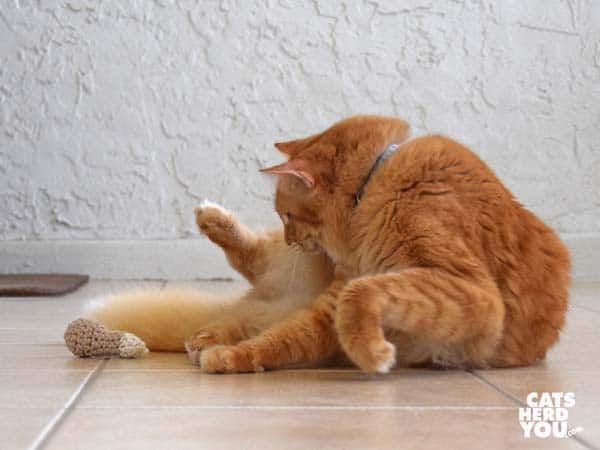
orange tabby cat paws knit toy

Newton: It’s more fun to play with when it doesn’t have someone else’s drool.

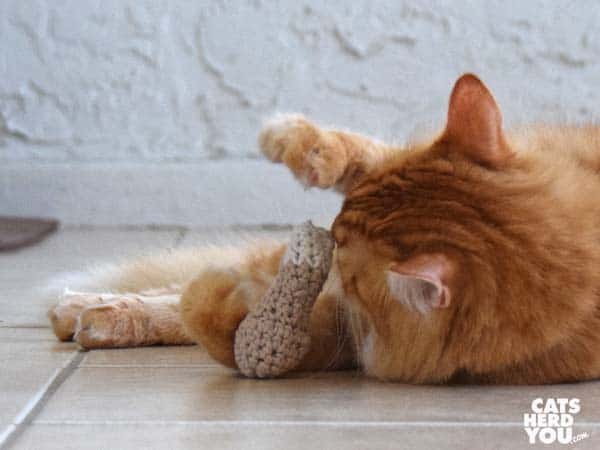
orange tabby cat plays with knit chicken leg toy

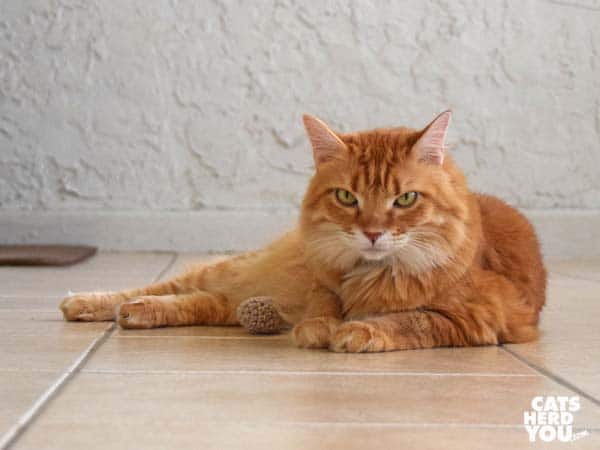
Newton: Now I have drooled on it and everyone will be able to tell that it’s mine.

orange tabby cat hides knit chicken leg boy near his belly

Ashton: Hey, Newt, have you seen my chicken leg? I left it around here somewhere.

Newton: Umm…. no. I haven’t. What did it look like?

brown tabby cat enters frame as orange tabby cat hides knit chcken leg toy

Ashton: You know, like a chicken leg.

Newton: Oh, okay. I’ll watch for it.

brown tabby cat looks at orange tabby cat who hides knit chicken leg toy

Ashton: Will you let me know if you see my chicken leg toy? 

one-eyed brown tabby cat looks into camera as orange tabby cat looks on, hiding knit chkcken leg toy

Miss Ellen at 15andMeowing15andMeowing kindly sent Ashton some handmade toys after her dentalwork. Big thanks for the thoughtful gift! It took Ashton a while to feel up to playing with them, but now that she is, she has to share them with Newton. Newton thinks all the toys in the house — and maybe all of the toys in the world — belong to him.

Share Share on email
Email
Share on twitter
Twitter
Share on facebook
Facebook
Share on pinterest
Pinterest
Share on google
Google
Share on tumblr
Tumblr
Share on linkedin
Linkedin

June 5, 2017 Filed Under: Cats Tagged With: Ashton, Newton 24 Comments

An Unusual Cat

Newton: This is strange. The sun is going down, and this new cat in the house is glowing! It doesn’t TASTE like a cat, though.

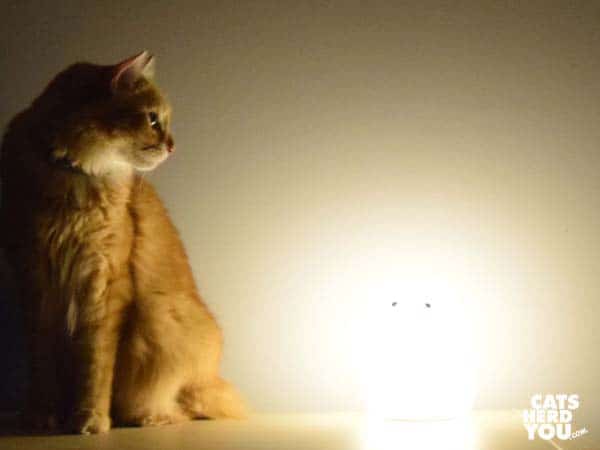
Newton: Now it’s night, and my new friend is still glowing away. Maybe he’s a moon. Moons glow at night.

orange tabby cat looks at glowing cat-shaped object

Newton: It’s okay, little moon, I’ll stay right here and make sure that no other kitty bothers you. I’ll stay all night long, or at least until the manpeep comes home. 

orange tabby cat sits next to glowing cat-shaped object

Share Share on email
Email
Share on twitter
Twitter
Share on facebook
Facebook
Share on pinterest
Pinterest
Share on google
Google
Share on tumblr
Tumblr
Share on linkedin
Linkedin

June 2, 2017 Filed Under: Cats Tagged With: Newton 20 Comments

Pet Microchips and Cancer: Know the Facts

I am seeing a lot more posts on social media about pet microchips causing cancer, and it’s not supported by the facts. Since information circulating on social media can cause people to make decisions about whether or not to chip their pets, I wanted to take a look at the current science about it.

What is a Pet Microchip?

A pet microchip is a small object about the size of a grain of rice that is injected under a pet’s skin between the shoulder blades. Each chip is encoded with a unique number, and when a microchip scanner is passed near the pet, the chip emits a radio wave with the that identifying number. The scanner then displays the unique number of the chip, uniquely identifying the pet.

Cat holds tablet displaying microchip on finger

Databases of microchips are maintained by the manufacturers, and consumers submit their contact information to the database so that there is contact information corresponding to the unique chip ID number. When a veterinarian or shelter scans a cat and needs to find the owner, they can contact the manufacturer or use a universal microchip lookup tool that can search multiple manufacturer databases at once. This makes it possible to access the contact information associated with the unique ID in the chip and contact the pet’s family.

Do Microchips Cause Cancer in Cats and Dogs?

In the United Kingdom,the British Small Animal Veterinary Association (BSAVA) has been tracking microchip adverse reactions since 1996. This gives long-term, real-life data about actual adverse reactions to implanted microchips in pets.

The most common adverse reaction reported to microchips is migration, when the chip does not remain behind the cat’s neck and between his shoulder blades. This happened to Pierre. His chip is located over the middle of his left shoulder blade. The risk of a migrated microchip is that it may not register if someone runs the scanner down the cat’s back if it migrates far enough. It isn’t a health risk.

gray tabby cat

The BSAVA reported 2 tumors at the microchip site in 3.7 million microchipped pets. In one of these cases, veterinarians are unsure whether the tumor was from a vaccination that was given at the same location.

Why Microchip your Cat?

On the other hand, the American Humane Association estimates that over 10 million dogs and cats are lost or stolen in the US every year. The return-to-owner rate is SO much higher in pets with chips, especially for cats.

Cats are 20 times more likely to get home from a shelter if they have a chip. Dogs, in general, have a better return-to-owner rate even without chips, in part because people are not as proactive about finding lost cats. But even dogs 2.5 times more likely to get home from a shelter with the help of a microchip.

Feral cat, photo credit flickr creative commons/Quinn Dombrowski

Ultimately, you have to decide what’s best for your cat. Every choice you make balances risks and rewards for your pets, from microchipping to what diet you choose for your furry companion. I am an advocate of microchips for identification because the chance of a cat being lost is much higher than 2 in 3.7 million, and I see a lot of heartbreak every week from people searching for their lost cats.


Research and further reading:

AVMA, Microchipping of Animals Backgrounder
Animals Journal, Frequency of Lost Dogs and Cats in the United States and the Methods Used to Locate Them
Ohio State University Research News, Microchips Result in High Rate of Return of Shelter Animals to Owners
American Animal Hospital Association, AAHA Universal Pet Microchip Lookup

Photo credits:

depositphotos/RasulovS and vetkit
flickr creative commons/Quinn Dombrowski

Share Share on email
Email
Share on twitter
Twitter
Share on facebook
Facebook
Share on pinterest
Pinterest
Share on google
Google
Share on tumblr
Tumblr
Share on linkedin
Linkedin

May 31, 2017 Filed Under: Rescue 22 Comments

  • « Previous Page
  • 1
  • …
  • 65
  • 66
  • 67
  • 68
  • 69
  • …
  • 494
  • Next Page »

Read Ashton’s Story in Rescued, Volume 2

These pawtographed books support Candy's Cats, who work tirelessly to find homes for cats in Florida.

Rescued, Volume 2: The Healing Stories of 12 Cats, Through Their Eyes. Proceeds from authographed copies benefit Candy's Cats.


Outside the US, contact us for shipping to your location.

Read Us by Email

Don't miss a thing! Cats delivered to your email.

Privacy Policy


Archives

All Rights Reserved

Articles and images on this site may not be reproduced in whole or in part without written consent. Please contact me if you are interested in reprinting or in having me write something unique for you.

Disclaimer

There are no veterinarians here. All health-related posts are the result of research and observation, but educational information is not a substitute for visiting your veterinarian. Do not self-diagnose your cat. For more information, see our disclaimer.

Policies

Disclosure Statement
Privacy Policy
Commenting Policy

Copyright © 2026 · Sometimes Cats Herd You · All Rights Reserved