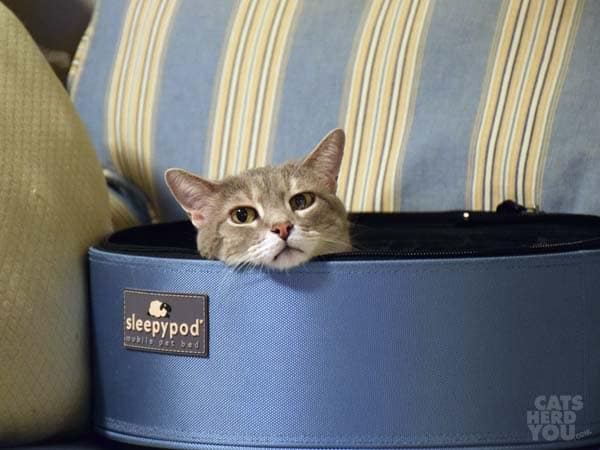
Pierre: I have reserved seating on the sofa.
 The head peep is going to be away this weekend, and I’m going to binge-watch some Tom and Jerry while she’s gone. Don’t touch that remote control!


Laugh. Learn. Love cats.

Have you ever wondered why one cat food is named chicken dinner and some is named chicken cat food?

It’s based on standards set forth by the American Association of Feed Control Officials (AAFCO). You’ve probably heard of them because they’re mentioned on every pet food label in a statement of nutritional adequacy. But AAFCO doesn’t just set forth guidelines for nutritional profiles in pet food; they also outline labeling guidelines that the manufacturers are to follow. Those labeling guidelines include how the product is named.
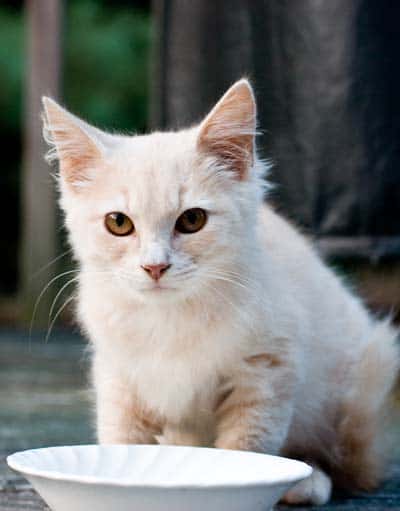 If a cat food is named “chicken for cats” or “tuna cat food,” at least 95% of the product must be the named protein, not counting added water and other condiments. If you count added water, 70% of the product must be the protein in the name.
If there are two ingredients listed on the cat food name, such as “salmon and chicken cat food,” the two ingredients combined must be 95% of the total weight of the product, not counting water. The first ingredient must be the one there is more of by weight, so a cat food can’t be mostly chicken and be named “salmon and chicken cat food.”
If the ingredient in the product name is at least 25% of the weight of the product (not counting water for processing) but less than 95%, the name of the product has to include a qualifying descriptive term, like “dinner,” “platter,” “entree,” “formula,” or “entree.” If you count added water, the named ingredient must be 10% of the product. This means that “tuna formula for cats” only needs to include 10% tuna.
This highlights why it’s important to read the label of any cat food you buy. A product named “chicken dinner” could contain more fish than chicken and still be within AAFCO guidelines. The product name isn’t necessarily a good guideline to helping you know what’s actually inside the can or the bag.

If the product has two ingredients in its name, such as “chicken and rabbit entree,” those two ingredients need to comprise 25% of the product’s weight (excepting water weight). The second ingredient mentioned must be at lest 3% of the product.
If a product uses the word “with” in the product name, such as “cat food with tuna,” the ingredient is only required to be 3% of the product by weight.
Take a few extra minutes when you’re buying your cat food to read your cat food label carefully to be sure you know what your kitty is eating. It can help avoid surprises later.
Reference and further reading:
FDA, Pet Food Labels – General
US Government Publishing Office, Electronic Code of Federal Regulations, Title 21, Chapter 1, Subchapter E, Part 501 – Animal Food Labeling
Photo credits:
Brian Leon on Flickr
Beverly Pearl on Flickr
The head peep has been cat sitting for cousins Earl and Shep this week. As you can see, Cousin Earl is doing well. He lost his collar somewhere in the house, but the head peep can’t find it anywhere. Paws up for the hiding job, Earl!

Cousin Shep would like to know when dinner starts. He’s a very sweet kitty, but when the head peep arrives, he thinks dinner should happen immediately. This is his “can we eat yet?” expression.
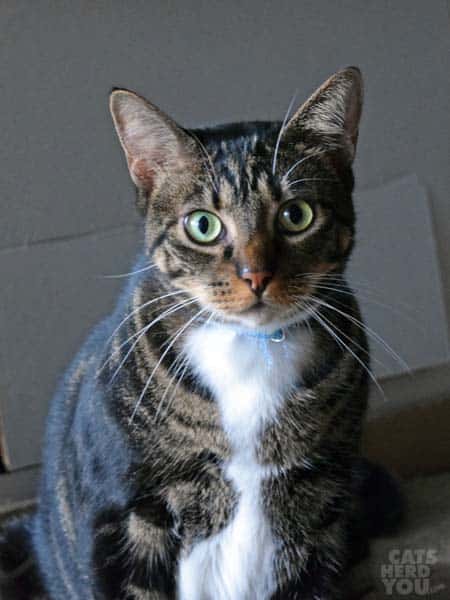
The head peep managed to capture a shot of Cousin Earl just after a bolt of lightning struck just outside. You can tell from Earl’s fluffed tail what he thought of that!
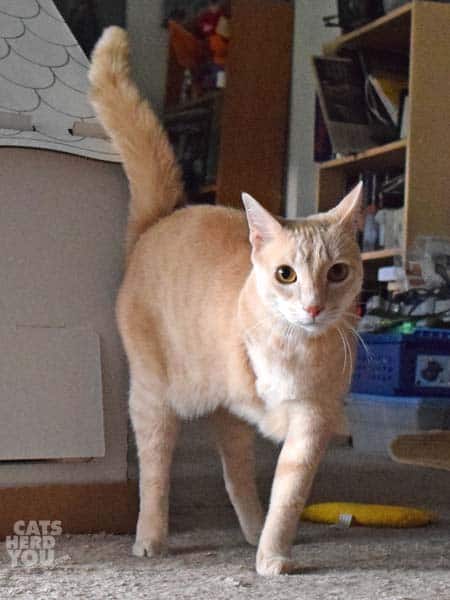
Our cousins are doing great, though they really missed Aunt O and are glad to have her home again. We’re kind of glad to not have to share her so much, too!