Cats Herd You

Laugh. Learn. Love cats.

  • Home
  • Safety
  • Wellness
  • Rescue
  • Reviews
  • Life With Cats
  • About
  • Media Friendly
  • Contact
You are here: Home / Archives for Health

What’s in a Cat Food Name?

Have you ever wondered why one cat food is named chicken dinner and some is named chicken cat food?

do you know difference between chicken cat food and chicken dinner for cts

It’s based on standards set forth by the American Association of Feed Control Officials (AAFCO). You’ve probably heard of them because they’re mentioned on every pet food label in a statement of nutritional adequacy. But AAFCO doesn’t just set forth guidelines for nutritional profiles in pet food; they also outline labeling guidelines that the manufacturers are to follow. Those labeling guidelines include how the product is named.

Cat Food
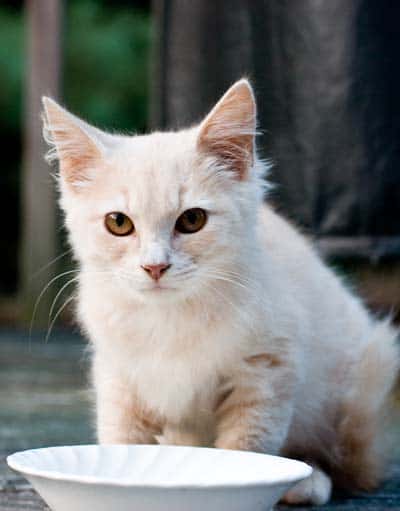
Cat at bowlIf a cat food is named “chicken for cats” or “tuna cat food,” at least 95% of the product must be the named protein, not counting added water and other condiments. If you count added water, 70% of the product must be the protein in the name.

If there are two ingredients listed on the cat food name, such as “salmon and chicken cat food,” the two ingredients combined must be 95% of the total weight of the product, not counting water. The first ingredient must be the one there is more of by weight, so a cat food can’t be mostly chicken and be named “salmon and chicken cat food.”

Cat Dinner or Entree

If the ingredient in the product name is at least 25% of the weight of the product (not counting water for processing) but less than 95%, the name of the product has to include a qualifying descriptive term, like “dinner,” “platter,” “entree,” “formula,” or “entree.” If you count added water, the named ingredient must be 10% of the product. This means that “tuna formula for cats” only needs to include 10% tuna.

This highlights why it’s important to read the label of any cat food you buy. A product named “chicken dinner” could contain more fish than chicken and still be within AAFCO guidelines. The product name isn’t necessarily a good guideline to helping you know what’s actually inside the can or the bag.

cats_sitting_on_bagged_food

If the product has two ingredients in its name, such as “chicken and rabbit entree,” those two ingredients need to comprise 25% of the product’s weight (excepting water weight). The second ingredient mentioned must be at lest 3% of the product.

With an Ingredient

If a product uses the word “with” in the product name, such as “cat food with tuna,” the ingredient is only required to be 3% of the product by weight.

Take a few extra minutes when you’re buying your cat food to read your cat food label carefully to be sure you know what your kitty is eating. It can help avoid surprises later.


Reference and further reading:

FDA, Pet Food Labels – General
US Government Publishing Office, Electronic Code of Federal Regulations, Title 21, Chapter 1, Subchapter E, Part 501 – Animal Food Labeling

 Photo credits:

Brian Leon on Flickr
Beverly Pearl on Flickr

Share Share on email
Email
Share on twitter
Twitter
Share on facebook
Facebook
Share on pinterest
Pinterest
Share on google
Google
Share on tumblr
Tumblr
Share on linkedin
Linkedin

August 20, 2015 Filed Under: Health 25 Comments

It’s Time to Check Your Chip

This Saturday, August 15 is National Check the Chip Day. It’s a reminder to all of us that getting your cat microchipped isn’t the only step in the process in giving her a much higher chance of getting home. Cats have a 20 times higher chance of being returned to their owners after entering an animal shelter if they are microchipped.

Just having a microchip isn’t enough. You have to be that the chip is readable and that your information is up to date. That’s what Check the Chip today is to remind you about.

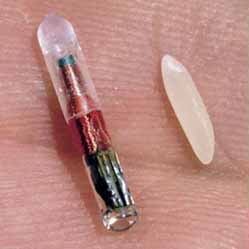
A pet microchip is slightly bigger than a grain of riceGet Chipped

If your cat isn’t already microchipped, getting her chipped is a simple procedure that can be done at your veterinarian’s office. Reduced-cost and sometimes even free microchips are available at events in your community. Microchips are implanted under the skin with a large-gauge needle, like getting a vaccination.

Get Registered and Keep Contact Information Current

cat using computerMake sure your chip is registered, and keep it up to date if your contact information changes. New phone number? New address? Don’t just change the information with your friends. Update it with the microchip registration for your cat, too.

This is important because one of the leading causes of microchipped pets not being able to get home is not being able to find the current contact information for the pet’s home. If you get a microchip implanted in your kitty and then move across the country, your old vet who implanted it may lose touch with you. If your microchip isn’t registered, the last person the microchip company knew had the chip was your old vet. Keep your contact information up to date with the chip registry to be found when your pet needs you most.

Check the Chip

Check the chip! Microchips are implanted between the shoulder blades. When Ashton was a bony, little kitten, you could feel the chip, about the size of a big grain of rice, if you scritched her shoulders just right, just past the end of her neck at her shoulders.

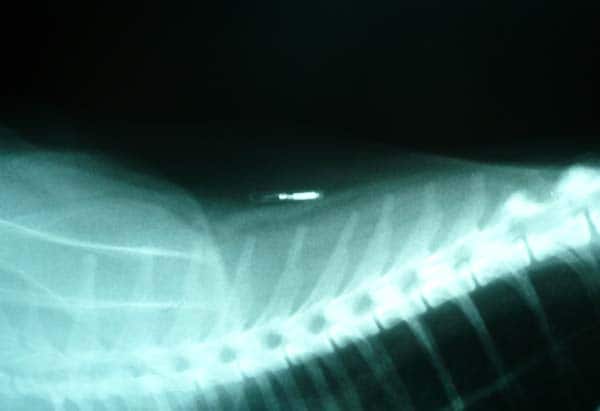
feline microchip x-ray

In rare cases, a microchip can migrate. Pierre’s chip has migrated about two inches so it’s over his shoulder blade instead of between his shoulders. This is unusual enough that when our vet felt it, he let some of his vet techs feel it so that they would recognize a migrated chip if they felt one.

RFID ScannerChip migration doesn’t hurt your cat, but it does mean that if someone passes a microchip scanner over your pet’s shoulders, it might not be energized by the electromagnetic field produced by the scanner. This can lead to the microchip not being detected. To be sure this hasn’t happened, ask your veterinarian to scan for your cat’s chip as a part of their routine veterinary exam.


References and Further Reading

Ohio State University Research News, Microchips Result in High Rate of Return of Shelter Animals to Owners

Photo Credits:

Light Warrior, Wikimedia Commons
Joel Mills, Wikimedia Commons
Oscar111, Wikimedia Commons

Share Share on email
Email
Share on twitter
Twitter
Share on facebook
Facebook
Share on pinterest
Pinterest
Share on google
Google
Share on tumblr
Tumblr
Share on linkedin
Linkedin

August 13, 2015 Filed Under: Health 21 Comments

Obesity in Cats Can Start Early

Being a young cat isn’t necessarily enough to keep your kitty from becoming overweight. A new study about early life risk factors for obesity in cats, published by researchers at the University of Bristol in the UK, has shown that a dry food diet and indoor lifestyle are independent risk factors for obesity in cats around a year old.

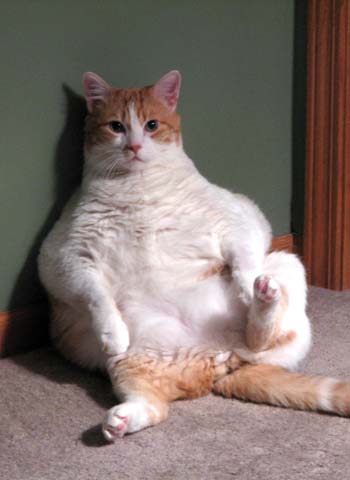
fat catThis data was gathered as part of a first-of-its-kind program at the University of Bristol in the UK. The Cat Longitudinal Analysis of Welfare Study (CLAWS) collected information from kittenhood through two years about cats adopted from rescue centers to understand how their early development shapes their later health and behavior. Surveys filled out by each cat’s family asked them to report their cat’s body score as well as other information such as feeding habits and behavior information.

At 12 ½ – 13 months old, 7% of the 966 cats were owner-reported to be either overweight or obese. Cats with restricted or no outdoor access were more likely to be part of this group, and cats who were eating a diet of over 50% dry food were also more likely to be classified as overweight or obese.

While this study was conducted in the UK, the findings apply to cats here in the US, too. In fact, only about 10% of cats live permanently indoors in the UK, while that number is much higher in the US. That means US cats are more likely to be in danger of obesity from that risk factor alone.

The dry kibble diet risk factor also applies to cats in the US. The UK isn’t the only place that a dry diet is the most popular diet choice for domestic cats. In the US, 78% of pet households feed dry food most often, making it a big impact on feline diets in the states.

kibbles

Careful attention to a cat’s diet and plentiful opportunities for exercise while a cat is young are important in the risk of obesity developing during early adulthood, so make some time to play with your kitty today. She’ll appreciate it, and it will help her stay in better shape.


References and Further Reading

ScienceDirect, Risk factors identified for owner-reported feline obesity at around one year of age: dry diet and indoor lifestyle
University of Bristol, CLAWS Feline Welfare Study
University of Bristol, Bristol Cats Study
International Cat Care, Indoors vs. Outdoors
APPA National Pet Owners Survey

 Photo Credits:

flickr, Dan Perry
flickr, Mark Turnauckas

Share Share on email
Email
Share on twitter
Twitter
Share on facebook
Facebook
Share on pinterest
Pinterest
Share on google
Google
Share on tumblr
Tumblr
Share on linkedin
Linkedin

August 6, 2015 Filed Under: Health 21 Comments

Pheromones May be Key to Attracting Cats to Scratchers

Don’t throw out that old, well-scratched cat tree just yet! It might be the best way to help keep your kitty from scratching things you don’t want her to.

gray tabby cat scratches sisal postCat scratchers come in all shapes and sizes, and enhancing their attractiveness to your cat so that she prefers scratching there instead of scratching on your sofa can be frustrating when you don’t know how to get her to get started using a beautiful, new cat tree you just brought into the house. A new study may have unlocked one of the keys: pheromones.

A team from Texas Tech led by professor John McGlone used kittens to test various cat scratchers to determine which one cats preferred and why. The study offered horizontal scratchers, vertical scratchers, and scratchers with all kinds of substances, even bubble wrap. They found that the kittens preferred cardboard scratchers in an S shape over the others offered.

Even more interesting, the study looked more closely at what attracted the kittens to the scratchers by putting various substances on the favored S-shaped scratchers. The results suggested that what really attracts cats to scratchers is pheromones left by cats who scratched there before, which trigger a social response for the next cat who encounters it to scratch the scratcher to mark it, too.

buff cat scratches on scratching postWhile catnip oil attracted some attention to the scratchers, kittens clearly preferred scratchers that were previously used by other kittens. Each subsequent kitten that used the same scratcher used it for longer and longer, suggesting that the pheromones left by the previous kittens were attracting the new kitten to it.

The researchers say that the next step is to determine exactly which pheromone impacts cat behavior. Once it is isolated thorough organic chemistry and animal behavior work, it can be applied to scratchers to attract cats and help keep your furniture safer from cat claws.

One day soon, there may be a scratcher attractant spray. Until then, you might want to think twice about throwing away your cat’s favorite scratcher, even if it’s looking a little tired. That might be the best way to be sure that your kitty is going to return to it again and again.


Reference and further reading:

ASDA-ASAS Joint annual meeting, Evidence for a cat pheromone that modulates kitten scratching

Photo credit:

Raelene Gutierrez on Flickr

Share Share on email
Email
Share on twitter
Twitter
Share on facebook
Facebook
Share on pinterest
Pinterest
Share on google
Google
Share on tumblr
Tumblr
Share on linkedin
Linkedin

July 30, 2015 Filed Under: Health 25 Comments

  • « Previous Page
  • 1
  • …
  • 11
  • 12
  • 13
  • 14
  • 15
  • …
  • 18
  • Next Page »

Read Ashton’s Story in Rescued, Volume 2

These pawtographed books support Candy's Cats, who work tirelessly to find homes for cats in Florida.

Rescued, Volume 2: The Healing Stories of 12 Cats, Through Their Eyes. Proceeds from authographed copies benefit Candy's Cats.


Outside the US, contact us for shipping to your location.

Read Us by Email

Don't miss a thing! Cats delivered to your email.

Privacy Policy


Archives

All Rights Reserved

Articles and images on this site may not be reproduced in whole or in part without written consent. Please contact me if you are interested in reprinting or in having me write something unique for you.

Disclaimer

There are no veterinarians here. All health-related posts are the result of research and observation, but educational information is not a substitute for visiting your veterinarian. Do not self-diagnose your cat. For more information, see our disclaimer.

Policies

Disclosure Statement
Privacy Policy
Commenting Policy

Copyright © 2026 · Sometimes Cats Herd You · All Rights Reserved