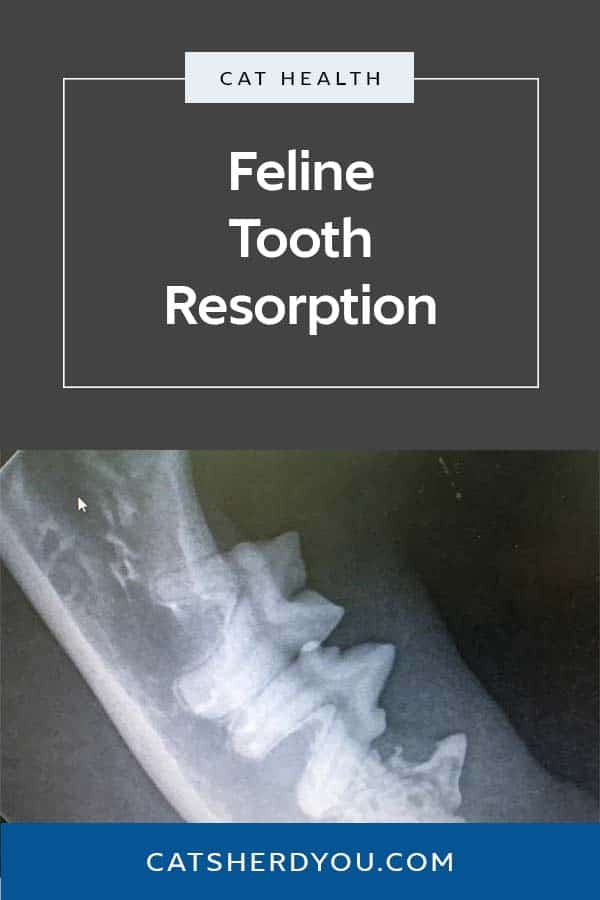
When I shared that Ashton was going to have a tooth pulled, it was surprising how many friends commented about cats having teeth removed, too. What’s up with all these cats losing teeth? Feline tooth resorption.
Tooth resorption, where the cat’s own body begins to break down a tooth, happens more often than you would expect. It is one of the most common diseases in domestic cats, with about 29% of cats having at least one resorptive lesion.
What is feline tooth resorption?
Tooth resorption happens when odontoclasts, cells in the cat’s mouth, gradually destroy the tooth by digesting it at a cellular level.
Holes – or lesions – form in the outermost layer of the tooth, sometimes starting in the root, and other times in the visible of the tooth, called the crown. Because tooth resorption can be hidden beneath the gums, you may not be able to see when tooth resorption begins.
The only way to detect below-the-gumline lesions on teeth is with x-rays. Your veterinarian can only see this kind of resorptive lesion after it spreads upward into the crown. Sometimes the holes in the crown of the tooth are visible on examination, and other times, a cat’s gums become inflamed and will cover the area of the tooth with the lesion.
Ashton’s gums were inflamed around her damaged tooth, and the gum seemed to be stretching up to try to cover her tooth, as soon below.

Resorptive lesion on tooth. Photo courtesy Bay Hill Cat Hospital.
What her inflamed gums were hiding was a tooth that had a huge hole in the side. Look at the x-ray image that shows what was hiding under the gum. Doesn’t that look like it must have been painful?

Radiograph showing tooth resorption courtesy Bay Hill Cat Hospital
If left long enough, tooth resorption will destroy the tooth entirely, until nothing remains above the gumline. Ashton’s same premolar on the other side of her mouth was completely gone, as seen in this image.

X-ray of tooth completely destroyed by tooth resorption courtesy Bay Hill Cat Hospital
Signs of Tooth Resorption
Once the lesions above the gumline can be painful to your cat. Cats are good at hiding pain, so it may not be obvious. Signs that could mean tooth resorption include:
- Difficulty eating or dropping food outside the bowl
- Chewing with only one side of the mouth
- Bleeding from the mouth
- Excessive salivation
- Overall withdrawal or change in mood
- Bad breath
Ashton never misses a meal, so the only clue we had at home there could be a problem was her terrible breath. It’s a good thing we knew what her regular breath smelled like so we could tell when there was a change. It meant the vet needed to take a look at her teeth!

What causes tooth resorption?
The exact cause of tooth resorption isn’t understood. Researchers have a list of conditions that happen around teeth with resorption, but they have not been able to establish whether these conditions cause resorption or whether they are an effect of it, including an acid pH and the fact that there are more vitamin D receptors in the tissue around the teeth.
Some cats, especially purebreds like Siamese and Persian, are more prone to tooth resorption, so there is a genetic component to the tendency for the condition. Plenty of mixed-breed cats, like Ashton, get tooth resorption, too, so genetics isn’t the only factor at work.
How do you treat tooth resorption?
Tooth resorption is progressive. You can’t stop or reverse it. Once it is detected, the only treatment is to extract the tooth.
Veterinarians don’t yet have an adequate way to prevent tooth resorption. Brushing your cat’s teeth at home with toothpaste meant for cats is a good way to detect issues with your cat’s teeth and gums early so you can bring them to your vet’s attention.

Cat with toothbrush. Photo credit depositphotos/RasulovS
Research and further reading:
DVM 360, Dental Corner: How to detect and treat feline odontoclastic resorptive lesions
DentalVets, Feline Tooth Resorption Lesions
Vetbook, Tooth resorption
Banfield Applied Research & Knowledge Team, Literature Review – Feline Tooth Resorption
American Veterinary Dental College, Tooth Resorption
Tooth resorption and vitamin d3 status in cats fed premium dry diets
Merck Veterinary Manual, Nutritional Requirements and Related Diseases of Small Animals