
August 15 is National Check the Chip Day. It’s a reminder to all of us that getting your cat microchipped isn’t the only step in the process in giving her a much higher chance of getting home. A 2009 study at the College of Veterinary Medicine at Ohio State revealed found that cats have a 20 times higher chance of being returned to their owners after entering an animal shelter if they are microchipped.
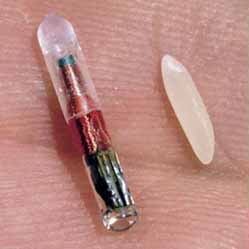
A pet microchip is slightly bigger than a grain of rice
Just having a microchip isn’t enough. There is a three-step process you should complete for any microchipped pet:
Step 1: Get Chipped
Getting your cat microchipped is a simple procedure that can be done at your veterinarian’s office. Reduced-cost and sometimes even free microchips are available at events in your community. Microchips are implanted under the skin with a large-gauge needle, like getting a vaccination.
Step 2: Get Registered and Keep Contact Information Current
Register your microchip, and keep it up to date if your contact information changes. This is important because one of the leading causes of microchipped pets not being able to get home is not being able to find the current contact information for the pet’s home. If you get a microchip implanted in your kitty and then move across the country, your old vet who implanted it may lose touch with you. If your microchip isn’t registered, the last person the microchip company knew had the chip was your old vet. Keep your contact information up to date with the chip registry to be found when your pet needs you most.
Step 3: Check The Chip

An example of an RFID scanner used to check microchips
Check the chip! Microchips are implanted between the shoulder blades. When Ashton was a bony, little kitten, you could feel the chip, about the size of a big grain of rice, if you scritched her shoulders just right, just past the end of her neck at her shoulders. In rare cases, a microchip can migrate. this doesn’t hurt your cat or dog, but it does mean that if someone passes a microchip scanner over your pet’s shoulders, it won’t be energized by the electromagnetic field produced by the scanner. This can lead to the microchip not being detected. To be sure this hasn’t happened, ask your veterinarian to scan for your cat’s chip as a part of their routine veterinary exam.
References
Microchips Result in High Rate of Return of Shelter Animals to Owners, OSU Research News


Thanks for reminding my human to update our microchips!!
This is great information. I didn’t even think about asking someone to check the babies’ chips, but it makes a lot of sense to do it once a year. If our vet doesn’t have a scanner, we know the shelter upstairs from the clinic does, so we’ll ask someone to check our chips the next time we’re there!
That is good information. We cannot afford to get all of us chipped. Besides we are pretty darn feral, so no one could catch or pick us up but we do think it is a great idea especially for dogs that do wander off and it has found many a dog it’s owners.
We were micro chipped by the RSPCA before we came home. When we visit the vets for our annual reviews they always check the micro chip is still in the same place.
Luv Hannah and Lucy xx xx
Never knew these chips could migrate. Thanks for letting us know that we should have them checked. XO, Lily Olivia, Mauricio, Misty May, Giulietta, Fiona, Astrid, Lisbeth and Calista Jo
Ivy’s chip moved -more we suspect cause she was little when it went it and now she…isn’t so much. MOL
we talk about chips all the time with potential adopters and love that sometimes you can “show it off” to people when it can be felt in the little ones….people are amazed
Thanks for the reminder! I didn’t know they could move around. I will have to be sure to get my kitty’s chips checked!
Excellent reminder! I often hear about people saying their cat got lost but wasn’t microchipped because they were indoor only.
None of us have been microchip. There’s no National Database to store the necessary information so microchips aren’t effective in uniting lost pets with their families. I’ve spoken to vets and they say that they sometimes do find a microchip in a lost pet but there’s nothing more they can do to help locate the family.
So important to keep the information current! Thanks for sharing!
Excellent PSA!
Pop has to send them blood money to keep my chip up to date and it’s due next week. You reminded TW she has to update the info since we changed vets. Good info.
Great PSA!!
OH! and your “new” tree is ACE.
What a great reminder!
and we didn’t realize the chips cold migrate… definitely something to check for!
We were microchipped at the shelter so when we were adopted mom took their word for it. Funny thing though mom wanted evidence so one time at the vet she begged the vet to show her that we were indeed microchipped. Mom finally got her peace.
I had updated the boys’ info with PetWatch a few years ago, don’t think anything’s changed, but it’s worth checking in, so thanks. And I’d never think to have the microchips checked. They were put in by the shelter before adoption–standard practice. I do know that Nicki’s has stayed in place, but Derry’s had migrated half way down his back. LOL. (That from the x-rays last winter.)
As for a standing desk at work, at least part of the time: super idea. Though I can just imagine the committees that would be struck, for years to come, to debate the merits of them first, then to debate budget, who to buy from, etc. Ha. It currently wouldn’t fit in with the established furniture “standards” that the university has adopted.
Thanks for the reminder to get our chips checked. Mom says she will have that done on all of us.
Thanks
Marty