
For years there has been a growing body of research linking cat ownership and depression, especially in women. A number of studies have looked at his from different angles, trying to determine the actual cause of this, and a new study may have come across an unexpected cause: Bartonella bacteria.
Previous Research
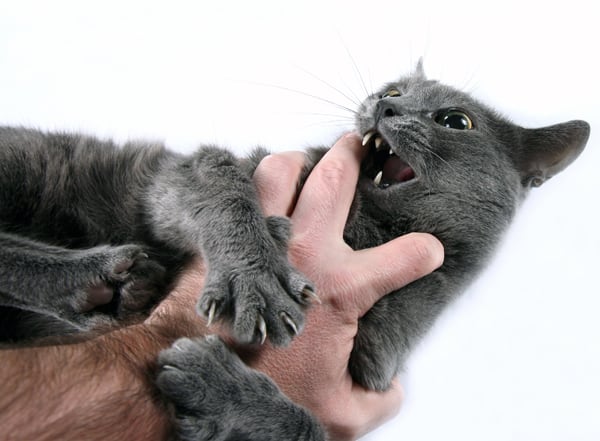
Data analysis of patient records for 1.3 million patients previously discovered a statistical association between cat bites and human depression. That study’s authors suggested that the women could be infected with Toxoplasmosa gondii, which made them depressed. The researchers did not suggest that the cat bites were necessarily the cause of the Toxoplasmosa infection, but it was being noticed as a common characteristic of the depressed women who all had cats.
Previous research had already linked depression and suicide attempts to the Toxoplasmosis infection. One theory is this happens that when humans are infected with Toxoplasmosa, the immune system kicks in to try to ward off the attacker by producing molecules called cytokines that tell your immune cells to get to work. High levels of cytokines have been linked to both depression and suicide attempts.
New Research on Animal-Inflicted Injuries and Depression
A pair of researchers in the Czech Republic wanted to take a closer look at the correlation between animal-inflicted injuries and depression. Study subjects filled out a questionnaire where they identified how closely they lived with dogs or cats during their whole lives and whether they had been bitten or scratched by a dog or cat.

The research subjects also took the Beck Depression Inventory, a standard diagnostic tool to measure the severity of depression, and they also identified whether they had ever been diagnosed as infected with Toxoplasmosa gondii.
Detailed analysis of the survey results found that neither cat bites nor Toxoplasmosa were the primary correlation to depression in women. Instead, depression occurred more often in women who had been scratched by cats.

This led the researchers question whether something other than Toxoplasmosa might be triggering depression in women. The study’s authors propose that the Bartonella bacteria, which is responsible for cat-scratch disease, might actually be the cause.
Cat-scratch disease, also known as cat-scratch fever, is carried by fleas and ticks and transmitted to humans primarily by scratches from cats, usually when the cats are kittens. Cats get the Bartonella bacteria that causes cat-scratch disease by being bitten by infected fleas, and it is found in up to 40% of cats.

Human medicine usually focuses on the physical symptoms caused by Bartonella, which can include a bump or blister at the wound site where the bacteria entered the body, low grade fever, enlarged lymph nodes, and fatigue. Newer research about Bartonella in humans shows that it can become a chronic condition that returns after it seems to be eradicated by antibiotics, and it can also cause psychiatric issues, including treatment-resistant depression.
Just as the previous correlation of depression in cat owners to Toxoplasmosa infection was not fully explored, the statistical link between cat scratches, potential Bartonella infection, and depression is still in its early stages, and the study authors suggest that a wider study be performed.
Hopefully science will soon help us learn more about whether this is really the root cause of the observed link between living with cats and depression. In the meantime, it is a good idea to reinforce during kittenhood that human hands and feet aren’t toys to bite and scratch, trim your cat’s nails, and to try to quickly get rid of flea infestations. Those are good practices regardless of the outcome of future research.
Research and further reading:
Parasites & Vectors, Cat scratches, not bites, are associated with unipolar depression – cross-sectional study
Lancet, Feasibility of neonatal screening for toxoplasma infection in the absence of prenatal treatment
The Journal of Nervous and Mental Disease, Toxoplasma gondii Seropositivity and Suicide Rates in Women
PLOS One, Describing the Relationship between Cat Bites and Human Depression Using Data from an Electronic Health Record
Centers for Disease Control and Prevention, Bartonella Infection – for Veterinarians
Journal of Clinical Microbiology, Bartonella sp. Bacteremia in Patients with Neurological and Neurocognitive Dysfunction
Medscape General Medicine, Do Bartonella Infections Cause Agitation, Panic Disorder, and Treatment-Resistant Depression?
Photo credits:
depositphotos, photo-deti
depositphotos, OlegTroino
flickr creative commons, Tambako the Jaguar


Interesting. My human has only rarely gotten scratched by cats, in spite of being around them all her adult life (and a good portion of her childhood), and she is not a depressed person. So apparently, she’s managed not to contract Bartonella.
This is a really interesting study. Mom has had scratches over the years but we don’t think she’s depressed so she must have been okay!
The Florida Furkids
This is very interesting stuff! Thank you so much for sharing it with us. I’ll be interested to see what future research reveals.
Wow, how interesting! I’ve managed to avoid getting scratched very often through the years but it seems like obvious good hygiene practices should be stressed as you’ve done.
that is interesting….
Very interesting!
guys….sure & inn deed over de course oh de food servizz gurls life time her haz hada scratch and bite; nothin vizshuz that al coe hall…noe knot that kind….dinna fix up…. shuld bee interesting ta see what further ree sultz thiz studee brings ~~~~~ ♥♥♥
OK, so now TW knows why she’s so depressed all the time. Several years after I came to live with them, I was treated for Bartonella. I had a course of antibiotics but wouldn’t let them do another blood test to see if I was cured.
This is interesting and I am curious to see where this all leads. However, I also believe that that some people (and families) have a predisposition to depression in the way others have a predisposition to heart disease and diabetes.
That was amazing information as we appreciate it too!
Wow….thank goodness I have never bitten mom or any buddy. Some times I get a little to quick with my claws but not on purpose
Hugs madi your bfff
Very interesting ! That’s great information. We wonder what future studies reveal. Purrs
so the chimps that are affected by the parasite so that they take more risks are actually depressed? http://www.independent.co.uk/news/science/toxoplasma-gondii-parasite-that-breeds-in-cats-could-affect-human-behaviour-when-it-infects-people-a6861221.html
Very interesting. Thanks for sharing…though we don’t like the idea that cats scratching and biting could cause depression.
That is interesting, I have never read anything like this before.
One more reason for anti community cat humans to champion killing me them. Did this study differentiate between levels of depression…and times of year depression symptoms were experienced? There are many factors that contribute to depression, and clinical depression can also be genetic, not cat caused. Lots more research is required.
Excellent comment and one I was going to make. They will seize on any excuse to harm community cats.
Mom gets scratched all the time by us and is not depressed. Interesting. You asked if the vet took Mr Kitty’s thyroid – no. At the time of surgery she did not know what this tumor was – it was just under the skin so that was all she took. At his age I did not want to be too invasive so we will let this heal and continue to monitor his thyroid. Happy Mardi Gras.
Definitely more study needed but very interesting stuff.
Funny….I’ve been around cats /most/ of my life and have been scratched by a few and I suffer from depression. However,my depression is NOT caused by this,it was caused by my life. I have two cats now and they are what helps keep me out of my depression. So I find it interesting how people believe cat scratches and bites can lead to depression and never once look at other factors in a person’s life that could lead to depression.
That was really great information. And very interesting, too. Mommy has been scratched 100 times in her life,but she seems to be OK now.
This is very interesting I always thought our cats were supposed to elevate our mood and stave off depression. Thanks for sharing
This is a joke, you don’t even mention the journal the study was published, nor do you mention the name or the scientists who performed the studies not what their credentials are. Quit posting garbage on the internet that has no business on the internet unless you are willing to jeopardize your career on the line for providing false information.
I’m sorry you didn’t understand that the section titled Research and Further Reading at the end of the article includes the references felt were missing. The first article listed indicates both the journal name (Parasites & Vectors) and the title of the article (Cat scratches, not bites, are associated with unipolar depression — cross-sectional study). You can click the link to read the source material, which includes the researcher names. Thanks for reading.